

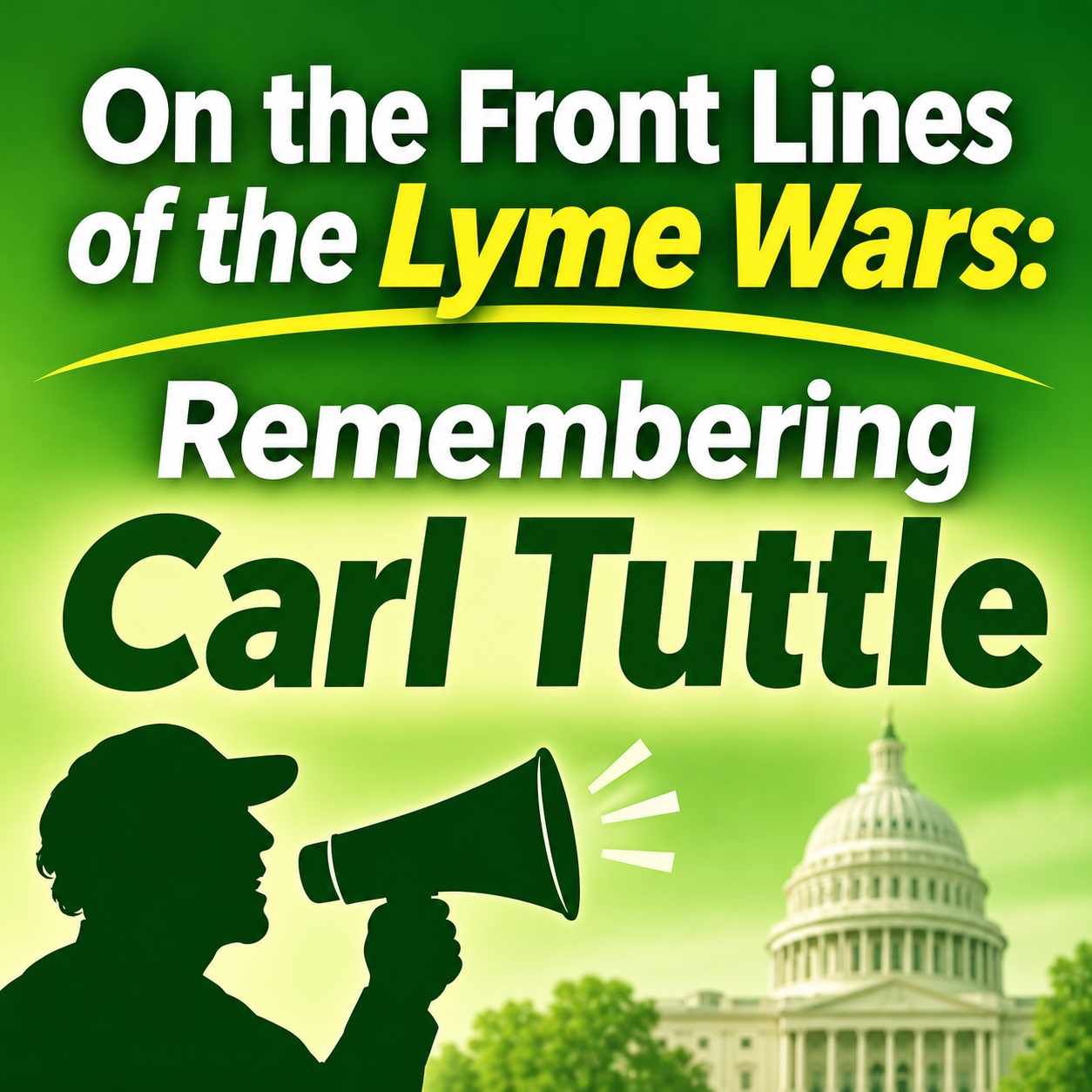
On the Front Lines of the Lyme Wars: Remembering Carl Tuttle
From a multi-day protest at IDSA headquarters to “building the new,” a fellow advocate looks back on years of working alongside Tuttle
A deliberate disinformation campaign by CDC and IDSA has confused a nation of intelligent physicians into believing Lyme is easily diagnosed and treated. The conflicts of interest and improper influence among these organizations have contributed to terrible suffering and financial losses for thousands of people. An investigation is long overdue.
Bruce Fries, a longtime Lyme disease advocate who collaborated with Carl Tuttle on numerous advocacy initiatives, remembers Tuttle as an important figure in the movement who helped bring patients’ concerns to policymakers and the public.
“I had the honor of collaborating with Carl on a number of Lyme disease advocacy initiatives over the years,” said Fries. “We cross-promoted petitions, shared updates, and worked to bring important issues to the attention of policymakers and the public.”
One of the most memorable collaborations took place in May 2014, when Fries issued his first press release as a Lyme disease advocate. Titled Lyme Warriors Call for Congressional Investigation of CDC, IDSA, Vaccine Industry, the release quoted Tuttle and linked to his petition calling for a congressional investigation of the CDC, the Infectious Diseases Society of America (IDSA), and the American Lyme Disease Foundation (ALDF).
Fries calls the release one of his favorite historical relics from those early days. “It’s a snapshot of life on the front lines of the Lyme Wars,” he said.
“An investigation is long overdue,” Tuttle said in the 2014 release. “The conflicts of interest and improper influence among these organizations have contributed to terrible suffering and financial losses for thousands of people.”
Tuttle suffered from Lyme disease for twelve years and was misdiagnosed and denied treatment by multiple doctors before he was finally diagnosed with late-stage Lyme disease. Despite receiving the IDSA-recommended treatment, he remained ill and was bedridden and dependent on oxygen for several months.
“There is no medical training for the later stages of Lyme disease,” Tuttle said at the time. “Patients are ping-ponged through the medical community for years before they are able to obtain treatment. A deliberate disinformation campaign by CDC and IDSA has confused a nation of intelligent physicians into believing Lyme is easily diagnosed and treated. The only people who benefit from the CDC/IDSA narrow definition of Lyme disease are the patent holders within CDC and IDSA and the vaccine manufacturers who stand to make millions from royalties.”
It was no coincidence that the release went out during the Mayday Project’s two-day protest at IDSA headquarters. Tuttle helped promote the event through updates to his petition, which had attracted nearly 100,000 signatures. That online following gave the protest a substantial virtual army to complement the people who traveled to Washington for the demonstration.
Mayday Project coordinator Josh Cutler called on his more than 3,000 followers to join “Operation Storm IDSA.” The campaign combined an in-person demonstration with a coordinated effort involving telephone calls, emails, and social media.
A social media post about the campaign apparently prompted IDSA to spend more than $10,000 on a security team, according to the building manager. The manager became an unlikely ally, providing real-time information and even photobombing protesters’ pictures.
Fries served as Mayday’s director of communications and media relations. He describes the strategy as “public shaming,” a phrase suggested by the director of Ralph Nader’s Public Citizen Health Research Group when Fries sought advice on taking on one of the country’s most influential professional medical organizations.
“We made it easy, and we made it fun,” Fries recalled. “We held training sessions, provided detailed instructions, and distributed lists of telephone numbers and email addresses. Everyone knew exactly what to do and how to do it.”
The combination of organized public pressure and a visible demonstration made it difficult for the organization to ignore the protesters’ demands.
Fries remembers the boots-on-the-ground protest as a multi-day block party, with “plenty of energy, camaraderie, and a sense that we were accomplishing something that mattered.”
According to Fries’ contemporaneous notes, the organizers secured an in-studio television interview on News Channel 8 and coverage on Fox 5 DC after a reporter was escorted out of the IDSA lobby by security guards who mistook him for a protester.
“Back then, it was like the Wild West,” Fries said. “We experimented, improvised, and weren’t afraid to try unconventional approaches. The virtual component was especially rewarding because patients and advocates from around the world could participate, even if their health prevented them from traveling.”
For Fries, the experience also reflects how the Lyme disease advocacy movement has evolved. Over the years, he and Tuttle mellowed, shifting their emphasis from investigating and exposing bad actors toward what Fries calls “building the new.”
“Holding institutions accountable remains important, but creating better institutions, policies, and opportunities for patients is ultimately where we need to go,” Fries said.
Tuttle’s petitions gave patients and advocates a way to get involved, make their voices heard, and sustain pressure long after a particular protest or news cycle had ended. Fries values both the work they accomplished together and the evolution of their shared approach to advocacy.
“Looking back, I’m grateful to have been part of that period and to have collaborated with Carl,” Fries said. “Those were extraordinary times. The people who stood up, spoke out, and kept pushing when it would have been easier to walk away helped shape the history of Lyme disease advocacy. Carl was one of those people. He will be missed.”
( Press Release Image: https://photos.webwire.com/prmedia/48616/364560/364560-1.png )
WebWireID364560
- Related Keywords
 Lyme Disease
- Idsa
- Cdc
- Mayday Project
- Public Shaming
- Contact Information
- Bruce Fries
- President
- Paitent Centered Care Advocacy Group
- Contact via E-mail
This news content may be integrated into any legitimate news gathering and publishing effort. Linking is permitted.
News Release Distribution and Press Release Distribution Services Provided by WebWire.