

Big Tech Engineering Performance Rose 150% Per Developer Over 18 Months, Commit-Level Study Shows
A study of 137,592 commits from public repositories compares this year’s AI productivity claims at Google, Microsoft, Meta, Cloudflare, Vercel, and OpenAI with what engineers actually shipped.
"It’s hard for technical leaders to picture what a good, high-performing team looks like today. Everyone is getting better and faster every month. That’s why we put this report together, so they know where to aim," said Jirka Bachel, co-founder and CTO of Navigara. "Every earnings call this year will feature some AI productivity number, and almost none of them come with a confidence interval.
For the past two years, corporate boards have approved AI budgets for engineering departments based on vendor surveys and internal self-reports. Almost none of that spending has been checked against what developers actually shipped. Navigara, the engineering performance measurement company, built a commit-level benchmark to close that gap. It scores merged commits, the individual changes engineers ship, across the public GitHub repositories of six organizations: Google, Meta, Microsoft, Cloudflare, Vercel, and OpenAI.
In the second quarter of 2026, 705 qualifying software engineers delivered as much scored throughput as 1,736 engineers would have delivered at Q1 2025 rates. That gap, 1,031 developers’ worth of added capacity without a corresponding hire, is what Navigara calls capacity.
“It’s hard for technical leaders to picture what a good, high-performing team looks like today. Everyone is getting better and faster every month. That’s why we put this report together, so they know where to aim,” said Jirka Bachel, co-founder and CTO of Navigara. “Every earnings call this year will feature some AI productivity number, and almost none of them come with a confidence interval. We designed this study so a claim like ’AI made us 30% faster’ either survives a resample of the data or it doesn’t.”
For anyone reading a single-quarter AI productivity number, the finding that matters most is this: the aggregate change this quarter is +17.5% versus Q1 2026, with a 95% confidence interval of -0.7% to +38.8%, meaning the result is statistically indistinguishable from zero. For a fixed panel of the same 388 engineers tracked in every quarter of the study, the quarterly gain narrows to +3.5%. The 18-month trend tells a different story: output per engineer is up 150% since Q1 2025 (95% CI: +111% to +195%), and the year-over-year comparison is similarly strong, at +130% for the open cohort and +82% for the fixed panel.
Where Public Claims Diverge From What Was Shipped
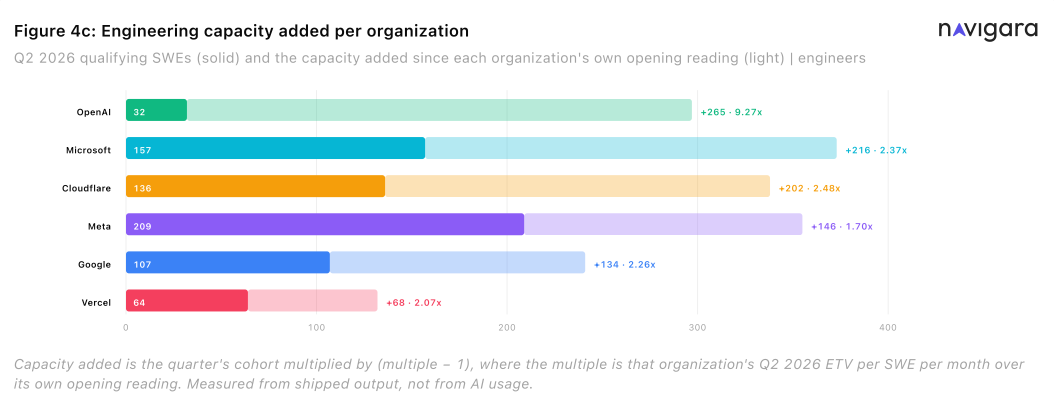
The three companies with the loudest public AI narratives are not moving at the same pace. OpenAI’s qualifying engineers now ship 9.27 times their opening-quarter baseline, the widest multiple in the sample, though that cohort has grown from 6 qualifying engineers in Q1 2025 to 32 today, still a ramp rather than a steady state. Cloudflare ships at 2.48 times its opening baseline, ahead of established incumbents Google (2.26x) and Microsoft (2.37x). Vercel, the third company in the loud-claims group, sits at 2.07x, ahead only of Meta, which has the narrowest multiple of the six companies studied at 1.70x. The research suggests that public claims about AI’s engineering benefits still do not reliably predict what actually gets shipped.
What the Aggregate Can and Cannot Say
The qualifying developer cohort, engineers active enough to be counted in a given quarter, shrank from 793 to 699 people between the first and second quarters of 2026. A shrinking cohort with rising average output per remaining engineer can move the aggregate number without a single engineer changing behavior, which is why Navigara reports the fixed-panel comparison alongside the open cohort in every chart. The research is descriptive and correlational: it does not claim that AI adoption caused the increase in output, only that the increase exists and is statistically real on a year-over-year basis.
* Navigara counts a developer once per organization they commit to, so the 705 figure is larger than the 699 distinct individuals in the underlying sample. Navigara calls the resulting gap “1,031 developers of added throughput without a corresponding hire, capacity,” measured from committed code, not from AI tool usage. OpenAI accounts for 265 of that total, on an opening-quarter baseline of just 6 engineers, the figure the report itself flags as its least stable; excluding OpenAI, the other five organizations added 766 developers’ worth of capacity.
Methodology and Research Sample
The findings are based on 137,592 qualifying commits to public repositories at six organizations, scored by Navigara’s Engineering Throughput Value (ETV) model over a 78-week window from Q1 2025 to Q2 2026. Confidence intervals are calculated using bootstrap resampling with 1,000 iterations. The full methodology is published at research.navigara.com/methodology. Organizations were not sampled randomly: three (Cloudflare, Vercel, OpenAI) were selected because they make frequent public claims about AI productivity, three (Google, Meta, Microsoft) were selected as large incumbents with strong engineering reputations, and one additional organization in Navigara’s underlying dataset was excluded from every figure in this report because it is a private team. Navigara sells a platform built on the premise that engineering performance is hard to measure without a dedicated tool, and has a commercial interest in that premise holding up. The report states on its first page that its findings are descriptive, not causal. It does not separately disclose Navigara’s commercial interest, so this release states it here.
About the Research
“The Open Source Engineering Performance Report” is Navigara Research’s commit-level study of engineering throughput across six major technology organizations, published quarterly. The full report, including per-organization detail, work-classification breakdowns, and complete methodology, is available at research.navigara.com.
About Navigara
Navigara is the performance measurement platform for engineering organizations. Based in San Francisco with operations in Europe, it integrates with GitHub, Jira, and Linear to translate engineering execution into actionable signals for leadership. The company has raised $2.5M in seed funding from Inovo, Rockaway Capital, Rockaway Ventures, and QQ.
( Press Release Image: https://photos.webwire.com/prmedia/71136/360180/360180-1.png )
WebWireID360180
 Ai Productivity Metrics
- Engineering Performance
- Software Engineering
- Developer Productivity
- Commit-level Analysis
- Contact Information
- Michal Habdank-Kolaczkowski
- Chief Storyteller
- Navigara
- michal@navigara.com
This news content may be integrated into any legitimate news gathering and publishing effort. Linking is permitted.
News Release Distribution and Press Release Distribution Services Provided by WebWire.