

How the original CTS and the Nürburgring created V-Series and transformed Cadillac
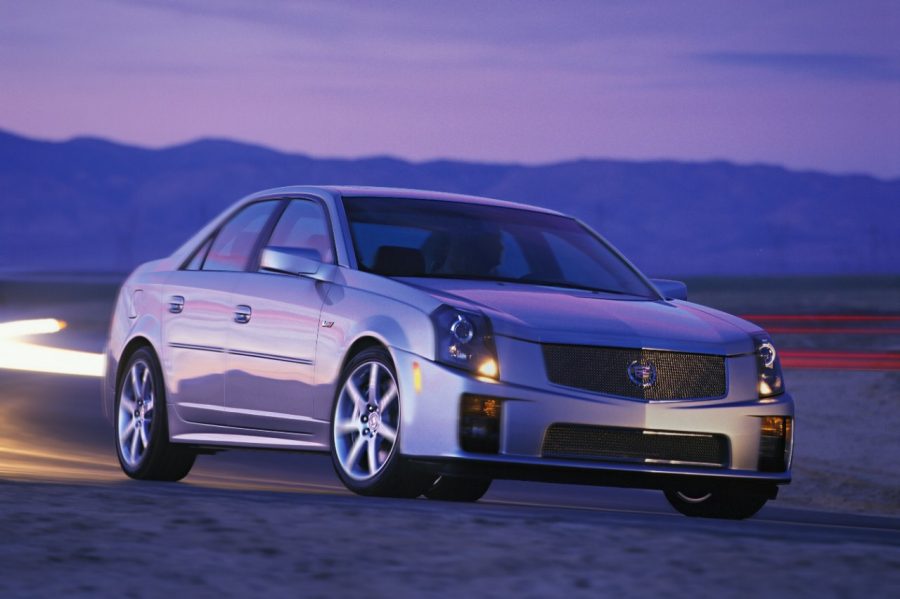
Among car enthusiasts, there is no more important racetrack than the Nürburgring. Its “northern loop,” the Nordschleife, is 12.9 miles of twisting, undulating, bumpy asphalt painted across Germany’s Eifel mountains. Since its opening nearly 100 years ago, the “Ring” has held countless top-tier automotive competitions. More recently, automotive engineers have adopted the famed German track as a proving ground like no other. When a vehicle can handle the high-speed challenge of a lap around the Nürburgring, engineers consider it proof of a job well done.
These days, when General Motors makes a trip to the Nürburgring, it’s a huge undertaking. The team typically consists of 30 people including engineers, technicians, and supplier partners, with as many as 10 vehicles in tow. Compare that to GM’s early days at the German track. When Ken Morris – now GM Senior Vice President of product programs, product safety, and motorsports – first went to the Ring back in 1997, it was with a small handful of colleagues and one production Cadillac sedan.
The Nürburgring was just one stop on a long European road trip, undertaken by Morris and colleagues as a fact-finding mission. They were gathering intelligence to help develop a vehicle they hoped would redefine the Cadillac brand: The 2003 CTS, a sport sedan that prioritized high-performance driving dynamics. Morris and the team drove around the Arc de Triomphe in Paris, through Austria and Switzerland, and on the no-speed-limit German Autobahn working to capture a sporty European driving experience.
These were all great experiences, but running a handful of laps around the Nürburgring Nordschleife was the most impactful. Morris realized this wasn’t just a car-enthusiast paradise – it was a crucial place for developing world-class cars. In 1998, Morris went back to Germany with an early CTS prototype and a technician. By the time the first production CTS debuted for model-year 2003, Morris estimates he had run as many as 600 laps of the Nürburgring developing that car.
Making a car work around the Nürburgring is a singular challenge, but it’s one that pays dividends. “When you dial in a car on the Nürburgring, it makes the car feel so much better on the highway,” Morris tells GM News. "If you have to make an evasive maneuver, it can help make the car feel more planted.”
The challenges that a car and driver face at the Ring go far beyond anything a typical customer will ever experience. But if a car works well there, it should work well just about everywhere. “It boils down to making the car fundamentally better,” Morris says.
The first-generation CTS reset expectations for what a Cadillac could be. “It was a massive departure from where Cadillac was at the time,” Morris recalls. “From a ride and handling standpoint, we made the CTS as good as we possibly could.”
The 2003 CTS, with its track-honed engineering, laid the groundwork for a whole new group of Cadillac models focused on high-performance driving: V-Series. Cadillac debuted V-Series with the CTS-V in 2004. V-Series models feature powertrain and suspension upgrades aimed at bringing track capability to the street, rivaling high-performance offerings from European rivals.
“We established the formula for the V-Series with the 2004 CTS-V. Start with a great base model, then add power, and more track capability,” Morris says. “So obviously we jumped at the chance to create this car. We launched the CTS with 220 horsepower, and we were talking about putting a 400-horsepower engine in the V.”
That engine was the 5.7-liter LS6 V-8 from the C5 Corvette Z06, the largest of any sport-sedan rival at the time. In 2006, the CTS-V got the upgraded 6.0-liter LS2 from the then-new C6 Corvette.
However, the CTS-V was about more than just power. As Cadillac’s offering against the sport-sedan models of legendary European automakers, the CTS-V couldn’t just be an acceleration monster – it had to excel in every type of driving. “‘Stop, turn, and go’ was our mantra,” Morris says. To that end, the CTS-V got stiffer springs, dampers, stabilizer bars, and bushings, plus a strut-tower brace and other structural reinforcements, all designed to take advantage of the base CTS’s Nürburgring-honed handling and elevate the car’s performance even further.
The team also fit the car with larger brakes, high-performance tires on larger 18-inch wheels, and a strengthened rear differential. Another important addition was an advanced four-mode stability-control system to help drivers lap a race track more quickly while maintaining safety on the road. It’s a direct predecessor of the Performance Traction Management system in current Cadillac V-Series models, which helps even professional racers set quicker lap times. All of this, of course, meant more laps on the Nürburgring.
Like the first-generation CTS, the original CTS-V helped redefine Cadillac for the 21st century. Many V-Series models followed, and today, Cadillac offers six V-Series models: CT4-V, CT5-V, OPTIQ-V, LYRIQ-V, ESCALADE-V, and ESCALADE-V ESV. The CT4-V Blackwing and CT5-V Blackwing continue in the tradition of the original CTS-V by offering Nürburgring-ready performance in a luxury-sedan package.
Morris looks back on the original CTS-V fondly.
“It was a great time because there was zero doubt about what the mission was, zero ambiguity about what we were trying to do, and it was really fun,” he says. “Fast forward to today – what V-Series models can achieve boggles my mind. It’s just gotten better and better as time goes on.”
By Chris Perkins, writer and editor, GM News
( Press Release Image: https://photos.webwire.com/prmedia/7/348251/348251-1.jpg )
WebWireID348251
This news content was configured by WebWire editorial staff. Linking is permitted.
News Release Distribution and Press Release Distribution Services Provided by WebWire.