

Turkcell and Huawei Deploy World First 5G-A Low-Altitude Commercial Network for Skyline Tourism in Cappadocia
Summary:
- Turkcell and Huawei have launched the world’s first commercial 5G-A low-altitude network in Cappadocia, covering hot-air balloon flight paths at altitudes up to 600 meters.
- Five C-band sites work as one coverage cluster, and Huawei’s MetaAAU is deployed to provide wider coverage and to reach continuous C-band coverage in this area…
- Taking advantage of the wide spectrum resources, Turkcell ran 4-carrier aggregation, reaching peak speeds of up to 2.6 Gbps
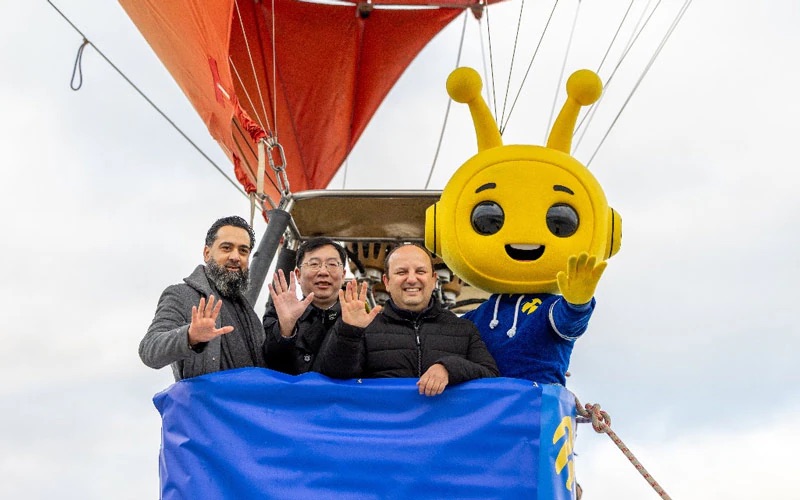
Turkcell, working with Huawei, has launched the world’s first commercial 5G-A low-altitude network here, giving hot-air balloon passengers a reliable connection at altitudes of up to 600 meters.
The network is designed so that passengers can stream the flight, hold a video call or post a photo while still in the air. A 5G CPE installed on the demonstration balloon provides on-board WiFi for devices such as 360-degree cameras. So, the connection is available to everyone on board, not only to those 5G subscribers.
Cappadocia is one of the world’s best-known balloon destinations, with flights running through the year and a large share of international visitors. Until now, those flights passed through whatever signal reached them. Ground networks are built for people at street level: antennas tilt down, beams point at the ground, and a balloon height up to 600 meters often sits at the edge of several cells at once, with a weak uplink from a swaying basket.
Huawei and Turkcell planned the network for the air instead. Five C-band sites work as one coverage cluster and hand the connection over as a balloon drifts, providing seamless connectivity and mobility along the flight path. Huawei’s MetaAAU, built on an extremely large antenna array (ELAA), provides roughly 3 dB more coverage than a traditional Massive MIMO site. Its narrow beams scan quickly enough to follow a moving balloon, and low-altitude beam settings are widened in both the vertical and horizontal planes so that cells cover airspace, not just the ground.
Mobility is tuned for low-altitude users. Priority policies keep them on Turkcell’s wide C-band spectrum instead of handing them to other bands too early, and uplink handover thresholds are adjusted for weak coverage at the cell edge. Latency-optimized assurance shortens the wait a user sees, and uplink features — improved error performance, higher-order modulation and resource compensation during interference avoidance — protect the upload that live video depends on. On top of this, Turkcell’s large bandwidth supports 4CC carrier aggregation with peak speeds of up to 2.6 Gbps.
“As Turkcell, we said, ‘Some journeys don’t need a ticket, just a connection.’ We redesigned our network, normally planned for ground users, to cover balloon flight routes up to 600 meters. Leveraging our standalone 5G core and 5G Advanced capabilities, we successfully implemented 4-carrier aggregation on a 5G Standalone (SA) network for the first time in Türkiye to stream live 360-degree footage. Most importantly, we brought this unique experience to our elders in our Digital Spring Rooms. Exploring through technology should be possible at any age. We have once again demonstrated 5G’s true potential across diverse fields.” said Prof. Dr. Vehbi Çağrı Güngör, Chief Technology Officer of Turkcell.
“The challenge was not one problem but several, and they arrived together: coverage, uplink, mobility and interference,” said David Li, President of Huawei’s Wireless TDD Product Line. “MetaAAU’s large array and narrow, fast-scanning beams gave us the coverage and precision to follow a moving balloon. The result is a network designed to sustain a live video link at altitudes up to 600 meters. For the industry, it also shows how 5G-Advanced can be sold as experience, not just capacity.”
The commercial model is what makes this more than a demonstration. The project also points to a new commercial opportunity. Turkcell is evaluating packages, such as a dedicated uplink plan, that could turn this capability into a commercial offer. For the industry, it marks a shift in how 5G-Advanced can be monetized: away from selling gigabytes and toward selling a guaranteed experience in a place where no network could previously reach.
The project also carries social value. Through Turkcell’s Digital Spring initiative, residents of the Nevşehir Kapadokya Nursing Home who cannot board a balloon because of their health or age experienced Cappadocia’s balloons through 360-degree video and VR glasses. The same link that serves a passenger in the basket brings the view to someone who would otherwise never see it, for example, the elders in nursing house, the patients in hospital.
The approach is designed to be repeated. The solution is based on 3GPP standards and Huawei’s MetaAAU, delivered in Cappadocia through a cluster of five C-band sites with antenna optimization and low-altitude beam, mobility and uplink settings. Other operators can apply the same cluster design and beam, mobility and uplink settings to their own spectrum and terrain. Beyond tourism, the same capabilities support drone logistics, aerial inspection, emergency response and connectivity around high-rise buildings — the use cases that make up the emerging low-altitude economy.
Cappadocia shows what that economy looks like in practice: a network planned for the air, a network planned for the air, with clear potential for new services.
FAQs:
Q1: What is the 5G-A low-altitude network, and why does it need a different approach?
It is a commercial 5G-A network in Cappadocia covering the balloon flight path up to 600 meters. This network was planned for the air: five C-band sites work as one cluster that hands over the connection as the balloon drifts.
Q2: What technologies addressed coverage and mobility?
Huawei’s MetaAAU, built on ELAA, delivers about 3 dB more coverage than a traditional Massive MIMO site. Priority camping on C-band, adjusted uplink handover thresholds, latency-optimized assurance and uplink features protect the live video link.
Q3: What can passengers do, and at what speed?
Passengers can live-stream the flight, hold a video call or post a photo in the air. A 5G CPE can be deployed on the balloon to provide on-board Wi-Fi. On network capability perspectives, 4-carrier aggregation reaches peak speeds of up to 2.6 Gbps
( Press Release Image: https://photos.webwire.com/prmedia/8/364546/364546-1.jpg )
WebWireID364546
This news content was configured by WebWire editorial staff. Linking is permitted.
News Release Distribution and Press Release Distribution Services Provided by WebWire.