

Thomas E. Barth’s “Healthcare Common-Sense” Offers a Practical New Look at America’s Healthcare Crisis
A Modest Proposal for Sustainable, Equitable, and Affordable Care examines rising costs, systemic complexity, and the need for competition, accountability, consumer choice, and compromise.
Healthcare reform has been debated in the United States for generations, yet rising costs, complicated systems, and political division continue to leave many Americans asking the same question: Is there a better way forward?
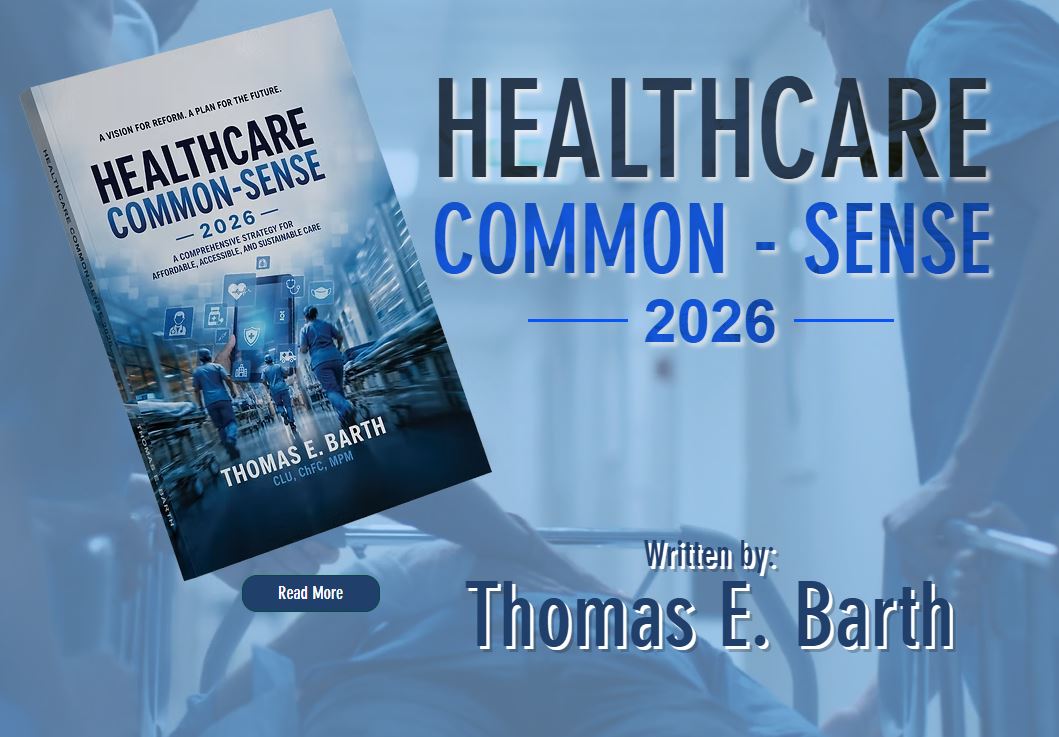
In “Healthcare Common-Sense: A Modest Proposal for Sustainable, Equitable, and Affordable Care,” author Thomas E. Barth, CLU, ChFC, APMP.CP, MPM takes a direct look at the forces driving the healthcare dilemma and offers a framework intended to move the conversation beyond political talking points.
Barth argues that healthcare is not suffering from one isolated problem. It is shaped by consumer demand, medical technology, an aging population, mandates, regulation, litigation, pharmaceutical costs, fraud, administrative complexity, and the competing interests of multiple stakeholders.
That complexity, he believes, is exactly why reform has remained so difficult.
The manuscript also points to the continued rise in national healthcare spending, including projections that total spending could reach approximately $8.6 trillion by 2033. For Barth, that trend is a clear signal that healthcare reform must address cost, efficiency, access, and sustainability together rather than focusing on only one part of the system.
A Proposal Built Around Competition and Choice
At the center of Barth’s proposal is a National Healthcare Commission designed to help select participating carriers, negotiate pricing, and manage the administration of a national healthcare structure.
Rather than eliminating private insurers, Barth proposes using competition among them. His framework envisions a competitive bidding process that could eventually include nine carriers offering a total of 27 plan options, giving individuals and families more choice based on their needs and budgets.
Doctors and hospitals would continue providing care. Insurance carriers would continue processing claims. Consumers would continue selecting plans and providers. All associated costs would be managed by the Commission. Artificial Intelligence (AI) can be used to identify excessively high prices, possible fraud, and to improve the quality of care. The goal, as presented in the book, is to reduce waste and inefficiency while preserving competition and consumer choice.
Why This Book Matters
“Healthcare Common-Sense” is not written only for policymakers or healthcare professionals. It is relevant to families, employees, employers, retirees, business owners, taxpayers, and anyone concerned about what healthcare may cost in the future.
The book encourages readers to question long-held assumptions, better understand the forces behind healthcare costs, and consider whether practical compromise can accomplish more than continued political division.
Barth also makes an important point throughout the book: no lasting solution is likely to succeed if every stakeholder refuses to give anything up. Insurers, providers, employers, government, brokers, pharmaceutical companies, and consumers may all have to accept change if the country hopes to create a system that is more sustainable and affordable.
More Than a Proposal, It Is a Call for Dialogue
The book does not simply present a plan and ask readers to accept it. Barth encourages discussion, debate, education, and public involvement. His final chapters call on readers to become informed, engage policymakers, promote dialogue, support transparency, and remain involved in the healthcare conversation.
His message is simple: meaningful reform requires more than legislation. It requires participation.
About the Author
Thomas E. Barth brings more than 30 years of experience in business development, marketing, insurance, bids, and proposal management. His professional background includes work with large self-insured health plans, giving him firsthand exposure to the structure and complexity of healthcare financing and administration.
The ideas behind the book have also developed over many years. The work was originally written in 2004 and later updated multiple times, including in 2026.
A Timely Read for Anyone Concerned About the Future of Healthcare
Healthcare affects nearly everyone. It affects what families spend, what employers provide, what patients can access, and what taxpayers ultimately support.
For readers who want to better understand why the system remains so difficult to reform and explore a different way of thinking about the problem, “Healthcare Common-Sense” offers a timely starting point.
Read the proposal. Question the assumptions. Consider the compromises. Join the conversation.
Purchase “Healthcare Common-Sense”
Learn more about Thomas E. Barth and purchase your copy of “Healthcare Common-Sense: A Modest Proposal for Sustainable, Equitable, and Affordable Care” at the official website:
https://www.thomasbarthbooks.com/
Book Details
Title: “Healthcare Common-Sense”
Subtitle: A Modest Proposal for Sustainable, Equitable, and Affordable Care
Author: Thomas E. Barth, CLU, ChFC, APMP.CP, MPM
Official Website: https://www.thomasbarthbooks.com/
( Press Release Image: https://photos.webwire.com/prmedia/92607/364534/364534-1.jpg )
WebWireID364534
- Related Keywords
 Healthcare
- Reform
- Affordability
- Insurance
- Competition
- Contact Information
- April Andrews
- FulFillment Officer
- The Ewings Publishing
- Contact via E-mail
This news content may be integrated into any legitimate news gathering and publishing effort. Linking is permitted.
News Release Distribution and Press Release Distribution Services Provided by WebWire.