

Who Sent the Train? Christopher P. Conrad Reconsiders God’s Wrath in “Train Tracks Theology”
A girl on a Kansas railroad track sets up a question at the heart of Conrad’s book: “When God warns someone of danger, what do they hear in His voice?”
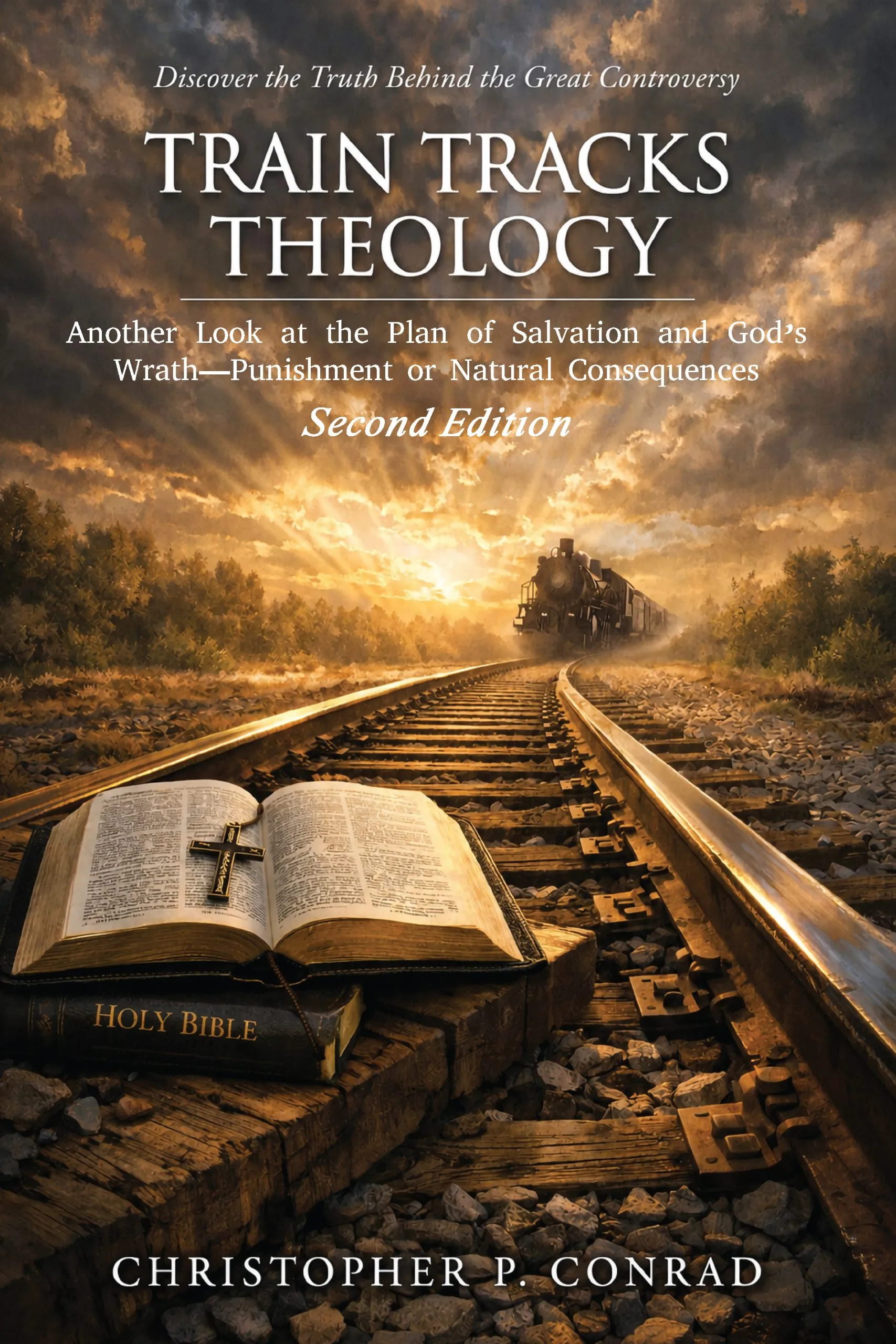
A girl in a pink dress sits down on a sun-warmed railroad track near Maple Hill, Kansas. She has no idea what the tracks are for. From a nearby hill, Jesus calls out for her to move. She stays where she is. By the time she can see the train, Jesus is on the tracks himself, pushing her to safety. Christopher P. Conrad tells this story twice in the opening pages of “Train Tracks Theology.” The second time, one detail changes everything: God sends the train.
Published by The Ewings Publishing LLC, “Train Tracks Theology” grew out of informal conversations among friends. They asked Conrad to put his understanding of salvation on paper so they could study it, and to show how his reading of Scripture fit with the writings of Ellen White. He wanted to give them something they could read in a sitting or two. Their request became a book about a distinction with consequences well beyond a Bible study:
whether a person who has done wrong feels safe turning to God for help.
In one telling of the railroad story, the train is already coming. Jesus sees a danger the girl cannot see and gives His life to get her out of its path. In the other, the girl has broken a rule, and Jesus takes the penalty in her place. Someone hearing either version could say that Jesus died for her. What might that person say next if the girl wanted to know whether she could trust His Father, too?
Conrad approaches that question through the Great Controversy, an understanding familiar to Seventh-day Adventist readers in which the conflict between Christ and Satan centers on the character of God. In Conrad’s reading, sin carries the seeds of its own destruction. He sees the cross as a public demonstration of both the danger God warned about and the lengths to which God will go to save someone. Readers encounter that argument alongside passages from the Gospels, the prophets, and Revelation, with references they can take back to their own Bibles.
Some of the book’s most revealing moments come when Conrad turns the question on himself. He admits that he finds it easier to be patient after a good night’s sleep, a leisurely breakfast, and a look at an empty calendar. Then he considers Jesus after a sleepless night, betrayed by Judas and denied by Peter. On the way to His execution, Jesus notices the women weeping for Him and speaks to them about their children. Conrad asks readers to pay attention to whom Jesus is thinking about on a morning when anyone else might have been forgiven for thinking only of himself.
For a church discussion group, a Sabbath school class, or someone privately revisiting a childhood picture of God, the opening story offers a place to begin. Read the two versions aloud. Then ask what the girl might do the next time she hears that voice from the hill. Her answer gets close to what Conrad believes is at stake when Christians talk about salvation.
Book information
“Train Tracks Theology: Another Look at the Plan of Salvation and God’s Wrath—Punishment or Natural Consequences”
Author: Christopher P. Conrad
Paperback ISBN: 979-8-90301-466-8
Hardcover ISBN: 979-8-90301-465-1
E-book ISBN: 979-8-90301-395-1
( Press Release Image: https://photos.webwire.com/prmedia/92607/364405/364405-1.webp )
WebWireID364405
- Related Keywords
 Train Tracks Theology
- Christopher P. Conrad
- Plan Of Salvation
- God’s Wrath,
- Great Controversy
- Contact Information
- April Andrews
- FulFillment Officer
- The Ewings Publishing
- Contact via E-mail
This news content may be integrated into any legitimate news gathering and publishing effort. Linking is permitted.
News Release Distribution and Press Release Distribution Services Provided by WebWire.