

Precision Beyond Day One: How LG Calibration Studio Medical Supports Consistent Display Performance
A radiologist examines a chest X-ray captured by a state-of-the-art imaging system. The clarity and detail of the image help reveal subtle differences in anatomical structures, providing valuable information for clinical interpretation. But while advanced imaging technology plays a critical role in capturing these details, the medical monitor that displays them is just as important.
Even high-performance medical displays can change over time. As components age, gradual shifts in luminance and grayscale response can affect how X-rays and other medical images appear on screen. Maintaining consistent image presentation therefore takes more than selecting the right monitor. It calls for regular calibration, performance verification and ongoing maintenance throughout the display’s working life.
To address this need, we at LG Electronics (LG) developed LG Calibration Studio Medical (LCS Medical), a software solution designed to help healthcare providers maintain consistent performance across compatible LG medical displays. By combining calibration, quality assurance (QA) testing and centralized management through LG Business Cloud, LCS Medical supports both workstation users and administrators overseeing large numbers of displays.
When Every Shade of Gray Matters
In medical imaging, subtle differences in grayscale can be crucial to how images are interpreted. Whether viewing X-rays, CT scans or mammograms, clinicians rely on the consistent presentation of fine tonal variations to examine anatomical structures and potential abnormalities. Medical displays must therefore reproduce grayscale levels accurately and predictably over time.
This is where LCS Medical’s calibration capabilities come into play. The software supports display calibration based on Digital Imaging and Communications in Medicine (DICOM) Part 14, which defines the Grayscale Standard Display Function (GSDF) for standardized grayscale presentation.
Using a compatible built-in or external calibration sensor, LCS Medical measures display performance and adjusts luminance and grayscale response toward defined target values. This helps maintain consistent image presentation as display characteristics change with use.
LCS Medical also supports simultaneous calibration of multiple compatible monitors, helping reduce the effort involved in maintaining displays that are used together. Users can review calibration results and access reports, which makes it easier to treat calibration as part of routine maintenance rather than a one-time setup procedure.
A Display Can Look Fine. But Is It Performing as It Should?
Calibration alone does not tell the whole story. Healthcare facilities also need to confirm that a display continues to meet the performance criteria for its intended use. Depending on the region and clinical application, this may involve periodic QA checks and documented test results.
LCS Medical supports QA testing, including acceptance tests, based on procedures from a broad range of international and regional medical display quality control standards and guidelines. These include procedures associated with the American College of Radiology (ACR), the American Association of Physicists in Medicine (AAPM), the International Electrotechnical Commission (IEC) and other recognized organizations and regulatory frameworks across major healthcare markets.*
In practice, QA involves two types of checks. In visual inspections, users examine test patterns on screen. In measurement tests, they assess the display using an external sensor. LCS Medical helps teams organize these activities, review previous results and document findings against defined criteria. Checks can also be scheduled in advance, making it easier for staff to complete them on time. Built-in test patterns and device-setting controls support these routine checks directly at the monitor.
Beyond the Workstation: Centralized Display Management With LG Business Cloud
End users typically focus on the display at their own workstation. Administrators, by contrast, may be responsible for hundreds of medical displays across radiology departments, examination rooms and multiple facilities. Coordinating maintenance schedules, reviewing results and tracking device status at that scale calls for a centralized view.
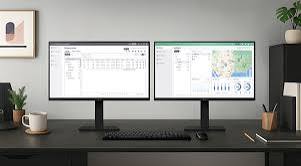
LG Business Cloud integration, introduced in 2026, extends LCS Medical’s workstation-level tools to centralized display management. Through a browser-based dashboard accessible from a desktop, laptop or mobile device, administrators can monitor connected displays, organize them by location and coordinate maintenance across departments or facilities. A dedicated application installed on each connected workstation links local display activity to the cloud platform.
At a fleet level, administrators can schedule recurring calibration and QA activities – including acceptance, constancy and visual checks – across entire display groups. Supported calibration tasks can be initiated through scheduled commands, while QA schedules help users plan visual inspections and external-sensor measurements at the monitor. The dashboard consolidates maintenance histories and pass/fail results, with reports available for review or email distribution.
The dashboard also provides a fleet-wide view of each device’s connection status and firmware or application update status. Rather than checking each workstation individually, administrators can quickly identify displays that may need attention and coordinate follow-up. This helps healthcare organizations plan and document display upkeep more efficiently.
Because Great Medical Technology Needs to Perform Beyond Day One
Innovation in medical imaging is about more than what equipment can deliver on its first day. It is also about how consistently that equipment performs over time.
By combining calibration and hands-on QA testing at the workstation with centralized management through LG Business Cloud, we are extending our medical display expertise beyond hardware. LG Calibration Studio Medical supports end users performing checks on individual monitors and gives administrators a clearer way to schedule, track and document maintenance across entire display fleets. The result is image presentation that healthcare organizations can manage with confidence, long after day one.
# # #
* LG identifies support for QA test procedures associated with the American College of Radiology (ACR); the American Association of Physicists in Medicine (AAPM) Task Groups 18 and 270 (TG18 and TG270); New York State and New York City Primary Diagnostic Monitor (PDM) procedures; the German Institute for Standardization (DIN) standard DIN 6868-157; the International Electrotechnical Commission (IEC) standard IEC 62563-1; The Japanese Engineering Standards of Radiological Apparatus (JESRA) X-0093; the Mammography Quality Standards Act (MQSA); and the Royal Australian and New Zealand College of Radiologists (RANZCR). Not all of these are certifications. The specific tests supported and applicable requirements may vary by software version, location, intended use, sensor and display model. Support for a testing procedure does not itself establish regulatory compliance or replace locally required QA processes.
( Press Release Image: https://photos.webwire.com/prmedia/6/364395/364395-1.jpg )
WebWireID364395
This news content was configured by WebWire editorial staff. Linking is permitted.
News Release Distribution and Press Release Distribution Services Provided by WebWire.