

Streamlining metal parts production to revitalize American industry
Founded by MIT alumni, Fabri uses 3D printing and software to eliminate many of the steps that slow down traditional metal casting.
The United States used to be the world leader in metal casting, a process where liquid hot metal is poured into a mold to solidify into a desired shape. But more than 70 percent of American metal casting facilities have closed since the industry’s peak in the 1950s. Today, China and India dominate global metal casting production, which is critical for making the components of jet engines, nuclear and gas turbines, medical devices, and more.
Fabri is trying to revitalize American metal casting. The company, founded by Steven Davis ’24; Thomas Cole ’91, MBA ’13; and Pieter Coulier, is building a new kind of metal casting foundry that uses additive manufacturing, software, and vertical integration to eliminate many of the most labor-intensive steps associated with traditional metal casting.
Fabri is already producing parts for a growing list of customers at its 16,000-square-foot plant in Billerica, Massachusetts, where it is applying its approach to one of the most multidisciplinary and challenging types of metal casting, known as investment casting. The company is working with Raytheon, Lockheed Martin, and Sikorsky Aircraft, among others, and is moving through qualification to make parts for the most critical aerospace and defense applications.
Fabri’s first foundry was designed to be quickly replicated. Even as it significantly expands capacity at its current plant, demand from customers is driving the company to build a far larger facility in 2027 that will produce bigger parts at higher volume as customer programs move into production.
“Metal casting is one of the oldest and most prevalent manufacturing methods in the world,” Davis says. “It’s a uniquely difficult process because there are so many different steps. There’s so much domain knowledge and experience you need to understand it. If we get cut off from the world’s casting capacity, that means no more pots and pans, no more storm drains and other basic things, but also no more aircraft. Lots of medical devices, like titanium hip implants, are cast. Power generation also depends on metal parts. These are very critical industries that we need to continue to produce.”
Faster metal production
Davis grew up competing in robotics competitions like BattleBots. The biggest challenge for his small, underfunded teams was getting the parts to make the robots.
Davis arrived at MIT in 2020, where he majored in mechanical engineering. As part of a summer internship after his sophomore year, he worked at Relativity Space, which builds reusable rockets. There he saw multi-million-dollar projects being delayed by the same hurdles he faced in robotics competitions. His team would wait weeks for expensive machines to make parts.
“I realized the problem was scale,” Davis says. “These production processes couldn’t even scale to aerospace, so they weren’t going to scale to far larger industries.”
When Davis returned to MIT that fall, he worked on adapting the precision and flexibility of 3D printing to producing metal parts. Davis also took several classes taught by John Hart, MIT’s Class of 1922 Professor and head of the Department of Mechanical Engineering. Hart co-founded several additive manufacturing companies including VulcanForms and Desktop Metal. He continues to advise Fabri.
“I was very interested in finding the best uses of additive manufacturing,” Davis recalls. “A lot of the most successful companies weren’t making end parts; they were making tools. My favorite example is Invisalign. They’re not printing the dental liners: They are printing the molds that make the aligners.”
Davis began thinking about starting a company roughly midway through his bachelor’s degree at MIT. He met Cole through his MIT network. Cole had founded a fully automated CNC machining company making dental implants that was acquired by AstraZeneca. Pieter Coulier, Fabri’s third co-founder, previously developed the simulation and metal 3D-printing algorithms at Velo3D that enabled SpaceX’s Raptor engines to be printable.
Davis also began visiting foundries, where he repeatedly heard their biggest bottleneck was labor.
“They all have huge ‘Help Wanted’ signs out front,” Davis says. “Capacity is going down. That’s why we realized automation had to be a core part of our thesis. According to the American Foundry Society, these workers are retiring at a rate of 3-to-1. It’s really hard to find these foundry engineers who understand what goes into the process and can design these molds. We have customers tell us they had an engineer retire and now they can’t make certain parts anymore. We want everything we learn to be encoded into our software forever.”
Investment casting is a complex, multistep process.
“Traditional investment casting starts by cutting a hard tool out of steel,” Davis explains. “Then you injection mold wax patterns into it. Those wax parts get glued together into what’s known as a tree. Then you dip the tree into liquid loaded with ceramic powder, you stucco it with sand, dry it, and repeat the process seven or eight times. That’s how you get the ceramic mold to pour your steel into to make the part.”
Fabri’s process starts with the part’s computer-aided design (CAD) file. The company’s proprietary software, FoundryOS, designs a pattern for each part, which Fabri prints in resin using established techniques including digital light processing (DLP) and stereolithography. The printed pattern is dipped in ceramic slurry to build the shell that molten metal is poured into. FoundryOS incorporates data from every step and uses machine learning models to improve the process and the parts with each casting.
“By printing that mold right off the bat, we remove the need for all those early steps,” Davis explains. “We fully automate the creation of the [complex patterns and channels] needed for making that tree. Instead, we print it all in one piece and consolidate a lot of that work.”
Davis says traditional tooling can cost upward of $1 million for complex enough designs and take many months to make — a big reason companies have to wait so long for parts.
Davis built the first prototype of Fabri’s printer in the basement of his MIT fraternity using funds from the MIT Sandbox Innovation Fund. After subleasing a space in Ashland, Massachusetts, Fabri was pouring metal within six months. Today, he says Fabri’s approach also cuts post processing and benefits from the increased flexibility of 3D printing, which allows Fabri to iterate on parts in days.
“What really hurts traditional foundries is they put a design into production, they tool up, they cut a tool, and when they get their first part, they realize something’s wrong,” Davis says. “Then they have to rework it or fix it. They’d like to fix the tooling in the process, but they can’t because they spent so much on the tool and waited six to nine months for it.”
Reinvigorating an industry
Fabri opened its first foundry in Ashland in 2025 and moved production to Billerica in spring of 2026. Davis says the company can go from receiving a design to producing a finished part in as little as a week. Fabri is making parts out of aluminum, copper alloys, and stainless steel, primarily for munitions, aviation, and naval applications. In early 2027, the company plans to begin casting nickel superalloys, the metals used in the turbine blades that can currently have four-year wait times.
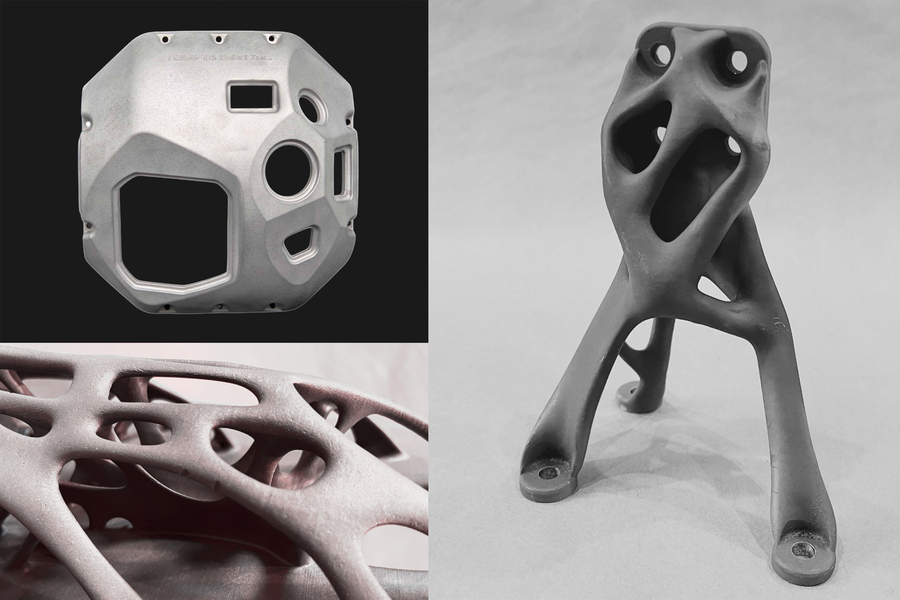
The company’s process also enables complex geometries and organic topologies that hard tooling can’t produce.
“We’re building the software that can make these parts more intelligently and faster,” Davis says. “Qualifying for aerospace production with a company like Raytheon is a really big deal. Most startups and 3D-printing companies we know haven’t done it. The ability for us to go from opening our first facility in 2025 to now going into production with some of the nation’s most critical platforms is a huge milestone. We are going to be making parts that are going to fly in the systems and go into the munitions platforms that the country needs.”
( Press Release Image: https://photos.webwire.com/prmedia/6/363995/363995-1.jpg )
WebWireID363995
This news content was configured by WebWire editorial staff. Linking is permitted.
News Release Distribution and Press Release Distribution Services Provided by WebWire.