

Skyfall AI introduces the world’s first AI CEO, Steve and announces $2M startup program
Steve uses World Models and Recursive Self Improvement to run businesses. Skyfall has acquired three businesses and is running them autonomously on Steve
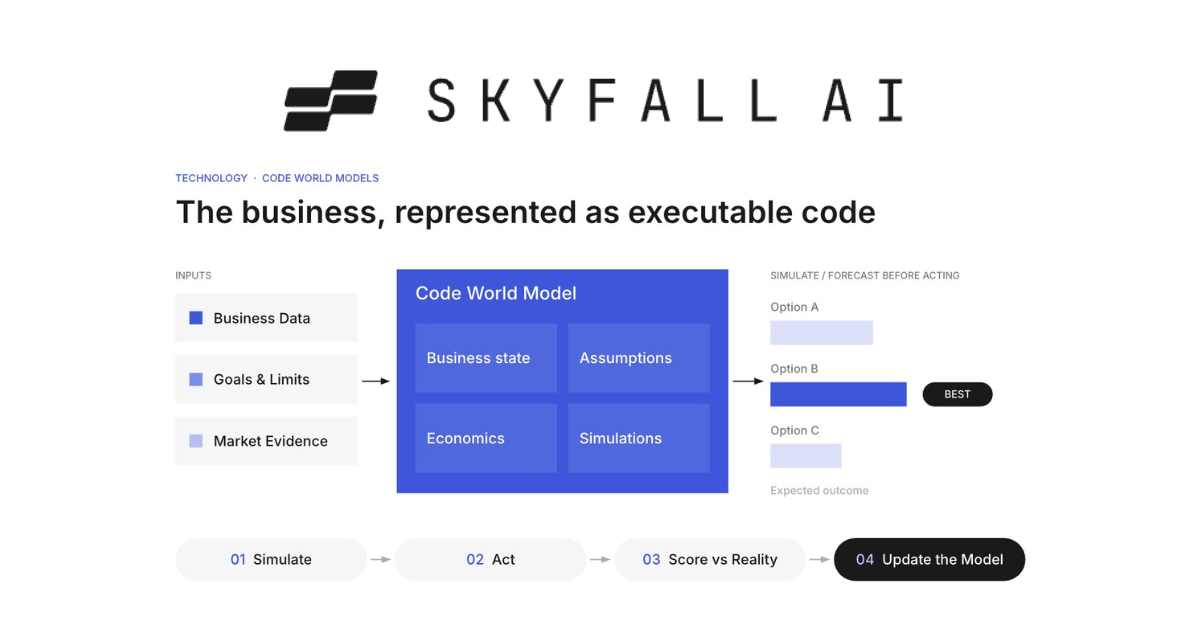
Skyfall AI today introduced Steve, the world’s first autonomous business harness that can run digital businesses such as SaaS products and Shopify apps. Steve, the world’s first AI CEO, is powered by World Models, RSI, simulation, a policy engine and a team of specialist AI agents. Steve makes better decisions and improves results over time by learning and improving from experience, much like a business run by people. A human owner still sets the direction and makes business-critical decisions. Skyfall plans to bring Steve to more types of businesses soon.
Alongside the launch of Steve, Skyfall AI is announcing a $2 million Startup Program, through which Skyfall will acquire 5 additional startups to run completely autonomously on Steve.
Testing across different business needs
Skyfall has been running two businesses on Steve for over two months and a third for a week. The company reports the following early results:
- Business one: Total monthly revenue has grown by 2.3x over the last quarter.
- Business two: After a steady decline in revenue for the last 5 years, as well as high churn and a period with no new paying users, revenue has now stabilized and the business is bringing in new customers.
- Business three: The business has just been incorporated into Steve a week ago and the results are too preliminary to report.
These businesses have different revenue patterns, customer needs and operating pressures. They give Skyfall different conditions in which to test Steve’s world models, agent coordination and self-improvement loop.
A dashboard for each anonymized business
Skyfall plans to launch Steve’s public dashboards alongside this announcement. Readers will be able to open the public dashboard for each business, shown under an anonymous name with identifying details withheld.
Each dashboard will show goals, metrics, agent work, decisions, scheduled jobs and harness changes. Readers can follow how Steve runs the business, replans work, acts within permissions and updates its own harness.
World models help Steve plan and replan
Steve uses a code world model to represent how customers, product use, revenue and costs relate. It is an executable model written in code, built from business records and business inputs. Steve uses it to simulate possible actions, estimate their effects and plan work toward the business goals.
For example, a cheap ad campaign may bring many visitors but few buyers. Steve could use the model to compare it with a campaign aimed at people likely to pay, estimating the sales and cost of each option before spending more. If the results fall short, it can change the plan and test a different approach.
Each proposal can carry a forecast, time frame and confidence level. The policy engine checks the chosen action before it runs. Steve then compares the actual result with the forecast. Differences feed into changes to the model and a new plan for what to do next.
RSI improves the system doing the work
Steve uses recursive self-improvement to update its own code, skills, agent setup, tests and code world model. Each change links a problem or missed forecast to the system component that produced it, with a record of the change and its effect in later runs.
This loop can change how work is broken into tasks, how agents route work to each other and which tests are used to check a result. Later runs use the updated harness and produce fresh evidence about whether the change helped. Those results can trigger further changes to the planning, testing or coordination logic itself. The policy engine governs these changes using the owner’s rules.
Two operating examples show why changes to the harness matter:
- Improving customer emails: Steve tested different approaches to lifecycle emails and compared the results. It then updated its instructions using the best-performing versions, so later emails followed what it had learned.
- Resolving agent deadlocks: During a website update, growth and engineering agents repeatedly handed the deployment back to each other. Neither took ownership, and one lacked the access needed to deploy. Steve changed its own harness so the orchestrator reviews and resolves these conflicts instead of letting the delegation loop continue.
A policy engine that governs execution
Before an action runs, the policy engine matches a structured decision against ordered rules set by the owner and rules that were learnt over time. It checks the decision type, spending and customer impact. The result is one of four levels: run automatically, run and notify, request approval or block. The matched rule and required checks stay attached to the decision.
For example, an owner could let Steve issue refunds of up to $30 automatically, while requiring approval for larger refunds. The policy engine checks the amount before a refund is issued and holds anything above that limit for the owner.
By separating work Steve can do from decisions that need approval, these rules let daily operations continue while the owner considers larger decisions. The owner remains in charge of goals and permissions, so improvements to the harness must stay within those limits.
Expanding the Portfolio via the $2M Startup Program
To accelerate testing and expand Steve’s operating capabilities across more software and digital business models, Skyfall is deploying $2 million dedicated to acquiring 5 early-stage startups. Founders interested in transitioning their products to run 100% autonomously on Steve can apply to join the program.
Learn more about Steve today at: https://skyfall.ai/steve.
About Skyfall AI
Skyfall AI is a Research lab building the foundational infrastructure for the autonomous enterprise. Moving beyond the limits of LLMs, Steve is an application of these Enterprise World Models for running digital businesses. Founded by the team behind Maluuba, the deep learning lab acquired by Microsoft, Skyfall is led by AI pioneers Sam Pasupalak, Kaheer Suleman, and Sumit Pasupalak. Headquartered in San Francisco with a research hub in Toronto, Skyfall is backed by Fidelity, Touring Capital, M13 and iNovia Capital. Learn more at https://skyfall.ai/
( Press Release Image: https://photos.webwire.com/prmedia/81468/363914/363914-1.png )
WebWireID363914
- Related Keywords
 Skyfall Ai
- Autonomous Business
- Ai Ceo
- Contact Information
- Riley Munks
- PR Advisor
- Activate PR - https://www.activate-pr.com/
- riley@activate-pr.com
This news content may be integrated into any legitimate news gathering and publishing effort. Linking is permitted.
News Release Distribution and Press Release Distribution Services Provided by WebWire.