

The Pillar and Ground of the Truth by Pavel A. Florenskij
Five evenings, from 16-20 November at the Historical Archive’s new premises, Arsenale, staged by Antonello Pocetti.
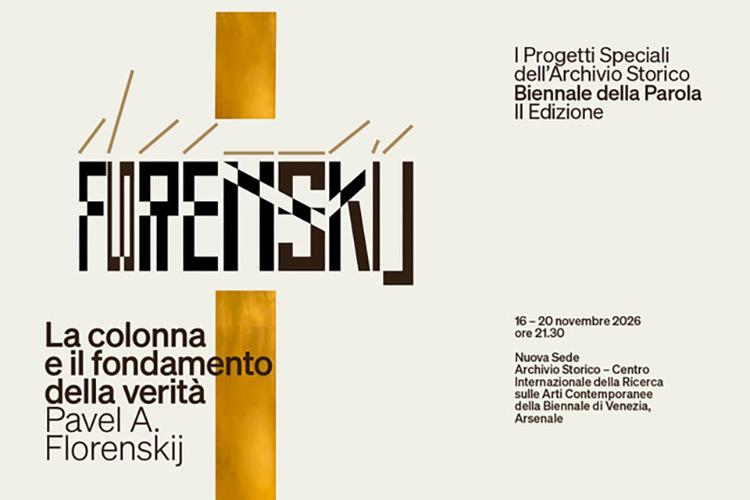
Tickets will be available starting Thursday 29 October at 3:00 pm on La Biennale di Venezia website.
Biennale of the wordLa Biennale di Venezia presents The Pillar and Ground of the Truth by Pavel A. Florenskij (1882–1937), the new special project of the Historical Archive – International Centre for Research on the Contemporary Arts, as part of the Biennale of the Word. Taking place from Monday 16 to Friday 20 November 2026 at the new premises of the Historical Archive at the Arsenale, the project is conceived and directed by Antonello Pocetti and comprises five evenings, each exploring a central theme in Florenskij’s thought.
Drawn from his writings, the texts have been adapted for the stage to convey the complexity and depth of his reflections. Each evening will begin with contributions by prominent figures from the worlds of culture, philosophy and religion, each offering a perspective on the author’s thought and themes, further explored in the subsequent staged readings.
Following its first edition, devoted to Meister Eckhart’s Commentary on the Gospel of John and presented in March 2025 at the Portego delle Colonne of the Scuola Grande di San Marco, the Biennale of the Word continues its exploration of language as a means of knowledge and transmission of thought. At the heart of this second edition is the work of Pavel A. Florenskij, which investigates the relationship between language and truth.
Born in 1882 in Yevlakh, Azerbaijan, Pavel A. Florenskij studied mathematics in Moscow before turning to philosophy and theology. Ordained a priest of the Russian Orthodox Church in 1911, he was a man of remarkable intellectual range and versatility: an Orthodox priest, mathematician, philosopher, theologian, art critic and scientist, he combined his pastoral duties with intensive research spanning a wide range of disciplines, from mathematics to music, from painting to philosophy. Following the 1917 Revolution, he chose to remain in Russia, where he took part in important scientific and technical projects. Arrested on charges of counter-revolutionary activity and sentenced to forced labour, he was executed near Leningrad on 8 December 1937. He is regarded as one of the foremost European thinkers of the 20th century.
His thought develops through a constant striving towards a spiritual dimension, the “Spirit of God”, capable of perceiving the invisible within the visible, placing the magical, multifaceted and symbolic word at the foundation of every field of knowledge. At the heart of this thought lies the word, which Florenskij sees as a living, multifaceted and symbolic reality, conceived as the relationship between the spirit of knowledge and the world to be known, discovered, and experienced. The word is a driving force that leads the mind beyond the subjective towards an immediate and profound experience of reality. In language, as in mathematics and art, Florenskij perceives a transcendent and symbolic dimension, directed towards the search for a universal and ideal synthesis of knowledge.
The Biennale of the Word reaffirms the role of the Historical Archive – International Centre for Research on the Contemporary Arts at the Arsenale as an active centre for research and cultural production, where memory enters into dialogue with the present. The Archive’s heritage thus becomes an opportunity for new interpretations and exchanges between languages, disciplines and forms of knowledge, encouraging reflection on the present and the imagining of the future.
Monday 16 November, 7.00 pm
Introduction by Silvano Tagliagambe
I – Truth. Truth is not merely about intellectual adequation nor is it an abstract concept; rather, it reveals itself in a living person: Christ. Turth is revealed through love, charity and openness towards others and it is grounded in an antinomic logic: apparent contradictions coexist because they reflect the Mystery of the Trinity, in which unity and multiplicity exist together without either ever subsuming the other.
Tuesday 17 November, 7.00 pm
Introduction by Massimo Cacciari
II – Visible/Invisible. The relationship between the visible and the invisible is a central theme in Florenskij’s work, particularly in The Pillar and Ground of the Truth and Iconostasis. The two realms are complementary: the visible is a sign of the invisible, and the invisible manifests itself through the visible. The icon becomes a window onto the invisible, a window onto the Kingdom of Heaven. Knowledge becomes a symbol and constitutes the real presence of the meaning it embodies.
Wednesday 18 November, 7.00 pm
Introduction by Adriano dall’Asta
III – The Mystical Value of the Word. Chrism and Form. The word is not merely a means of communication, but also an ontological medium, capable of revealing and influencing reality. As a bearer of meaning, the word has a profound connection with divine truth. Every word possesses “a mystical value”, in the sense that it is never neutral: it resonates beyond its semantic meaning and manifests spiritual reality.
Thursday 19 November, 7.00 pm
Introduction by Lorenzo Fellin
IV – The Word as Incarnate Truth. Letters from the Gulag – Part I. The creative act, the brushstroke, the mark, the surface covered in colour are not merely symbols of action, but something existing in its own right: a sensory perception, a gift from the artist. Likewise, the word, energy and a restrained gesture become a space of epiphany, silence, anticipation and inner resonance. Through his letters to his loved ones, Florenskij, the man , in the intimacy of his imprisonment and solitude, engages in dialogue with humanity and encourages it to seek peace through research and knowledge.
Friday 20 November, 7.00 pm
Introduction by Natalino Valentini
V – The Word as Testament. Letters from the Gulag – Part II. The word is not merely a linguistic construction, but a vehicle for profound truth. Bearing witness is a sacred act that conveys spiritual and ontological knowledge. A living testimony to the human spirit in the face of suffering and oppression takes shape. Subjected to strict censorship, the letters Florenskij wrote from the Gulag to his wife and children offer profound insight into his faith and inner resilience: “Do not forget me”.
Dramaturgy and direction: Antonello Pocetti
Original music: Filippo Perocco
Cast: Two actors (Dario Aita and Alessio Vassallo)
Musical ensemble: Ensemble L’arsenale, directed by Filippo Perocco, with Silvia Cingoli (guitar), Roberto Durante (keyboard, synthesiser), Ilario Morciano (saxophone), Livia Rado (soprano), Igor Zobin (accordion)
Set and costume design: Antonino Viola
Lighting design: Tommaso Zappon
Sound: Thierry Coduys
( Press Release Image: https://photos.webwire.com/prmedia/6/363453/363453-1.jpg )
WebWireID363453
This news content was configured by WebWire editorial staff. Linking is permitted.
News Release Distribution and Press Release Distribution Services Provided by WebWire.