

Stories of success, from Gyros Island to the Colombian Amazon
While climate change and nature loss crises still threaten life on Earth, WWF dares to hope that we can build a better future together. From protecting biodiversity in Greece’s Gyaros island to providing solar energy for women-led businesses in the Colombian Amazon, here’s some good news on the progress we are making.
Hope remains amid nature loss
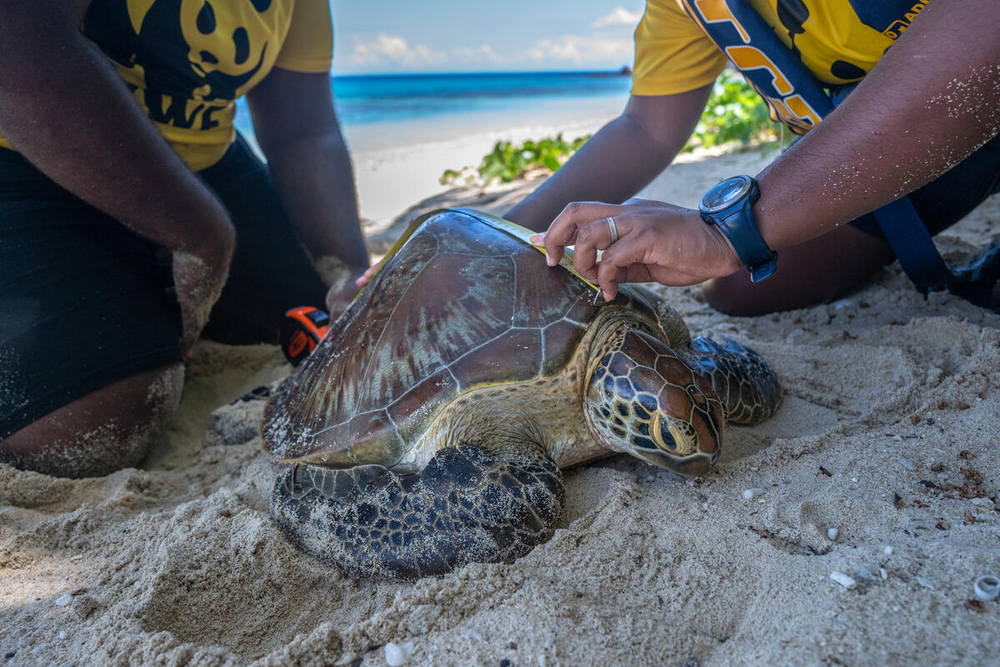
Every two years, WWF’s globally recognized Living Planet Report shows how nature is faring in our changing world, with the latest edition revealing a 73% decline in monitored wildlife populations over a 52-year period. Importantly, however, it also concludes that there is still a clear path toward recovery if we trigger positive tipping points in our energy, food and finance systems – the main drivers of nature loss. The report also looks at recent encouraging recoveries in green turtles, bluefin tuna, tigers and southern African elephants that show conservation can be effective.
Dr Kirsten Schuijt, Director General of WWF International, said: “Biodiversity continues to be degraded at an alarming pace. Yet amid these steep declines, there are grounds for hope. The report highlights evidence that many species populations are stable or recovering, alongside inspiring stories that show nature can rebound and change is possible.”
Monitoring data (1970-2022) for 35,803 populations of 5,790 vertebrate species was compiled by ZSL (Zoological Society of London).
The island of Gyaros and its surrounding waters are now fully protected after long-running efforts by WWF-Greece helped lead to a presidential decree in April. We have worked with partners since 2013 to protect the biodiversity of Gyaros – supporting the recovery of habitats on land and in coastal waters, increasing fish stocks and conserving populations of rare and endangered species such as the Mediterranean monk seal and the Yelkouan shearwater.
The creation of a Gyaros marine protected area, a decision pending since 2018, finally establishes a permanent legal framework for protecting this unique area, the biodiversity it hosts and the natural resources local communities depend on.
While we are delighted with the decision, we see this as a starting point for further action – an opportunity for nature protection to coexist with sustainable development, research, education and the active participation of the local community. Dimitris Karavellas, General Director of WWF-Greece, said: “Gyaros proves that when we join forces around a common vision, nature protection and sustainable development become reality.”
Newly released data reveals that, in 2025, Namibia recorded its lowest black rhino poaching levels in more than a decade. While 43 rhinos were still sadly poached, this represents a 53% decrease from 2024. Positive trends were also seen for elephants and pangolins, with reductions in poaching and other wildlife crimes affecting these species.
This progress reflects a collaborative approach to conservation involving local communities, government agencies and NGOs. WWF supports efforts to combat wildlife crime through investments in ranger capacity, wildlife monitoring technology, specialized wildlife crime courts and other anti-poaching measures.
Namibia’s landscapes support nearly 4,000 species found nowhere else, alongside important populations of rhinos, elephants, pangolins and many other species that are closely linked to healthy ecosystems, local livelihoods and national identity. WWF remains committed to supporting efforts that keep wildlife crime on a downward trend and help secure a future for Namibia’s iconic wildlife.
Constructive engagement by WWF-Romania over the past seven years has helped lead to groundbreaking action on EU biodiversity protection targets in Romania. The result is the establishment by the government of a new legal framework for biodiversity protection and creation of the country’s first National Catalogue of Priority Biodiversity Areas, covering more than 600,000 hectares – around 2.5% of Romania’s territory. About 340,000 hectares of state forest are included in the catalogue, roughly doubling the area of state forests managed under a biodiversity-oriented protection regime.
Romania is still a long way from achieving the 10% EU strict-protection target, and the real test now lies in whether protected areas are properly monitored and further extended.
WWF-Romania is working with all interested parties, including government agencies, local communities and civil society organizations, to further strengthen the framework for nature restoration while ensuring local communities are treated fairly.
Small-scale fishers lose as much as 35% of their catch due to lack of cooling from boat to market. Creating a temperature-controlled supply chain, through ice machines or chest freezers, can help reduce these losses, increasing food security, incomes and the sustainability of fishing. However, many ‘cold chain’ investments underperform because they are planned in isolation from local contexts.
WWF and partners have therefore launched a practical framework for developing successful and sustainable cold chain projects. Designed primarily for entrepreneurs and development agencies, the playbook has already been used by WWF field teams from Kenya, Madagascar, Tanzania, Mozambique and South Africa who recently gathered together in Cape Town to discuss how they can better support the development of impactful projects in the region.
WWF-backed field surveys have revealed the world’s highest known Asian elephant presence, with a family camera-trapped at 3,266 metres in India’s Eaglenest Wildlife Sanctuary – fascinating news as it challenges long-held assumptions about the species’ ecological limits and highlights the importance of monitoring wildlife in under-studied mountain landscapes.
The discovery was made by WWF-India and the Arunachal Pradesh Forest Department, who were jointly undertaking the first statewide assessment of elephant distribution and trends in human-elephant conflict. The surveys helped us identify habitat fragmentation caused by expanding settlements and linear infrastructure as the principal driver of conflict, with crop damage posing the greatest challenge for rural communities. As a result, we have created a strategy and action plan that prioritizes maintaining habitat connectivity, integrating wildlife safeguards into infrastructure planning, strengthening community-based management and improving compensation mechanisms.
Our global programme to encourage a renewable energy transition among local communities is helping two women-led businesses in the Colombian Amazon. Here in the heart of one of the world’s most important biodiversity hotspots, women are historically guardians of nature and leaders of many community production systems. So it’s great to see two women-led associations benefitting from solar energy, provided by WWF and funded by the Mott Foundation, that’s helping their businesses to flourish and providing an inspiring example to others.
The Association of Progressive Women in Puerto Limón, whose business raising and selling chickens used to experience frequent power outages, now has a reliable energy supply that ensures stable temperatures and ventilation for their flocks.
The El Progreso Association of Women Fish Farmers and Agricultural Producers (ASOPAEP) had been raising tilapia and cachama fish without any access to electricity. Now they are using solar power to aerate fish ponds, refrigerate products and light up workspaces – helping them to expand production and strengthen their business.
Finance professionals from around the world can learn about the links between nature and the financial system through the recently launched WWF Nature Finance Academy.
Threats to nature, such as deforestation, water stress, pollution and resource depletion, create significant risks for businesses, economies and financial institutions. The academy provides practical knowledge for better financial decisions and governance through a free global learning platform that offers sector-specific training for banks, investors, insurers and regulators.
Built by experts and structured from foundational concepts to specialized, commodity-level detail, learners can move through the courses at their own pace.
Topics covered include assessing nature-related risks and dependencies, understanding how nature affects the financial system, integrating nature into lending, investment and regulation, applying emerging risk frameworks, and exploring sector-specific risks and supervisory policy responses.
From safeguarding forests to taking climate action (July 2026)
Stories of success from the Arctic to Papua New Guinea (April 2026)
From India to Madagascar - stories of success (October 2025)
WWF in 2025: A year of ambitious action
( Press Release Image: https://photos.webwire.com/prmedia/7/363438/363438-1.jpg )
WebWireID363438
This news content was configured by WebWire editorial staff. Linking is permitted.
News Release Distribution and Press Release Distribution Services Provided by WebWire.