

From Expertise to Intelligence: NISCO Deploys World’s First Swarm-Intelligence Steel Model at Scale
300+ AI Applications Deliver Annual Cost Reduction of Over CNY100 Million (Approx. US$15 Million)
Summary:
- Nanjing Iron & Steel Co., Ltd. (NISCO) has worked with Huawei and ecosystem partners to commercially deploy the world’s first steel model powered by swarm intelligence—the YuanYe Steel Large Model (YuanYe), transitioning steel production from relying on experience to being powered by data and intelligence collaboration.
- NISCO has developed the first-of-its-kind swarm-intelligence-based industrial cluster architecture powered by “left brain and right brain collaboration” (“right brain” for probabilistic computing and “left brain” for precise and scientific decision-making). It has also integrated AI into core operational activities, such as ironmaking, rolling, quality inspection, and environmental control, and rolled out 25 business agents and over 300 AI models.
- 100% of NISCO’s key equipment is now connected and digitally controlled, with prime-grade molten iron yield up 10%, new product R&D cycles shortened by 50%, and annual costs down over CNY100 million (approx. US$15 million)—setting a benchmark for the digital and intelligent transformation of the global steel industry.
Nanjing Iron & Steel Co., Ltd. (NISCO) has worked with Huawei and ecosystem partners to commercially deploy the world’s first steel model powered by swarm intelligence—the YuanYe Steel Large Model (YuanYe)—across multiple scenarios at scale. This helps NISCO transition its core operations from relying on experience to being powered by data and intelligence collaboration.
NISCO has built a robust digital and intelligent foundation by adopting industry-leading products including Ascend, Kunpeng, Huawei Cloud Stack, and Pangu models. By embedding AI into every core stage of production—ironmaking, steelmaking, rolling, and quality inspection—NISCO is forging green and high-end AI-powered super steel plants.
Unlike general-purpose monolithic models, YuanYe innovatively fuses multiple AI models with the steel industry’s metallurgical mechanism models to create a dual-drive, multi-model cluster architecture. This architecture features a “right brain” for probabilistic computing and a “left brain” for precise and scientific decision-making. Powered by massive amounts of sensing data aggregated from millions of operational technology (OT) data points across 26 business domains, NISCO has achieved real-time digital twin mapping within its intelligent operations center, laying solid data and scenario foundations for YuanYe. This enables the entire steelmaking process to become not only visible, but also capable of precise control and intelligent assessment. Now 100% of NISCO’s key equipment is connected and digitally controlled and its new product R&D cycles have been shortened by 50%, reducing annual costs by over CNY100 million (approx. US$15 million).
As of this month, NISCO has launched 25 business agents by October 2026. These agents cover a wide range of scenarios, from visual quality inspection and process optimization to production scheduling and operations management.
Breakthroughs in four core scenarios: YuanYe redefines traditional operations for significant safety, efficiency, and quality gains
- In the ironmaking stage, AI makes traditionally invisible blast furnaces transparent. YuanYe leverages blast furnaces’ internal sensor data and metallurgical mechanism analysis to perform real-time dynamic simulations of the ironmaking process. Assisted by furnace temperature prediction and health diagnosis models, furnace operators can predict temperatures and identify issues two hours in advance, with over 90% accuracy. This shifts furnace operations from reactive post-event remediation to proactive pre-control, increasing prime-grade molten iron yield by over 10% while significantly cutting unit energy consumption.
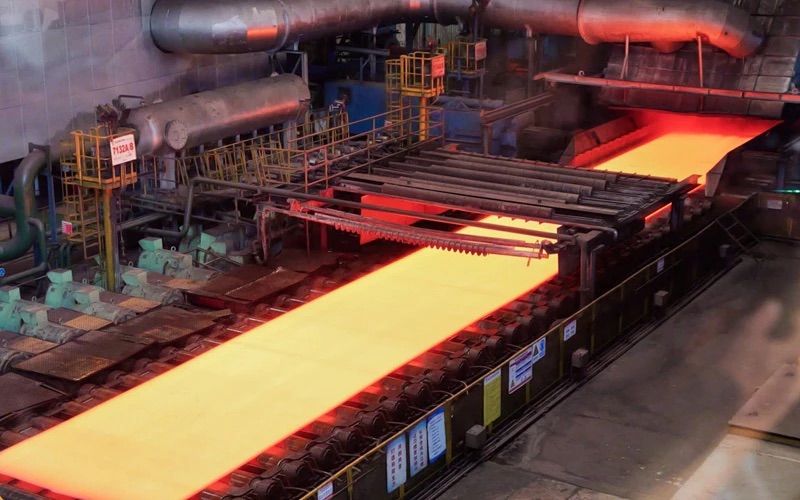
- In the rolling stage, AI drives precise predictions and codifies expert experience to enhance the operational stability of steel rolling and secure leadership in product quality. To tackle the highly dynamic and complex operating conditions during the rolling process, YuanYe’s rolling-force prediction model achieves millisecond-level response, narrowing the thickness tolerance to ±0.2 mm and reducing the steel thickness deviation to 1.9% to reach a world-leading standard. The rolling-force hit rate has jumped from 88% to 98%, supporting a steady annual output of over 2.5 million tons of steel plates and increasing the overall yield rate by 0.5%. Enhanced dimensional precision and physical-chemical stability allow NISCO’s products to meet demanding steel specifications across diverse applications, ranging from mega stadiums and oil pipelines to 10,000-ton cruise ships and LNG storage tanks.
- In quality inspection, the synergy between robots and AI models serves as a discerning “eagle eye,” doubling metallographic inspection efficiency. During metallographic inspection for finished steel, the integrated smart metallographic inspection system built on YuanYe has achieved full-process automation, covering sample grinding and polishing, image acquisition, and smart grading. Inspection accuracy has risen to over 95%, while per-sample inspection time has been shortened from 10 minutes down to 3–5 minutes. This 80% increase in overall inspection efficiency frees human operators to focus on anomaly analysis and high-level decision-making.
- In the energy and environmental control stage, NISCO leverages the YuanYe architecture to develop the S-Link Intelligent Agent for Gas and Flue Gas Sulfur Control. Integrating 602 process parameters alongside multi-modal image and knowledge capabilities, the agent achieves a smart closed loop across source prediction, process optimization, and end-of-pipe compliance. By combining mechanism inversion with time-series forecasting, it issues precise sulfur-risk warnings one hour in advance, achieving a sulfur prediction accuracy of over 95%. Operational optimization algorithms then calculate the optimal gas blending scheme within seconds. Finally, game-theoretic models dynamically allocate emission quotas, slashing natural gas co-firing consumption by nearly 50%. This has reduced downtime caused by emission exceedance by over 25%, and delivered more than CNY600,000 (approx. US$90,000) in annual economic benefits—securing both environmental compliance and drastic cost reduction.
From automating labor to empowering people: Defining a new paradigm of inclusive AI
Li Jinyan, General Manager of the Digital and Intelligent Integrated Development Department and Director of the AI Research Institute at NISCO, said: “Digital and intelligent transformation is inherently human-centric. Its purpose is not to replace people, but to unleash human potential. Our goal is to lift employees out of the endless sea of data, empowering them to direct their creative energy toward work of higher value.” To date, NISCO has deployed over 300 AI models across its plants, alongside more than 1,000 low-code agents and lightweight applications built independently by frontline employees.
As Cheng Yongfu, Senior Industrial Solution Expert at Huawei’s Steel & Non-ferrous BU, noted: “The real value of industrial AI can only be realized when it expands from single-point applications to comprehensive integration with production, operations, and management, which can unlock sustained, scalable empowerment.”
Looking ahead, as model deployment expands and computing demands continue to grow, NISCO will team up with Huawei and other partners to explore the construction of dedicated data centers for smart steel plants. Centered on the AI-native three-tier architecture (AI-native OS, AI-native factory, and AI-native enterprise) and powered by the YuanYe model, NISCO is accelerating high-quality steel development, aiming to provide a replicable and scalable benchmark for the digital and intelligent transformation of the global steel and manufacturing industries.
FAQs:
Q1: What is swarm intelligence and “left brain and right brain collaboration”?
YuanYe breaks away from the single-model pattern of general-purpose large language models and adopts a distributed multi-model cluster architecture. Its “right brain” is a perceptual-cognitive model (primarily AI models) that handles large-scale probabilistic statistics and macro-summarization, mimicking people’s intuition and experience accumulation. The “left brain” is a scientific operations-research optimization model (primarily mechanism models) that handles precise industrial-grade computation and scientific decision-making. YuanYe combines industry knowledge ontology, steel large model, scenario-specific small models, and agents to meet rigorous requirements for reliability, safety, and real-time performance in the steel industry.
Q2: How to make traditionally invisible blast furnaces transparent?
In the past, operators had to visually inspect the temperatures of blast furnaces which have complex internal environments. They could only make delayed, experience-based adjustments—an approach of reactive post-event remediation. Today, based on the massive amounts of real-time data from over a thousand sensors inside and outside furnaces, YuanYe integrates process mechanisms with furnace temperature prediction and health diagnosis models to perform real-time dynamic simulations. Furnace operators can now shift from reactive post-event remediation to proactively predicting temperatures two hours in advance with over 90% accuracy. This has significantly improved the yield of primary-grade molten iron and reduced energy consumption.
Q3: How to tackle extreme conditions and high-precision challenges during the rolling stage?
Rolling involves extreme temperatures (up to 1,200°C), colossal rolling forces (up to 120,000 kN), and rapid dynamic changes. Every pass alters thickness, profile, and microstructures, and inaccurate force predictions can easily cause cobbles and shutdowns. YuanYe’s AI rolling-force prediction model delivers millisecond-level response and supports rapid, high-precision modeling with small sample sizes across all steel grades, upgrading traditional operations into data-driven model tuning.
Q4: How to achieve automated, precise metallographic inspections in quality inspection?
Traditionally, metallographic inspections, which evaluate microstructures to determine steel performance, rely heavily on manual sample grinding, microscopic observation, and manual rating against standard charts, making it a tedious and labor-intensive process. Today, with robots powered by AI visual models, NISCO’s integrated smart metallographic inspection system has achieved micron-level grinding and polishing precision while enabling direct and AI-driven microstructural grading. By taking over 50% to 60% of high-intensity, repetitive tasks, this system has reduced per-sample inspection time from 10 minutes down to 3–5 minutes.
Q5: How to balance the dual imperatives of ultra-low emissions and cost-effective output stability with YuanYe-powered agents?
Traditional manual adjustment methods with delayed response have struggled to meet the tightening environmental standards for ultra-low emissions across the steel industry. To prevent costly downtime caused by emission exceedance, steelmakers are often forced to co-fire expensive natural gas as a defensive measure. The YuanYe-powered S-Link Intelligent Agent has fundamentally transformed this reactive approach. By fusing metallurgical mechanism modeling, computer vision, and temporal forecasting into a multimodal architecture, the agent accurately analyzes sulfur loads across blast furnaces and coke ovens, issuing risk warnings one hour in advance. Simultaneously, to minimize the cost of natural gas co-firing, the agent executes operational research optimization within seconds to dynamically adjust the blending ratios of high- and low-sulfur gases. Furthermore, the system features a visual human-machine collaborative interface, ensuring that AI-driven decisions are safely embedded into existing scheduling workflows in a controlled way. This approach ensures environmental compliance and significantly cuts operational production costs. It also indirectly saves tens of millions of yuan in end-of-pipe treatment investments, while providing solid data support for securing preferential environmental electricity tariffs.
( Press Release Image: https://photos.webwire.com/prmedia/8/363386/363386-1.jpg )
WebWireID363386
This news content was configured by WebWire editorial staff. Linking is permitted.
News Release Distribution and Press Release Distribution Services Provided by WebWire.