

Watch the universe emerge from the dark ages, with Lumina
The new simulation tracks dark matter, galaxies, stars, and cosmic structures over the universe’s first 2 billion years, in greater detail and volume than ever before.
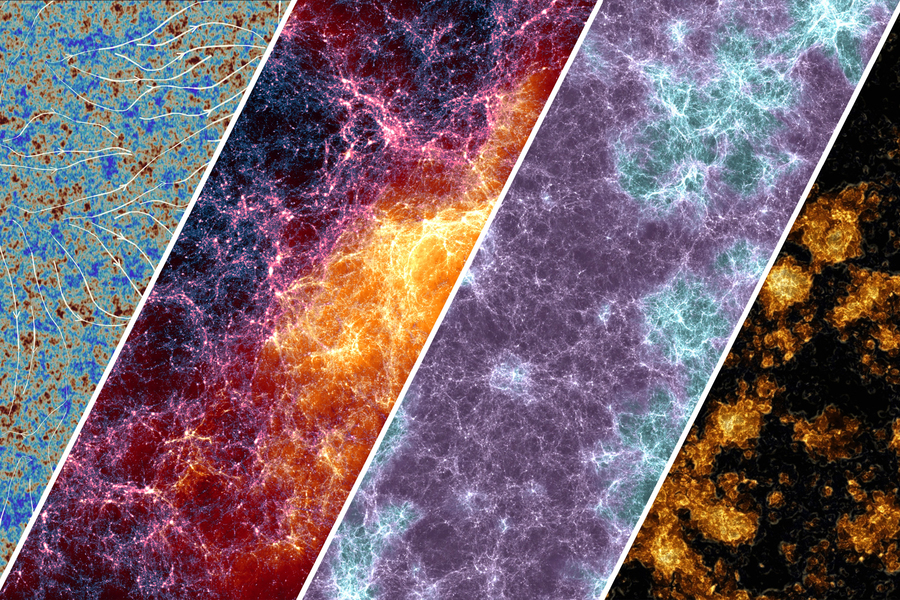
With the Big Bang, the universe burst into existence as a hot and dense soup of electrons and subatomic particles. This primordial ionized plasma, initially smaller than a single atom, rapidly expanded and cooled. In the process, particles in the soup slowed enough to bind with electrons, forming electrically neutral hydrogen.
As this neutral hydrogen accumulated, the effect was like a shroud, preventing light and other forms of radiation from freely passing through. Around 380,000 years after the Big Bang, the universe was plunged into a cosmic “dark age.”
Now, a new computer simulation is giving scientists a detailed view of how the first galaxies, stars, and other structures could have unfolded from that time, to eventually pull the universe out of its dark age.
In a paper appearing today in the Monthly Notices of the Royal Astronomical Society (MNRAS), physicists from MIT, Harvard University, and elsewhere present Lumina — a large-volume, high-resolution simulation that follows the early universe from the dark ages through the next 2 billion years of cosmic evolution.
Two pivotal transformations
Lumina covers a huge patch of the early universe that spans 500 megaparsecs, or about 1.6 billion light-years wide. In that space, the simulation tracks the evolution of dark matter, gas, stars, and radiation (such as photons), across enormous cosmic scales and also zooming down to the detail of an individual developing galaxy.
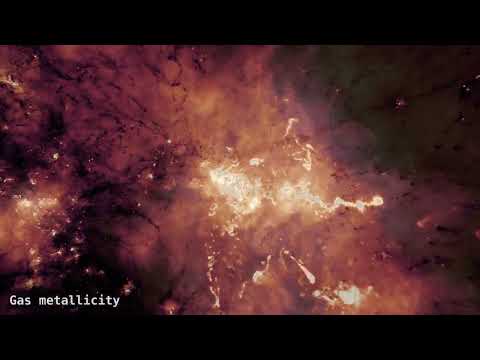
Fly through of massive halo in the Lumina simulation.
Over the 2 billion years that Lumina simulates, it captures the emergence of two huge transformations in cosmic history: hydrogen re-ionization and helium re-ionization.
Hydrogen re-ionization is a period when early stars were able to push out enough ultraviolet light to interact with neutral hydrogen and strip it of its electron. This “re-ionizing” prevented the hydrogen from absorbing photons, instead allowing light to travel freely. Hydrogen re-ionization helped to lift the veil of neutral hydrogen — a process that Lumina captures in detail for the first time.
The simulation also tracks helium re-ionization, a process similar to its hydrogen counterpart, in which much higher-energy light breaks apart neutral helium.
In its detailed simulations, Lumina revealed that hydrogen re-ionization was likely driven by light from early galaxies and stars. In contrast, helium re-ionization was fueled by much more energetic early supermassive black holes in their active, accreting phases. Together, this represents the first time a simulation has captured both hydrogen and helium re-ionization.
“Lumina does everything from small-scale star and galaxy formation to large-scale re-ionization of hydrogen and helium, in a volume that is 100 times larger than previous best simulations,” says study author Mark Vogelsberger, a professor of physics at MIT.
He and his colleagues are making Lumina available to the scientific community so that scientists can compare its detailed simulations of the evolution of early cosmic structures with snapshots taken by new and future telescopes. Then, they might begin to piece together the processes that shaped the first galaxies, stars, and structures in the universe.
The study’s MIT co-authors are Xuejian (Jacob) Shen and Teodora-Elena Bluichi. Additional authors include first author Oliver Zier (a former postdoc in the Vogelsberger Lab), Rongrong Liu, Sonja Koehler, and Lars Hernquist of the Harvard and Smithsonian Center for Astrophysics; Aaron Smith of the University of Texas at Dallas; Rahul Kannan of York University in Canada, and Volker Springel and Rüdiger Pakmor of Max Planck Institute for Astrophysics in Germany.
Cosmic computation
Lumina takes its name from the Latin word meaning “lights.” At the heart of Lumina is IllustrisTNG, which was previously developed by scientists at MIT and elsewhere, including members of the Lumina team. IllustrisTNG is a large-scale simulation that tracks the interactions of dark matter, gas, and other processes involved in forming galaxies, from the Big Bang to the present day.
In building Lumina, the team refined IllustrisTNG’s code to enable the simulation to track the formation of galaxies with the same level of detail but throughout a much larger volume. They combined this leveled-up galaxy model with a model of radiation transport, which simulates how different forms of radiation such as ultraviolet light interact at extremely large, cosmic scales to capture processes such as hydrogen re-ionization.
The new and improved simulation resolves extremely fine details across huge scales. In practice, the simulation encompasses half a trillion individual elements, including dark matter particles and gas cells, which is about 30 times higher-resolution than IllustrisTNG. Lumina captures all this detail and evolves it forward in time, across an enormous patch of about 500 megaparsecs, which is 100 times larger in volume than previous simulations.
Running the calculations for every single cell over 2 billions years of cosmic time, and across extremely large and very small scales, involves a significant amount of computing power. The team ran Lumina on Frontier, one of the world’s most powerful supercomputers, based at Oak Ridge National Laboratory in Tennessee.
“At peak scale, the calculation brings together the equivalent of more than 100,000 CPU cores and around 15,000 GPUs,” says Shen. “Making all of those processors communicate efficiently while continuously evolving trillions of interacting pieces of information is itself an extraordinary feat of computer engineering.”
Full zoom
Lumina begins its simulations at around 45 million years after the Big Bang, in the midst of the dark ages, when neutral hydrogen dominated the early universe. The researchers set the simulation with initial conditions approximating what physicists theorize should have existed in such a dark cosmic period.
They then let Lumina run to calculate how matter at those times, in the form of gas and dark matter, interacts across the simulation’s half-a-trillion cells. Simultaneously, the simulation calculates where and how radiation, such as ultraviolet light from stars, emerges and interacts with its surroundings.
On the project website, the team provides a number of videos that depict the various scales, time periods, physical processes, and layers of cosmic structures that Lumina simulates. Examples include a “zoom-in” from the full, large-scale patch of the universe to a single, disk-shaped galaxy; and a time-lapse of the full volume, over 2 billion years, that captures the pattern of hydrogen as it is re-ionized over time.
“On the one hand, it’s evolving dark matter as well as the gas in the universe, and on the other, it’s also tracking how radiation travels,” Zier explains. “We see dark matter and gas start to clump in these over-densities. And when we zoom in, we can see gas is falling into these dark matter haloes. Zooming in more, we see this is where the first galaxies form. And the first stars form in those first galaxies. Those stars then create radiation. The simulation then tracks that radiation, and we can zoom way out to see how that radiation travels out from stars, through the universe, until at some point it ionizes some neutral hydrogen.”
“Other simulations cannot zoom in as far as this,” Vogelsberger notes. “The difference between the smallest and largest scales that we simulate is larger than in any other simulation.”
Zoom-in from large-scale structures to a disky galaxy in the Lumina simulation
Looking ahead, the team plans to apply Lumina to map the large-scale structure of the early universe. The simulation can also help to predict the gravitational-wave patterns that early galaxies and black holes might produce. Whatever Lumina simulates could soon be compared with actual observations from new and upcoming telescopes.
“One of Lumina’s major advantages is its sheer size,” Shen says. “It produces enormous populations of simulated galaxies, finally allowing us to make comparisons with the very large galaxy samples that upcoming surveys will observe.”
This research was supported, in part, by NASA and the National Science Foundation, and used resources of the Oak Ridge Leadership Computing Facility at the Oak Ridge National Laboratory, which is supported by the Advanced Scientific Computing Research programs in the Office of Science of the U.S. Department of Energy.
Credit Caption:
( Press Release Image: https://photos.webwire.com/prmedia/7/363316/363316-1.jpg )
WebWireID363316
This news content was configured by WebWire editorial staff. Linking is permitted.
News Release Distribution and Press Release Distribution Services Provided by WebWire.