

New USPS Diwali Stamp Honors Traditional Autumn Festival
The U.S. Postal Service commemorated the joyous Hindu fall festival of Diwali with a new Forever stamp at the Embassy of India in Washington, D.C. On the Hindu calendar, Diwali falls on the eve of, or on, the new moon that occurs between mid-October and mid-November. In 2026, the main day of the festival will be Nov. 8.
“Since 1893, the Postal Service has issued stamps commemorating the cultures of people who have come from around the world,” said Shibani Gambhir, USPS revenue operations senior vice president, who served as the dedicating official. “Ours is truly a world culture, and our stamps allow us to weave together a tapestry that reflects the rich and multifaceted heritage of America.”
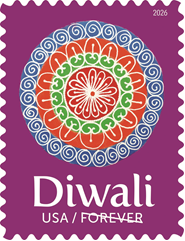
The U.S. Postal Service celebrates the joyous holiday of Diwali with an image of a rangoli, a vibrant floor pattern traditionally made from materials such as colored rice powder, chalk and flower petals. One of the most important annual Hindu events and usually observed over five days, the autumn festival marks the triumph of good over evil.
For Diwali — also known as Deepavali — people create rangolis in and around their homes. The intricate designs, which often feature floral imagery, geometric shapes and religious iconography, are thought to bring good fortune. In addition to traditional materials, artists today use paints and sparkly adornments to bring their colorful creations to life.
The word rangoli comes from the Sanskrit term rangavalli. On the Indian subcontinent, the art form has different names, such as kolam, alpana and chowkpurana. In many families, the art of making rangolis is passed down from generation to generation, but most people create them spontaneously. The beauty of each brightly colored pattern is fleeting, but after one unique rangoli is washed away, the artistic process begins again.
The meaning of Diwali often depends on regional identity, but Hindu stories provide a framework for the significance of the festival. For many people in the north of India, the holiday honors the return of Rama, an incarnation or avatar of the god Vishnu, after a long period of exile. For some in the south of India, it marks the defeat of the demon Narakasura by Krishna, another incarnation of Vishnu. Others commemorate Vishnu’s decision to make King Bali ruler of the underworld.
In preparation for the festival, many Hindus go shopping, clean their homes, open their doors and windows, make rangolis, and light oil-wick lamps called diyas with hopes that Lakshmi, the goddess of wealth and prosperity, will visit. In some regions of India, people gamble and play games, just as Hindu lore says that the deity Shiva did. On the festive main day of the holiday, families pray to Lakshmi, dress up in their best clothes, enjoy lavish feasts and sweets, exchange gifts, and light fireworks. Diwali also marks the new year for people in Gujarat and a few other states in India.
Diwali is an important festival in several religions. Buddhists honor ancient Indian emperor Ashoka’s conversion to Buddhism. Jains commemorate the teacher Mahavira’s attainment of liberation from the cycle of life and death. Sikhs celebrate the freeing of guru Hargobind from captivity.
This is the second Diwali stamp. The first one was issued in 2016.
Stamp design
The rangoli for the stamp was created by artist Sangita Bhutada, a native of India and longtime resident of the Houston area who has been a practitioner of this ancient folk art for nearly 30 years. Bhutada started by sketching out a design on paper, then began carefully sprinkling colored sand and starch-based powder on the floor, using her fingers and sometimes a regular kitchen strainer. She chose bright colors — blue, orange, green and red — plus white.
The original work took eight to 10 days, as opposed to the four to six hours Bhutada normally spends on a rangoli, and was 8 feet in diameter so when it was photographed it would come out properly in high resolution, she explained. Photographer Bijay Dixit, also based in the Houston area, did the honors. The resulting image was then set against a brilliant purple background.
News about the stamp is being shared on social media using the hashtag #DiwaliStamp.
William J. Gicker served as the project’s art director. Jennifer Arnold designed the stamp, which will be sold in panes of 20.
Diwali is a Forever stamp and will always be equal in value to the current First-Class Mail 1-ounce price.
Postal Products
Customers may purchase stamps and other philatelic products through The Postal Store at usps.com/shopstamps, by calling 844-737-7826, by mail through USA Philatelic, or at Post Office locations nationwide. For officially licensed stamp products, shop the USPS Officially Licensed Collection on Amazon. Additional information on stamps, first-day-of-issue ceremonies and stamp-inspired products can be found at StampsForever.com.
# # #
The United States Postal Service is an independent federal establishment, mandated to be self-financing and to serve every American community through the affordable, reliable and secure delivery of mail and packages to more than 170 million addresses six and often seven days a week. Overseen by a bipartisan Board of Governors, the Postal Service is currently pursuing a transformation plan aimed at restoring long-term financial sustainability, improving service, and maintaining the organization as one of America’s most valued and trusted brands.
The Postal Service generally receives no tax dollars for operating expenses and relies on the sale of postage, products and services to fund its operations.
( Press Release Image: https://photos.webwire.com/prmedia/6/363197/363197-1.png )
WebWireID363197
This news content was configured by WebWire editorial staff. Linking is permitted.
News Release Distribution and Press Release Distribution Services Provided by WebWire.