

WSS 2026 Speech - Sandrine Le Borgne, IATA Interim Director General
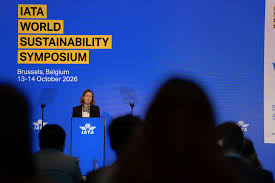
Ladies and gentlemen, colleagues,
What unites us at this Symposium is a shared commitment to achieving net-zero carbon emissions by 2050 for the aviation sector.
Yesterday was a powerful reminder of both the scale of the challenge before us and of the strength of the community committed to addressing it.
We also reinforced an important reality.
Decarbonizing air transport is not simply about meeting a climate objective. It is about building a more resilient future. It is about reducing dependence on fossil fuels, diversifying energy sources, advancing new energy pathways, while strengthening long-term economic competitiveness and increasing energy security.
And it is also about preserving the connectivity that aviation provides to people, businesses, and communities around the world.
That connectivity matters.
In 2024, air transport supported 11.6 million direct jobs, and 86.5 million indirectly. It also contributed to 3.9% of global GDP. Behind those figures are businesses and human connections.
The task before us is to deliver both sustainability and connectivity.
Yesterday we heard perspectives from across the value chain. We discussed energy production, finance, technology, infrastructure, policy frameworks, investment, and market development.
And those conversations highlighted two simple facts:
- The transition we are pursuing is complex,
- No single organization, government, technology, or industry can deliver this transition alone.
This is why one global, compatible framework matters more than any national or regional scheme, however well intended.
Why?
Overlapping carbon schemes will only raise the cost of flying without lowering emissions. Consistency is not a convenience for airlines, but the condition for the industry to work at all.
This is why IATA supports CORSIA as the only globally coordinated framework for international aviation.
Ambition sets direction. But direction alone does not produce fuel, unlock capital or build infrastructure.
Our focus remains the same: bringing stakeholders together to solve problems and create momentum.
So here are three things IATA remains committed to and plans to further develop:
- Access to SAF supply: Enable a truly global market for SAF: CADO SAF Registry and the SAF Matchmaker exist so that any airline can buy any producer’s fuel, wherever they are in the world. A tonne of SAF should be purchasable from anywhere at a competitive price.
- CORSIA as the globally coordinated framework for international aviation. Yesterday we were pleased to welcome ICAO to the alliance to bring forward CORSIA-EEUs, which now counts more than 80 signatories, including five states.
- Financial and environmental sustainability must go together. We will invest our energy into research and analysis, and in the actions we can take together to bridge the gaps to achieve our industry objective.
Closing
Yesterday reminded us of the size of the challenge.
Today should highlight the scale of the opportunity.
The opportunity is to look beyond the parts to the wider system in which they operate.
The opportunity is to deepen the conversation, challenge our thinking, and take actions to reach net zero.
Progress depends on open discussion. The goal is not unanimity. The goal is better decisions.
I wish you an inspiring and productive second day of the Symposium.
Thank you.
( Press Release Image: https://photos.webwire.com/prmedia/6/362944/362944-1.jpg )
WebWireID362944
This news content was configured by WebWire editorial staff. Linking is permitted.
News Release Distribution and Press Release Distribution Services Provided by WebWire.