

Nine People, One Pallet Jack: The Danish Startup Taking the Forklift Industry by Storm
Nineteen months after it was founded, The Mobile Robot Company beat established truck makers to the industry’s top prize with a €65,000 self-driving pallet jack that deliberately leaves the hardest decisions to humans. Now the nine-person company has to prove the idea can scale.
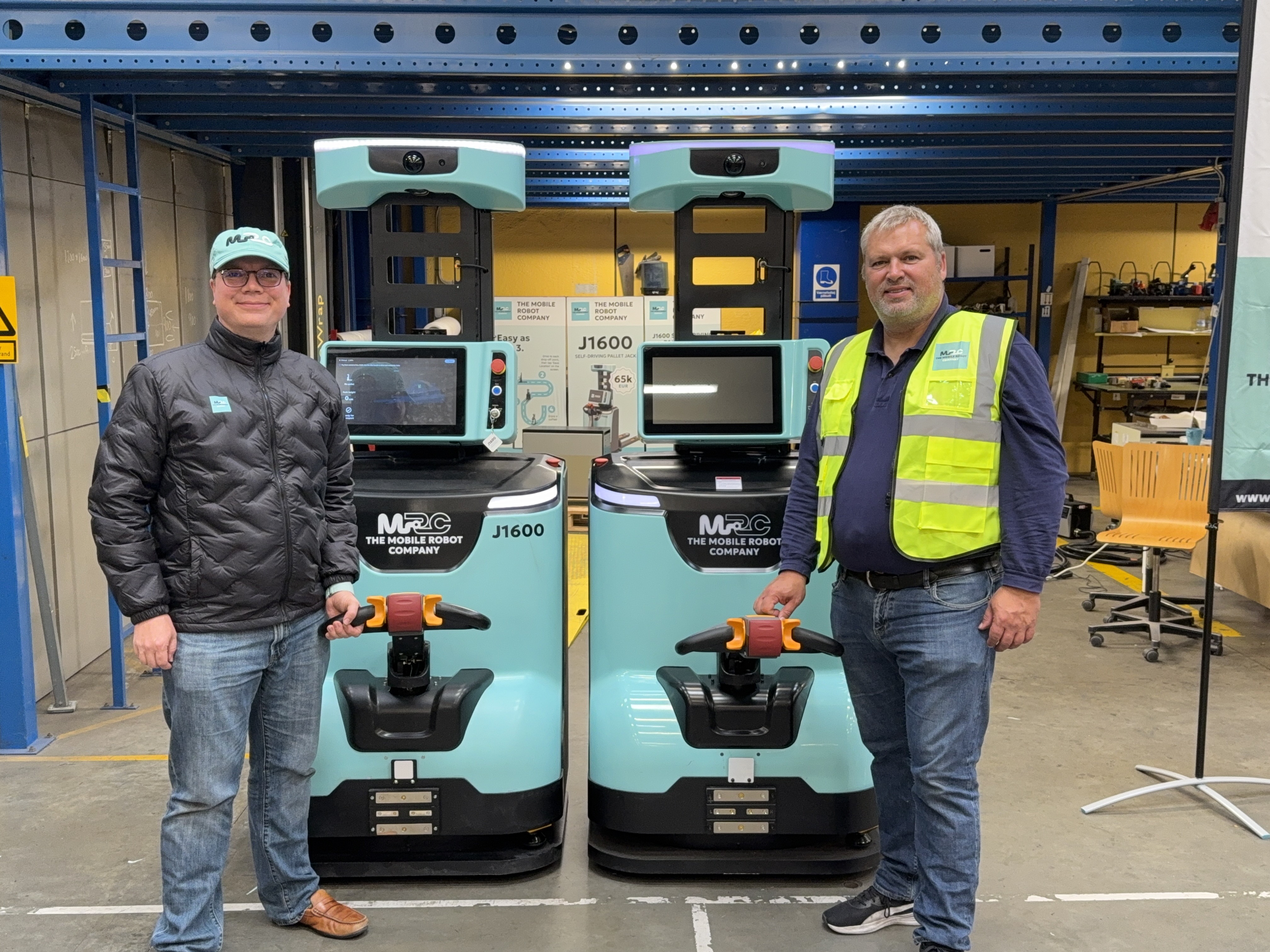
I welcome more people to join the dual-mode future. They help us get from 1% automation to 99% automation. - Emil Hauch Jensen, CEO of The Mobile Robot Company.
Forty-eight hours before the most important public appearance in their company’s short life, Emil Hauch Jensen and Odin Kudahl Skovsted had a robot that would not pass its own safety checks.
It was April 2026. The J1600, a self-driving pallet jack built by The Mobile Robot Company, a startup of fewer than 10 people on the industrial fringe of Copenhagen, was one of 17 finalists, whittled from 49 entries, due in Dortmund, Germany, for the IFOY Audit — the three-day test camp where an international jury of trade journalists puts the year’s most promising logistics equipment through its paces. The team had spent two weeks getting ready. Then a bug surfaced in part of the safety system, and it would not go away.
“We were in extreme panic,” Mr. Jensen recalled. At six in the evening the day before setup, the fault was still there. They loaded the robot onto a truck anyway. Mr. Jensen, an engineer named Pratheesh Prakash and the company’s driver, Henrik, drove through the night to Dortmund and went to bed. The next morning, as they were building the stand, the supplier of the safety controller called: it had found the problem. “If we hadn’t, that would have been a huge disaster,” Mr. Jensen said. “The robot did an amazing job throughout the whole show. We actually had no problems after that.”
Two months later, on June 25, Mr. Jensen was sitting in the middle of an audience of some 150 industry executives, academics and journalists in Stuttgart when the J1600 was named IFOY Industrial Truck of the Year 2026 — an award whose past winners include forklift giants such as Jungheinrich and Still, and which, the company says, had never before gone to a Danish firm. Mr. Skovsted, his co-founder, wasn’t there. He was in Italy, running an open house for customers with a local partner. “It was all hands on deck that week,” Mr. Jensen said. “I was kind of shocked. I had honestly no expectation of winning.”
The win capped an improbable 19 months. The Mobile Robot Company was founded in November 2024 by Mr. Jensen and Mr. Skovsted, two veterans of Denmark’s robotics industry who had, between them, helped put more than 10,000 robots into warehouses and factories around the world — and had concluded that most robot projects were, in their words, too hard, too slow and too complex. Their answer was not a more capable robot but a deliberately less ambitious one: a machine that looks and drives like the electric pallet jacks found in every warehouse, that can be sent off alone to deliver a load across a factory, and that, by design, will never pick up a pallet by itself.
It is a bet against an industry’s prevailing dream of full autonomy, placed at a moment when that industry is wobbling. And it is a bet that a company with nine employees and no venture capital can hold its ground against the forklift incumbents it has just embarrassed — and against the copycats it fully expects to follow.
“Everybody can make a dual mode,” Mr. Jensen said. “I don’t think everybody can make it as easy to use and as well designed as us.”
’Why don’t we do this ourselves?’
Mr. Jensen, who laughs easily and answers quickly, did not set out to build robots. In the mid-2010s he was selling air-filtration equipment for welding shops at Nederman, a Swedish industrial group, when he noticed his customers changing underneath him. In the space of three years, he said, the share of newly installed welding equipment that was robotic went from about 10% to about 60%. Robots need different filters. “That’s where I first got an eye on robotics,” he said, “and saw firsthand that something is changing in the market, and robotics is moving really, really fast.”
Soon afterward, Mobile Industrial Robots, the Odense-based maker of autonomous carts that was then one of Denmark’s hottest technology companies, asked him to run its business in China. He joined in 2018 — the same year Teradyne Inc., the American test-equipment group, agreed to buy MiR for up to $272 million, a deal that cemented Odense’s reputation as an unlikely robotics hub. Mr. Skovsted, a robotics veteran with more than two decades in the industry, was already there, running MiR’s technical-support and customer-success teams; he would rise to vice president of customer application support as the company grew from startup to global enterprise. The two spoke almost every day, mostly about customer problems. “We had a really good working relationship all the way back in MiR,” Mr. Jensen said.
China reset his sense of scale. At the time, MiR’s largest single-site installation anywhere in the world was 25 robots. A Chinese prospect asked for 3,000. “That could only happen in China,” Mr. Jensen said. MiR lost the deal to a local competitor; a year later, he learned the order had actually been for 5,000. He later worked for a Chinese robotics startup, Geek+, and then moved to Intel Corp. as part of a collaboration between the two companies, bringing Mr. Skovsted with him. “A lot of what the Chinese companies were attempting to do, most European startups that I know wouldn’t even dream that big,” he said.
What the two men were learning, project by project, was that the robots were rarely the problem. The problem was everything around them. MiR’s machines were platforms — “half-done solutions,” in Mr. Jensen’s phrase — onto which an integrator bolted a custom “top module” for each customer, then wired the whole thing into the warehouse-management system, the enterprise software and a fleet manager so that it could run without anyone touching it. “The last five and ten percent are the hardest and the most expensive and require a lot of custom engineering,” he said. “If you do 80% or 90% automation, you can significantly reduce the total cost.”
A visit in April 2024 to an Amazon.com Inc. distribution center in Germany crystallized the idea. Amazon’s fulfillment centers are famously dense with robots — by Mr. Jensen’s reckoning, the company operates more mobile robots than everyone else combined — but this facility, one tier up the logistics chain, had conveyors, scanning gates, a few idle robot arms and essentially no mobile robots. The operations manager told him why: the site changed its processes as many as 10 times a week, driven by whatever products were flowing through. “It wasn’t a cost issue,” Mr. Jensen said. “It was really the flexibility. That was for me a spark where I said, okay, there’s really something about having the human in control.”
The spark became a company at ROSCon, a robotics conference in Odense, in October 2024. "Odin was actually the one who looked at me and said, ’Emil, why don’t we do this ourselves?’" Mr. Jensen said. “I was immediately hooked.” Within weeks the pair were walking the floor of a materials-handling trade fair in Shanghai, where they spotted a Chinese product they thought they could import to Europe. The Mobile Robot Company was registered that November. By January 2025 the import plan was dead — safety concerns about the machine proved insurmountable — and they decided to design their own from scratch.
They had considered almost everything with wheels: cleaning robots, delivery robots, outdoor machines, an autonomous cart for moving totes. The pallet jack won on market size. “Anything that has wheels and drives, except self-driving cars, we had it in our thoughts,” Mr. Jensen said. “We thought the pallet jack has bigger and more obvious market potential.”
They financed it themselves. “Odin and I had both been lucky to be a little bit later in our career,” he said. “We had some capital that we’ve been able to put into the business.” Nearly two years on, the founders still own the company outright and have taken no outside equity. In an era when generative AI has made software cheap to produce — what Mr. Jensen calls the “SaaS apocalypse” — he regards the decision to build hardware as an accidental stroke of luck. “You can’t just ask an AI to make it for you,” he said. “It’s the mix that really makes it a defensible business that is hard for people to copy.”
A robot that doesn’t look like one
The J1600 is, at first glance, unremarkable. It is a walk-behind electric pallet jack of the kind found by the loading dock of nearly every warehouse in Europe: a tiller handle, a pair of forks, a 1,600-kilogram payload, a top speed of 5.4 kilometers an hour. The clues that it is something else are a 15-inch touchscreen where the control panel would normally be, a 3D lidar sensor on top, two safety scanners sweeping a 360-degree protective field at floor level, and three strips of blue light that show bystanders how far that field currently extends.
The ordinariness is the point. “The easier you can do it for the customer, the better,” Mr. Jensen said. “Don’t try to make it more advanced. Try to make it easier. And the easiest thing is the thing you already know how to do.” In manual mode the J1600 is meant to feel exactly like the truck an operator has used for years. The autonomous functions, he said, should feel “like trying a new app on your phone. You don’t need a manual, you don’t get a training video, you just open the app and start using it.”
The workflow is simple enough to describe in a sentence. An operator drives to a pallet, picks it up by hand, taps a destination on the screen — or drives somewhere new and presses “Save Location” — confirms with a physical button, and walks away. The robot builds its own 3D map as it drives, needs no reflectors, floor tape or Wi-Fi, and when it arrives it sets the pallet down at floor level and comes back, parks, waits or carries on to the next stop. The company says a new operator needs about 30 minutes of training; a first-time visitor to a demo typically has the robot running an autonomous task within 15 minutes. Mr. Jensen puts the real moment of conversion at closer to two. “When he has saved a brand-new location, picked up a pallet, and given the robot a task to deliver the pallet to that new location — it’s that quick,” he said. “Hey, I just did this. I can do this. This is not coming for my job.”
Even the name was chosen for its lack of personality. The founders toyed with Norse mythology before settling on a model number: J for jack, 1600 for the payload in kilograms. “It should not be something with a lot of personality,” Mr. Jensen said. An S, for stacker, and a CB, for counterbalance truck, are already reserved.
What the J1600 will not do is pick up a pallet on its own — and Mr. Jensen pushes back on the suggestion that this is a philosophy. “It’s not a philosophy,” he said. “It’s a limitation that is intentionally designed into the product.” The robot could be taught to slide its forks under a pallet, he said; what it cannot easily be taught is which pallet, whether the load is ready and whether it is stable enough to move. A fully automated system solves that with dimensioning gates, standardized plastic pallets and tight control of everything that enters the building. “That’s a small minority of customers,” he said. “For the majority, pallets come in from suppliers, they have all different kinds of materials on them. There is no way to make a system that can handle that fully automated.”
The arithmetic of the compromise, he argues, is favorable. On a 100-meter transport route, the robot is autonomous for about 80% of the task time, with the operator’s pickup accounting for the rest; at 500 meters, the figure rises to about 95%. “Means that you are saving 95%, or 20 times more productivity from the human labor,” he said.
Building it took less than a year. The company was founded in November 2024 and recorded the J1600’s market launch on Oct. 20, 2025 — a CE-marked vehicle with a safety architecture built to the European standard for driverless industrial trucks. The speed, Mr. Jensen said, came from the two founders knowing exactly whom to call. The chassis — the steel, the motors, the welding and the paint — is built to the company’s own design by what he describes only as “one of the top forklift manufacturers in the world.” The brain is an industrial Nvidia Jetson computer supplied through one of the chip maker’s partners. The safety components are Japanese and German. “I know it sounds easy,” he said. “It wasn’t easy. There was a lot of work, a lot of testing, but we had a really good roadmap.”
There were stumbles. A year in, the software was running about four months behind schedule, forcing the founders to redraw their plans. More recently the constraint has been silicon: Nvidia’s industrial chips are in such short supply, Mr. Jensen said, that the company is now placing orders in 2026 for delivery in 2028. “Challenging, of course, for a small company like us,” he said.
The robot is tested, and assembled, in Hvidovre, a suburb southwest of Copenhagen, in a facility overseen by Mr. Skovsted, the chief technology officer, and deliberately designed to be worse than a laboratory. The floors are uneven and dirty. The test loads include water tanks, car tires and crates of glass beer bottles. The pallets are, as Mr. Jensen puts it, “mostly bad qualities of pallets.” The idea is to catch what he calls the software’s “child diseases” before a customer does. Building in one of Europe’s most expensive labor markets, he argues, costs less than outsiders assume: the price of a J1600 is dominated by its electronics, not the hours spent bolting it together, and keeping production in-house keeps quality in view. “Robots are hard to make, hardware is hard, and quality is hard,” he said, “and the only way around it is to test, test, test.”
The first J1600 drove autonomously in January 2026. The company had six employees at the time. The scientific panel that evaluated the robot for the IFOY jury — drawn from the Fraunhofer institutes IML and IPA, the Technical University of Munich and TU Dresden — later described it as a “game changer” for low-threshold logistics automation, placing it in a new tier between the manual pallet truck and the fully autonomous mobile robot.
The price is on the website
In an industry where quotes are negotiated behind closed doors and a single automation project can run to seven figures, The Mobile Robot Company publishes its price list. A J1600 costs €65,000. A manual charger is €3,600, an automatic one €8,400. Installation and commissioning — five days on site, up to 25 drop points, operator training included — is €10,000. A typical configuration lands just under €80,000. Anyone can order one online.
“Why would you have to send an email to a sales rep asking for a price?” Mr. Jensen said. “It’s not like we are going to try to give you a customized price. We have the same price for everybody, total fair, total transparency.” He says the policy has cost him nothing in negotiations with distributors. “On the contrary, our partners tend to like it.”
The number itself he describes as a compromise with physics. “If I tell you the truth, we would have liked to have 50,000 instead, or even 40,000,” he said. “Sixty-five thousand is what we’ve been able to do with the amount of technology that we squeezed into the robot.” The price was built from the bottom up, from the cost of the components, and is, by his estimate, roughly half that of comparable robots. The company says a full automation project, once warehouse software and fleet management are integrated, can approach €1 million. Its pitch is that a customer will recoup the J1600 within 12 to 18 months, and it offers leasing at a monthly payment it says is about half an operator’s salary.
The company also charges €4,000 for a two-week trial — an unusual move for a startup still trying to win its first customers. Mr. Jensen is quick to clarify that trying the robot at the company’s demo center, or at a partner’s showroom, costs nothing. The fee buys a technician, a robot and a mini-project at the customer’s own site, with a handful of tasks selected for automation. “The most you can lose is four thousand euros if it doesn’t work out,” he said. “Most of the time it does.”
The part of the model that did hurt was giving up the customer. The company sells only through distributors, integrators and service partners, which handle demonstrations, trials, installation and after-sales service; the company supplies robots, parts, software, training and leads. Asked whether it was painful for a founder who had spent his career building sales teams to hand over the relationship, Mr. Jensen did not hesitate. “Yes. Yes, it was,” he said. The alternative, he argued, was a company that could not offer local support outside Denmark for years. “We were very conscious and clear about wanting to sell through partners as a way to scale to a global level in a very, very quick and rapid way.”
It has scaled quickly. By the time of the IFOY win in June, the company had distributors in eight countries; it now counts more than nine partners, Mr. Jensen said, and the robot’s interface has been localized into the major world languages. One of the first partners to sign up was not in Germany or the Netherlands but in Vietnam, where a distributor had seen the company’s posts on LinkedIn and asked to join. The gap that bothers him most is France. “If that’s you, or you know somebody, let me know,” he said.
The customer the company is chasing is one that the automation industry has largely ignored: a manufacturer or warehouse operator running a single shift with between one and five people pushing pallet jacks. “Nobody is courting them because they don’t have big million-euro budgets,” Mr. Jensen said. “But we are actually able to deliver a solution for a very, very low price that pretty much nobody else is able to.” The company finds them mostly online. “Small, medium companies using pallets — everywhere.”
To run the channel, the founders in January hired Fernando Fandiño Oliver, a veteran of the mobile-robotics and intralogistics industry, as senior vice president for Europe, the Middle East and Africa. Mr. Fandiño Oliver has said publicly that the region cannot be treated as one market. Mr. Jensen agrees: some countries are price-conscious, others quality-obsessed, others fixated on service-level agreements. “I haven’t found a market in EMEA where there is not a demand or a need for our products,” he said. “But the kind of partners, the kind of customers, are unique in every market.”
What the company has not yet done is name a paying customer. Pre-orders opened in December 2025; the first batch of robots entered production on schedule in the second quarter of 2026, Mr. Jensen said, with the supply chain the hardest part. He describes the order book as “a handful of partners and customers” and says the first customer deployments will be announced “very soon.” Revenue figures will not be published until 2027. The IFOY award, he said, “was a very big accelerator for our sales this year” — proof, for wavering customers and partners, that the technology had been “assessed and proven worthy by experts.”
A bridge, or a bridge to nowhere?
The market the company is aiming at is enormous and almost entirely untouched. By its own figures, more than a million pallet jacks are sold worldwide every year, more than 300,000 of them in Europe; some six million people push one for a living; and only about 1% of pallet handling is automated. The IFOY scientific panel cited that gap in rating the J1600’s market relevance.
The wider mobile-robot industry, meanwhile, has had a bruising stretch. In July 2025, Interact Analysis, a research firm that tracks the sector, cut its 2025 forecast for the mobile-robot market by $800 million and trimmed its projected growth rate through 2030 to 21% a year from 26%, blaming tariffs, policy uncertainty and a wave of buyers adopting a “wait-and-see” approach to capital spending. New warehouse construction was expected to shrink in 2025. At the same time, the industry’s giants have never been bigger: Geek+, Mr. Jensen’s former employer, listed in Hong Kong in July 2025 as the first publicly listed company in the warehouse-robot market, with 2024 revenue of 2.4 billion yuan, or roughly $330 million, and a retail offering oversubscribed more than 130 times.
Against that backdrop, a bootstrapped company of nine people selling a deliberately semi-autonomous machine invites several lines of skepticism. Mr. Jensen has heard them all.
The first is that human-in-the-loop automation is a way station. In a decade, the argument goes, perception AI will be good enough to judge a wobbly pallet, and the operator disappears. Mr. Jensen half agrees. “Hopefully. I would like to,” he said. “I have my doubts about it. I don’t know that we will be fully automated in 10 years. It might take longer.” His case is that the industry has poured its effort into ever more capable robots for the sliver of pallet movements that are already automated, while the rest stayed manual because nobody made automation cheap and forgiving enough. “We are making it 80% automated, so we are actually doing a lot to increase the overall percentage of automation,” he said. Manual work will not dissapaer, in his view, nor automation rise to 100%. “It’s just not going to zero and 100.”
The second is that the idea isn’t especially new. The IFOY Innovation Check, which rated the J1600’s functionality and implementation “very good,” gave its novelty, customer benefit and market relevance only a “good.” Mr. Jensen accepts the verdict. “We purposely tried to make a product that is familiar and addressing a known use case,” he said. “There is a lot of novelty, but it’s not in the direction of scientific breakthroughs. It’s much more in the direction of how do we create a really good user experience.”
The third, and most serious, is that the incumbents the J1600 beat to the award — companies with their own chassis plants, global dealer networks and balance sheets measured in billions — can build a dual-mode pallet jack whenever they choose. “Everybody can make a dual mode. That’s true,” Mr. Jensen said. “I imagine that we are going to have copycats.” His defense is the software — Mr. Skovsted’s domain as chief technology officer — which he calls “completely unique in the market,” and speed. “We are moving very, very fast, developing at a rapid pace. So I’m not really afraid of the competition.” Then, in a line that sounds less like bravado than strategy: “I welcome more people to join the dual-mode future. They help us get from 1% automation to 99% automation.”
There are practical limits, too, that the company’s marketing does not hide. In autonomous mode the J1600 operates indoors, on level floors — its rated gradeability when driving itself is zero degrees — and delivers only at floor level. Dock ramps, trailers, racking and anything with a slope remain the operator’s job. The company is also careful with its own numbers. Rather than publish a one-size-fits-all return-on-investment model, it encourages customers to build the business case on their own wages and shift patterns, and it scopes its headline claim precisely: the up-to-80% saving applies to repetitive transport, not to every process in a warehouse.
And there is the question of scale. Nine people are building, selling, supporting and shipping an industrial vehicle across eight countries while placing chip orders two years out. Mr. Jensen says the phone rings regularly with venture capitalists and angel investors wanting in, and that the company is “in talks with different funding options” — but also that it doesn’t need the money yet. “We don’t have huge capital needs at the moment,” he said. “We are fully covered for the next while.”
Asked what would have to happen for him to concede that the human-in-the-loop bet was wrong, he gave a one-line answer. “Customers would have to tell me. But they haven’t — quite the opposite.”
’The future drives itself’
The company’s tagline is “The Future Drives Itself,” and the recognition has been arriving faster than the robots. In November 2025, a month after the market launch and two months before the first J1600 drove autonomously, The Robot Report put the company on its list of 100 robotics startups to watch, and Nvidia Corp. admitted it to Inception, the chip maker’s program for AI startups. In March, Innovation Fund Denmark, the country’s public innovation fund, announced financial backing and strategic guidance to speed up development and commercialization — support Mr. Jensen described at the time as validation of the company’s technology and vision. In April, at the test camp in Dortmund, the team handed a green cap to everyone who tried the robot. “That became a thing at the show,” he said. “Everybody’s like, wow, you’re wearing the caps.”
The next engineering push is to make the robot drive less like a machine. Mr. Jensen wants the J1600’s Nvidia computer to do more with what the robot sees: to understand what it is looking at — “semantic AI,” in his phrase — and to make driving decisions that feel natural to the people walking alongside it. “We are replacing the human driver with an AI, and we want it to perceive its environment, understand its environment,” he said. “We are 70, 80% there.” The pickup, he is clear, stays manual for the foreseeable future. “Sometime in the future, we will also do more things with AI. It’s hard to know where we will end up and how soon.”
A second product is coming. Mr. Jensen will not say what it is, though the model-naming scheme — S for stacker, CB for counterbalance — is not much of a disguise, and he still speaks fondly of the autonomous cart the founders set aside in 2024. “We have products planned for new markets and capabilities,” he said. The company’s name, after all, is The Mobile Robot Company, not The Pallet Jack Company. “I’m sure you can guess somewhat the direction we’re going.”
As for how the story ends, Mr. Jensen is unusually candid for a founder. MiR, where he and Mr. Skovsted met, was sold to Teradyne within five years of its founding. Asked whether The Mobile Robot Company’s destiny is to be an independent Danish champion, a public company or an acquisition, he answered in four words: “Most likely an acquisition.”
Two years in, he says the hardest lesson has been how hard it all was. “Everything was harder than I imagined,” he said. “I don’t know if I really wish that I knew that back then, because that might have scared me from starting.” The pleasant surprise has been on the other side of the ledger. In 2024 the founders had a hunch that a market existed and nothing to show for it. “What I know now is that there is a really good demand and an incredible amount of enthusiasm for our product,” he said. “The conversion rates around those conversations are much better than we really could hope for.”
His ambition for the next decade is modest in its phrasing and immodest in its scope: that the fully manual pallet jack goes the way of the hand-pumped one. “If you look at the history of pallet jacks, you had hydraulic lifts with fully human power. Then you had the electrical pallet jacks, where the driving part was electric, motor powered. And now you have the self-driving pallet jacks that are robot powered,” he said. “I would like to see that category be the category 10 years from now.”
The trophy from Stuttgart, he noted, is very heavy. “But a great-looking one,” he said. “We couldn’t be prouder.”
The Mobile Robot Company at a glance
The Mobile Robot Company was founded in November 2024 in Hvidovre, Denmark, by Emil Hauch Jensen (CEO) and Odin Kudahl Skovsted (CTO). It has nine employees and is founder-owned, with no outside equity to date. Its product, the J1600, is a dual-mode self-driving pallet jack with a 1,600 kg payload, a top speed of 5.4 km/h and 3D lidar running on Nvidia Jetson. The robot lists at €65,000, a two-week trial costs €4,000, and a typical installed configuration comes in just under €80,000. The company sells only through its partner channel and had distributors in eight countries as of June 2026. The J1600 launched on Oct. 20, 2025, opened for pre-orders on Dec. 2, 2025, made its first autonomous drive in January 2026, began shipping in the second quarter of 2026 and was named IFOY Industrial Truck of the Year in June 2026. The company is backed by Innovation Fund Denmark, whose support was announced on March 6, 2026, and joined Nvidia Inception in November 2025.
( Press Release Image: https://photos.webwire.com/prmedia/108332/362592/362592-1.jpg )
WebWireID362592
 Mobile Robot
- Contact Information
- Emil Hauch Jensen
- CEO
- The Mobile Robot Company ApS
- (45) +45-88109012
- Contact via E-mail
This news content may be integrated into any legitimate news gathering and publishing effort. Linking is permitted.
News Release Distribution and Press Release Distribution Services Provided by WebWire.