

How blended cement, used everywhere from ancient Rome to modern London, could help counter climate change
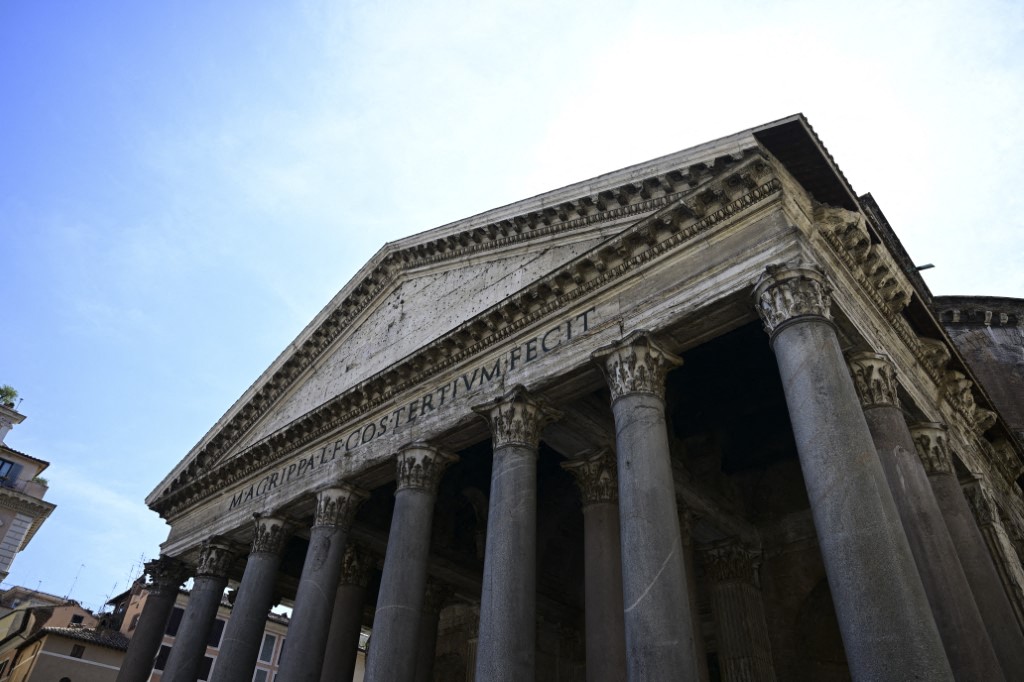
What do the Pantheon, the Burj Khalifa and the Shard have in common?
The answer is not architecture, height or Instagram appeal. It’s what’s holding them together.
They are made from concrete, which thousands of years after its invention, is still all around us. It forms our homes and schools, roads and bridges, hospitals, and skyscrapers. But producing cement, the ingredient that binds concrete together, comes with a substantial climate cost. Cement and concrete production account for around 8 per cent of global carbon dioxide emissions.
Clinker is the key ingredient in conventional Portland cement – and a major source of its carbon footprint. Producing clinker requires heating limestone and other raw materials to very high temperatures. Carbon dioxide is released both from the energy needed to generate that heat and, crucially, through the chemical transformation of limestone itself.
But clinker does not have to do all the work.
Blended cements reduce the amount of clinker needed by combining it with other materials with cementitious properties. Depending on where and how cement is produced, these can include fly ash, slag, natural pozzolans, calcined clay and limestone. Blended cements available today can produce up to 50 per cent fewer emissions per tonne than ordinary Portland cement, with comparable strength, durability and cost.
Using blended cements is taking on increased urgency. The Global Status Report for Buildings and Construction, produced by the United Nations Environment Programme (UNEP), finds that buildings and construction account for 34 per cent of global energy-related carbon dioxide emissions. Around half of the buildings expected to exist in 2050 have yet to be built – making the materials we choose to build them increasingly important.
Today, the climate benefits of blended cement are attracting increasing attention. But the underlying idea of combining materials to make concrete perform better is anything but new. Here are five remarkable buildings that bear that out.
1. The Pantheon: an ancient idea (Rome, Italy)
[p]Almost 2,000 years after it was completed, the Pantheon still has the world’s largest unreinforced concrete dome.
The Romans knew nothing about Portland cement, but they did know a thing or two about concrete.
Roman concrete, or opus caementicium, combined lime mortar with volcanic ash known as pozzolana. The builders also varied the aggregate through the structure, using progressively lighter materials higher in the dome.
The Pantheon is not an ancient example of modern blended cement. Instead, it demonstrates something more fundamental: builders have been exploiting the properties of pozzolanic materials to create strong, durable binders for millennia.
The chemistry has evolved enormously. The principle of looking beyond a single binding material has not.
2. Burj Khalifa: reaching 828 metres (Dubai, United Arab Emirates)
Building the world’s tallest tower is one thing. Getting the concrete up there is another. Rising 828 metres above Dubai, the Burj Khalifa required concrete that was exceptionally strong, durable and workable.
Engineers achieved this by combining Portland cement with supplementary cementitious materials, creating a high-performance blended cement system that could meet the project’s demanding requirements. Concrete had to be pumped vertically more than 600 metres during construction, setting a world record at the time.
The Burj Khalifa illustrates an important point about blended concrete: these materials are not used only for environmental benefits. They are also valued for the way they can improve concrete performance in some of the world’s most challenging construction projects.
London’s Shard is instantly recognizable for its glass façade and pointed silhouette.
The building’s extensive foundations used a cement blend containing 70 per cent ground granulated blast-furnace slag, a material derived from slag generated during ironmaking.
Using the slag helped limit the early heat generated as the foundation concrete cured, reducing the risk of thermal stresses in such large concrete elements. It also reduced the amount of Portland cement required.
The result sits beneath one of Europe’s most recognizable contemporary buildings: an example of a high proportion of supplementary material being used not despite demanding engineering requirements, but partly because of them.
At 541 metres, One World Trade Center presented engineers with extraordinary structural demands. Its reinforced concrete core forms the spine of the tower, carrying gravity loads while helping it withstand wind and seismic forces. It needed exceptionally strong concrete. But stronger didn’t simply mean more cement.
Its high-performance concrete mixes incorporated supplementary cementitious materials including fly ash, ground granulated blast-furnace slag and silica fume. Engineers also limited Portland cement in some mass-concrete mixes to help control the heat produced during curing.
The lesson is counterintuitive but important: reducing reliance on Portland cement does not automatically mean reducing performance.
5. Tilia Tower: the next generation (Lausanne, Switzerland)
Near Lausanne, a tower brings the story firmly into the present. Nearly two millennia after the Pantheon, the ingredients have changed considerably. The idea that one material doesn’t have to do all the work has not.
The 85-metre, 27-storey Tilia Tower is being built using limestone calcined clay cement (LC3).
The material replaces a large proportion of carbon-intensive clinker with two widely available materials: calcined clay and limestone.
That matters because it addresses cement emissions at their source. Less clinker means less limestone needs to undergo carbon-intensive calcination, and less high-temperature clinker needs to be produced.
LC3 can reduce carbon dioxide emissions from cement production by up to 40 per cent compared with traditional cement while maintaining the performance required for construction.
An old idea with new urgency
Experts say technical capability alone will not bring blended cement to scale. Standards and building codes can restrict which materials are used, while public procurement can help create demand for lower-carbon alternatives. Countries also need reliable supply chains for materials that can replace clinker.
Tackling those barriers is the focus of Blend Better Cement, a global campaign supported by the UNEP-hosted Global Alliance for Buildings and Construction and the Intergovernmental Council for Buildings and Climate, alongside partners.
With global warming accelerating quickly and the fallout of climate change spreading, experts say the push for blended cement must be part of a wider effort to make buildings more sustainable.
“All materials have a role to play, and all materials need to reduce their environmental impact,” says Gulnara Roll, Head of GlobalABC at the United Nations Environment Programme (UNEP). “That means looking across the whole life cycle of buildings: using fewer materials where possible, extending the life of what we already have, increasing reuse and circularity, and expanding responsibly sourced local, bio-based and other low-carbon materials. Blended cement is one important part of that transition.”
About the Global Alliance for Buildings and Construction (GlobalABC)
Founded at COP21, hosted by UNEP and with over 400 members, including 71 countries, the GlobalABC is the leading global platform for all built environment stakeholders committed to a common vision: A zero-emission, efficient, and resilient buildings and construction sector.[/p]
( Press Release Image: https://photos.webwire.com/prmedia/7/361388/361388-1.jpg )
WebWireID361388
This news content was configured by WebWire editorial staff. Linking is permitted.
News Release Distribution and Press Release Distribution Services Provided by WebWire.