

The EU Empowering Consumers for the Green Transition Directive (ECGT): what it means for travel and tourism
The sustainability certifications landscape has long been complex, and with the impending EU Empowering Consumers for the Green Transition Directive (ECGT or the Directive) coming into force on 27 September, accommodations, certifications and booking platforms are seeking greater clarity on how to prepare.
At Travalyst, the second iteration of our Certifications initiative aims to support relevant industry stakeholders in preparing for the requirements of the ECGT relating to sustainability labels before its implementation, by providing a mechanism for schemes to self-declare their compliance with the Directive.
We’re very grateful to Vedder for their legal counsel and support in the preparation of a guidance note as part of this iteration, and for their expert advice on shaping the Certifications initiative.
We asked Henrietta Worthington and Rachel Green from Vedder to share their insight on some of the most commonly asked questions about the Certifications initiative and the ECGT…
Vedder provides ongoing legal support to Travalyst. We have been advising various companies across industries and sectors in relation to the upcoming ECGT, so considering the application of the legislation to the accommodation sector and supporting Travalyst has been very rewarding.
Travalyst is playing a vital role in raising awareness of the upcoming requirements to its partners, stakeholders, certification schemes themselves, and the wider travel industry. Working across sectors, we are aware that many businesses remain unaware of the ECGT and how it may affect their operations. As a result, we have supported Travalyst by providing a practical guidance note detailing how companies may achieve compliance with the new regime. Travalyst has made this guidance note publicly available on its website as part of its role in supporting industry understanding of the ECGT.
There are three relevant points to highlight, being:
- Extraterritorial in nature: It has become clear that many international companies without an obvious EU nexus are yet to consider the applicability of the ECGT on their goods and services. However, it is important to note that it applies extraterritorially, and may affect any company which is doing business in the EU or marketing to consumers in the EU.
- Sector agnostic: The ECGT also applies across industries and sectors. The way in which companies may achieve compliance with the various requirements may vary between industries, which has exposed some difficulties in applying the requirements to certain sectors. We are hopeful that the EU will publish additional guidance to help specific industries navigate these complexities.
- Scope: The ECGT is intentionally broad and far reaching. We have been advising Travalyst specifically in relation to the ban on the use of sustainability labels that are not based on a “certification scheme”. However, the scope of the EGCT is even more broad (banning the use of generic sustainability claims, making claims about future environmental performance etc.) and companies should check how all of the requirements might affect their businesses.
What are the routes that certification schemes can take to achieve compliance with the ECGT?
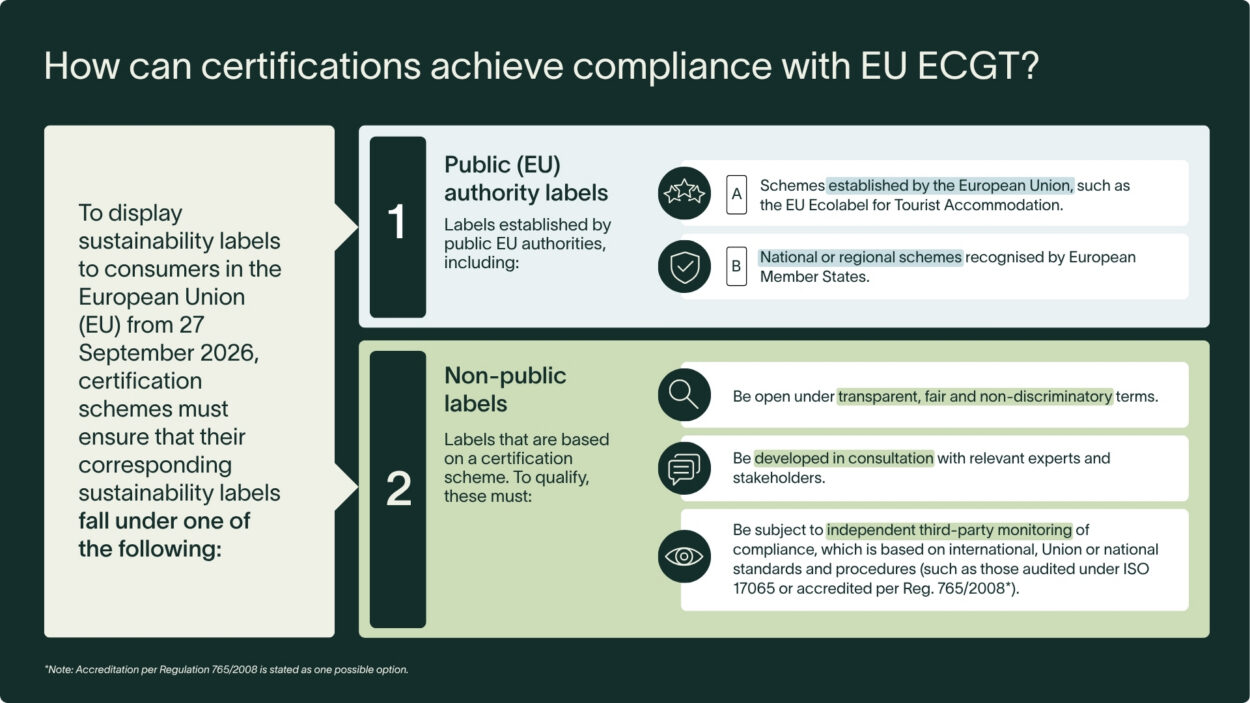
To achieve compliance with the ECGT, certification schemes and the sustainability labels they support must move away from self-declared or unverified claims. The Directive will ban the use of sustainability labels that are not (i) based on an ECGT-compliant certification scheme (the “Certification Scheme Route”) or (ii) established by a public authority (the “EU Public Authority Route”).
The Certification Scheme Route will require schemes to meet certain criteria which make up the ECGT’s definition of a “certification scheme”. To comply with these criteria, a certification scheme, upon which a sustainability label is based, must be a third-party verification system that is open to traders under transparent, fair and non-discriminatory terms. It must be managed by a scheme owner independent of both the trader and the third-party verifier, ensuring a clear separation of interests. Furthermore, the scheme must be based on criteria developed through a multi-stakeholder process and be easily accessible to the public in order to prevent misleading or unverified sustainability claims. For further details, please refer to our guidance note.
Labels which fall within the EU Public Authority Route are exempt from the ECGT definition of a “certification scheme” as they are already deemed to have a high level of credibility and have been subject to strict legal oversight. Examples include the EU Ecolabel (the official EU voluntary label for environmental excellence), as well as official labels established by EU Member States or regional governments and mandatory EU labels, such as the EU Energy Label and the EU Organic logo.
The European Commission’s “Questions & Answers”, originally published in November 2025 and updated in June 2026 (and from time to time), regarding the ECGT states that the approach set out in this requirement allows for “flexibility and adaptation to sector-specific or product-specific circumstances”. In short, there is an element of discretion as to how the third party monitoring procedure may be carried out, provided this does not fall short of the ECGT’s requirements in respect of competence and independence. In practice, satisfaction of the third-party auditing requirement will likely vary between sectors.
The ECGT does however provide some guidance as to how schemes can meet the third party auditing requirement, namely by demonstrating compliance with “relevant international standards”. This includes ISO 17065, which provides for periodic “surveillance” (i.e. monitoring) of products displaying a sustainability label to ensure the “ongoing validity of the demonstration of fulfilment” of product or process/service requirements. The Directive also refers to the mechanisms provided for in Regulation 765/2008, which offers a framework for using accredited, independent third parties to monitor trader compliance.
In short, the ECGT is designed to remove any means of self-certification and internal auditing procedures, and aims to ensure that schemes follow a structured, documented auditing process. In practice, there is still a lack of clarity regarding various elements of the auditing process, including, for example, the appropriate timeframe for audits. We anticipate that the future scrutiny and determination of the courts (and/or additional EU guidance) will be required to provide any certainty on various aspects of the ECGT.
Under the ECGT, the legal responsibility for ensuring a sustainability claim is accurate lies with the trader (for example, an accommodation provider) and the certification scheme itself. As the ECGT imposes legal requirements rather than voluntary industry standards, Travalyst acts as a repository for schemes’ own legal declarations of compliance.
In this context, Travalyst’s role is to support certification schemes and the broader travel industry in developing their awareness and understanding of the ECGT requirements and to provide them with the tools they need to self-declare their compliance. The Travalyst list of compliant schemes, which acts as a centralised registry of sustainability certifications that have self-declared their compliance with the ECGT, forms a key part of this initiative. However, it is important to note that this list should be viewed by consumers as a baseline for legal eligibility rather than a gold standard for compliance due to the fact that it relies on self-declaration rather than independent auditing.
The process of self-declaration and ensuring that traders have access to sufficient support and information needed to meet the ECGT criteria also ties in with the Directive’s focus on transparency and openness. The guidance for this requirement indicates that certification criteria should be publicly accessible online and set out in simple and unambiguous language, to enable all traders who are committed to meeting these conditions to apply for certification. In short, the more information there is available online about the certification process and requirements, the greater the likelihood of schemes being able to meet these criteria.
The aim of the ECGT with regard to sustainability labels is to increase the transparency and credibility of such labels and to provide clear and accessible information for consumers. In the accommodation industry it is likely that the impact will be:
Reduction in the number of operational schemesIt is likely that the number of operational schemes will reduce and consolidate as a result of the ECGT. While the Directive does not explicitly ban smaller schemes, it arguably creates a high barrier to entry that many currently operational schemes may struggle to meet. This reduction is likely to be driven by factors such as the end of self-auditing labels, as well as the cost of independent third-party auditing which may be prohibitive to smaller, niche or regional schemes.
Switching sustainability labelsWhile many organisations within the travel sector will undoubtedly make the switch to compliant sustainability labels, this is not necessarily the case across all industries. Their decisions are likely to be shaped by a strategic balance between legal need, cost and market access.
However, the competitive advantage of ECGT compliance (namely, the ability for organisations to market their certifications in the EU) is highly likely to be a key driver in leading hotels to move away from non-compliant schemes. The alternative option of remaining with unverified or ‘home-grown’ labels runs the risk of turning a sustainability claim into a legal and commercial liability.
The ECGT is designed to eliminate misleading claims, and increase consumer confidence. In the short term, uncertainties as to how to achieve compliance with various elements of the ECGT may lead to greenhushing. There are calls for the EU to provide further guidance as to how to comply with specific requirements. It is also likely that we will see some litigation in the coming years to receive clarity on certain interpretations. However, ultimately the ECGT will force businesses to review their sustainability claims and update their internal processes thereby increasing credibility, transparency and consumer confidence.
Find out more about our Certifications initiative and access further resources and guidance here.( Press Release Image: https://photos.webwire.com/prmedia/7/360660/360660-1.jpg )
WebWireID360660
This news content was configured by WebWire editorial staff. Linking is permitted.
News Release Distribution and Press Release Distribution Services Provided by WebWire.