

Earth observation satellites Copernicus Sentinel-3C and Earth Explorer FLEX successfully launched
Two satellites, one mission: protecting our planet
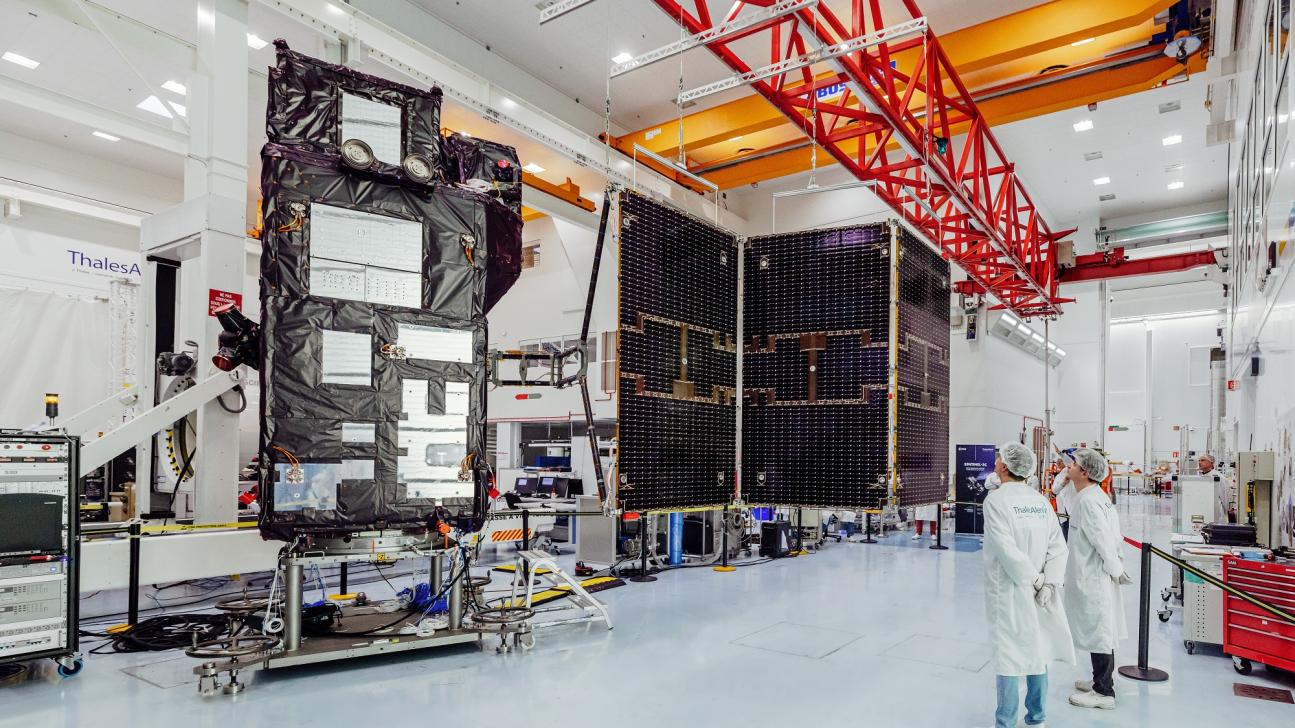
The Copernicus Sentinel-3C and Earth Explorer FLEX satellites, for which Thales Alenia Space – the joint company between Thales (67%) and Leonardo (33%) – is prime contractor, were successfully launched aboard a Vega C launcher from Europe’s Spaceport in French Guiana.
“I am delighted with the successful launch of these two satellites, which will provide unique data to scientists and policymakers to help understand climate change and preserve our ecosystems. They demonstrate Europe’s leadership in Earth Observation and are successful examples of collaboration within the European space sector in support of climate action.” said Hervé Derrey, CEO of Thales Alenia Space.
Sentinel-3C is an integral part of Copernicus, the world’s most advanced environmental monitoring program. This program is managed by the European Commission, funded by the EU and partially by the European Space Agency (ESA). It is jointly operated by ESA and EUMETSAT.
Sentinel-3C is the third satellite in the Copernicus Sentinel-3 mission, dedicated to monitoring the oceans and land surfaces. The Sentinel-3 satellites feature four state-of-the-art instruments which provide essential measurements on surface temperature, color and height of the oceans. The mission also supplies data on land surfaces, including vegetation, soil temperature, inland water quality (lakes, rivers), and fire detection.
With a launch mass of approximately 1,140 kg, Sentinel-3C will operate in low Earth orbit at an altitude of 814 km, with an operational lifespan of 7.5 years. It will join the Sentinel-3B satellite in orbit and continue the vital mission of providing images essential to understanding ocean currents, climate phenomena and the health of ecosystems.
FLEX (FLuorescence EXplorer) is a satellite in ESA’s series of innovative Earth Explorer missions. It will be the first to measure plant fluorescence from space with such a high degree of precision over vast territories. Data collected by FLEX and its instrument FLORIS, built by Leonardo, will further our understanding of how carbon moves between plants and the atmosphere, and of how photosynthesis affects the carbon and water cycles. With global warming and extreme climatic events – heatwaves, droughts, wildfires, winds, etc. – becoming ever more intense, the FLEX mission will help us to assess how climate change is impacting photosynthesis and, therefore, plant health and productivity. FLEX’s observations will help to optimize climate models, agriculture, and biodiversity monitoring.
Weighing approximately 400 kg, FLEX will operate in an 814-kilometre orbit, flying in tandem with one of the Sentinel-3 satellites. The mission’s operational lifespan in orbit is 3.5 years.
FLEX observations will be combined with those from Sentinel-3’s imaging spectrometer to correct for atmospheric bias and precisely quantify the level of fluorescence on the ground. Sentinel-3’s optical and thermal sensors will provide FLEX with complementary data on the plant’s environment. Data from both satellites will improve measurement accuracy, increase the temporal coverage of vegetation, and allow for a better interpretation of fluorescence within its environment.
A pan-European partnership
The Sentinel-3 mission illustrates the solid partnership between ESA, the European Commission, the European Organization for the Exploitation of Meteorological Satellites (EUMETSAT), industry, service providers and data users.
Thales Alenia Space in France, prime contractor for the satellites, is also responsible for developing two key instruments – the imaging spectrometer (OLCI) and the radar altimeter (SRAL) – as well as the platform. Thales Alenia Space entities in Spain, Belgium, and Italy are also involved. A consortium of more than 100 European companies contributed to the design and construction of the satellites, including Leonardo for the imaging radiometer (SLSTR) and Airbus Defence & Space for the microwave radiometer (MWR).
The FLEX mission illustrates the collaboration between ESA and the European space industry. Thales Alenia Space in France, prime contractor for the satellite, is also in charge of developing the platform, which also involves its Harwell and Belfast sites (United Kingdom) for the propulsion module and platform integration, Charleroi (Belgium) for on-board power management, Gorgonzola and L’Aquila (Italy) for the central computer’s processor board, and Madrid (Spain) for S- and X-band communications. A consortium of almost 40 European companies contributed to the construction of this satellite, including Leonardo, responsible for the high-resolution FLORIS imaging spectrometer that will map plant fluorescence, and Beyond Gravity, notably in charge of supplying the structures and thermal control for the platform and associated satellite engineering.
About Thales Alenia Space
Thales Alenia Space leverages a unique combination of skills, technological expertise, and industrial capabilities to deliver innovative solutions for telecommunications, navigation, Earth observation, defense, exploration, science, and orbital infrastructures— drawing on 50 years of proven experience. Institutions, governments, and private industry rely on Thales Alenia Space to design satellite-based systems that provide anytime, anywhere, connections and positioning, monitor our planet, enhance management of its resources, explore our Solar System, and unlock the mysteries of the Universe. Embodied by its Space for Life purpose, Thales Alenia Space sees space as a new horizon, helping build a better and more sustainable life on Earth, and beyond. A joint venture between Thales (67%) and Leonardo (33%), Thales Alenia Space also teams up with Telespazio to form the Space Alliance, which offers a complete range of solutions including services. Thales Alenia Space posted consolidated revenues of €2.36 billion in 2025 and has more than 8,000 employees in 7 countries with 14 sites in Europe. #spaceforlife www.thalesaleniaspace.com
( Press Release Image: https://photos.webwire.com/prmedia/7/360487/360487-1.jpg )
WebWireID360487
This news content was configured by WebWire editorial staff. Linking is permitted.
News Release Distribution and Press Release Distribution Services Provided by WebWire.