

£162 million boost for vital UK life sciences and materials research
EPSRC backs British science and engineering at two leading UK research institutes to develop new health tech and deepen understanding of advanced materials.
The Rosalind Franklin Institute and Henry Royce Institute will share just over £160 million of public funding from the UK government through UK Research and Innovation (UKRI) for the next five years.
This funding will help them build on their record of improving lives and driving growth.
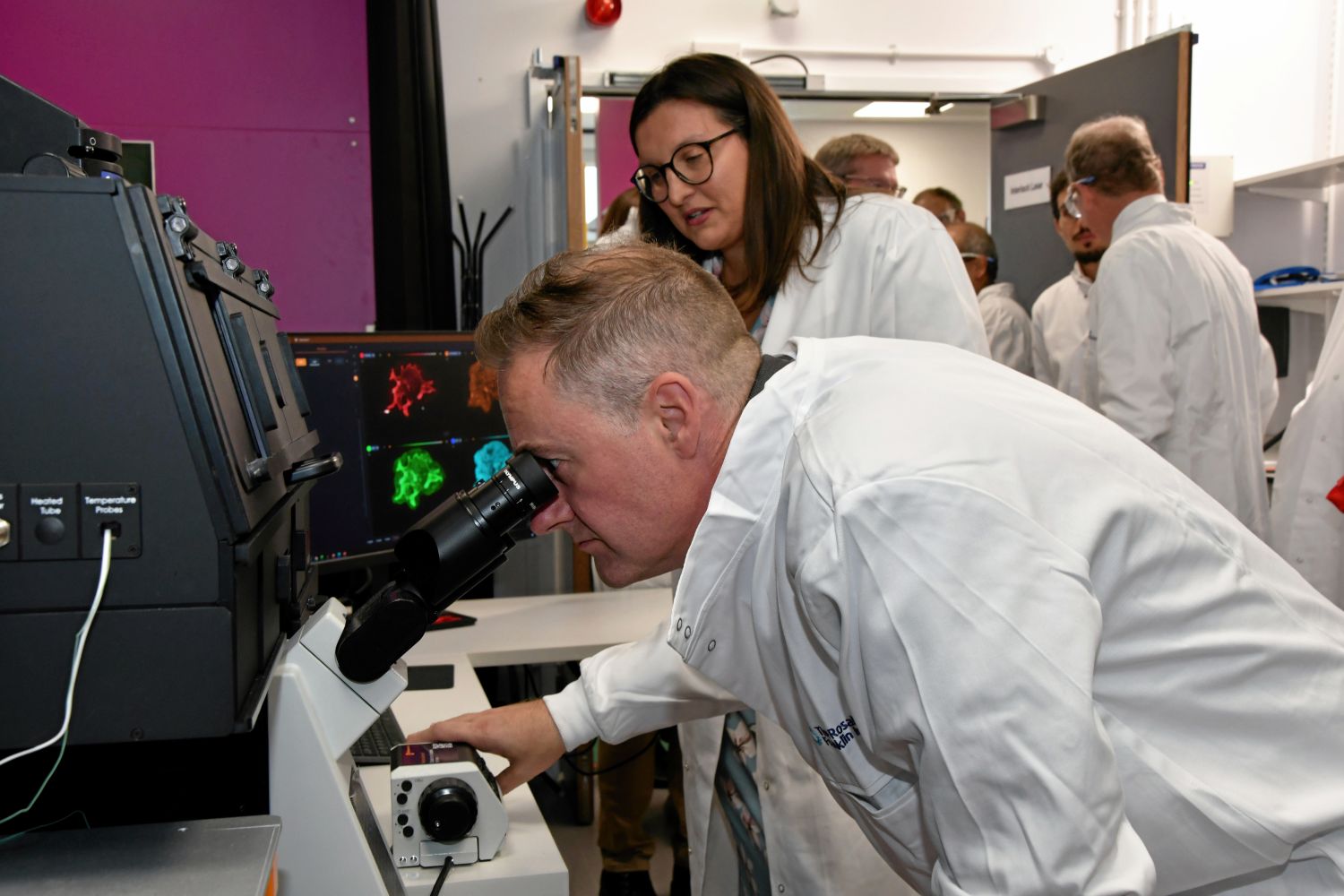
To mark the announcement, Science Minister Chris McDonald unveiled a new one-of-a-kind microscope at the Rosalind Franklin Institute.
It will allow researchers to see inside gut cells in far greater detail than ever before.
These insights will unlock new understanding of inflammatory bowel disease that could pave the way for new treatments for the one in 123 people living with the condition in the UK.
Pushing boundaries of knowledge
Science Minister Chris McDonald said:
We have world leading science research in the UK that pushes the boundaries of knowledge
It is the foundation of our mission to reindustrialise the country, creating good, well paid jobs by developing new technologies and growing British companies.
The Rosalind Franklin Institute and the Henry Royce Institute are world leading in their fields.
Combining biological knowledge, advanced physics and materials development to understand how the cells in our bodies function, and can be repaired and treated with precision medicines.
The research gives our country a competitive edge, so long as we commercialise it in industry.
Developing new medical technologies and treatments and bringing them to market is good for jobs and good for health, making a real impact on people’s lives.
World-leading institutes
From using llama antibodies to help combat COVID-19 to lighter, more powerful batteries, these two institutes are turning brilliant science into real-world impact.
Both were strongly recommended for continued funding after an independent review of their impact and the value they add to the research community.
Their world-leading facilities anchored at Harwell in Didcot and Manchester will provide new equipment and infrastructure for scientists, industry partners and businesses across the country.
The funding supports the government’s 10-year industrial strategy ambition of translating UK research into jobs, new investment and economic growth in every part of the country.
Driving growth
Executive Director for the Strategy Directorate at the Engineering and Physical Sciences Research Council (UKRI), Dr Kedar Pandya, said:
The Rosalind Franklin Institute and Henry Royce Institute have a proven track record of turning public investment into research that advances knowledge, improves lives and drives growth.
This continued funding from UKRI builds on that success.
It will give researchers the tools and resources to answer some of the biggest questions in the health and advanced materials industries, keeping the UK at the forefront of global science and engineering.
One-of-a-kind microscope
The Stimulated Emission Depletion (STED) microscope, unveiled by the Minister, operates at 10 times the resolution of conventional light microscopy.
Whereas a normal microscope shows the outer shapes of a cell, the STED microscope lets researchers see the fine structures and layers inside it.
The research team will use it to see how cells in the gut and other surfaces in the body behave when healthy versus when affected by disease.
Their new insights will help advance knowledge of chronic conditions like inflammatory bowel disease and gastric cancer.
Improving health pathways
This work builds on the Rosalind Franklin Institute‘s pioneering research in next-generation imaging, engineering, biology and diagnostics, which will benefit from a new £67.7 million investment.
During the COVID-19 pandemic, the Franklin team demonstrated their expertise when they found that tiny antibodies from llamas and alpacas, known as nanobodies, were capable of neutralising SARS-CoV-2 infections.
They proved their effectiveness in an animal model when administered as a nasal spray.
Professor Paul Matthews, Director of the Rosalind Franklin Institute, said:
We are delighted to have the strong endorsement of the UK government for our future plans.
The Franklin’s work over the next five years will build a new generation of imaging, chemistry and AI tools that let us see disease processes clearly enough.
From single molecules to whole organs, to identify disease earlier and confidently ‘drug the currently undruggable’.
Turning research into reality
The Henry Royce Institute will receive £95 million for research into advanced materials to help deliver the National Materials Strategy, launched in February 2026.
Royce’s battery development facility supported Molyon, a University of Cambridge spin-out, create a new generation of lithium-sulphur batteries.
These batteries are lighter, more sustainable and can store twice as much energy as current models.
The breakthrough helped Molyon raise $4.6 million in seed funding to bring the technology to market.
They have recently closed a second round of funding of more than £8 million to scale up high energy and power densities batteries.
Delivering new solutions
Through a partnership with The University of Sheffield’s academic and technical staff, Royce also supported MatNex to use artificial intelligence and machine learning models to design a new alloy.
The alloy could replace scarce rare-earth materials used in electric vehicles, wind turbines and other electrical equipment.
The project has since secured £700,000 in Innovate UK funding to expand the research.
Exciting new chapter
Professor David Knowles, CEO, Henry Royce Institute said:
This renewed UKRI investment marks an exciting new chapter for Royce.
I’m incredibly proud of how we’ve grown into a truly national capability for advanced materials research and innovation, connecting the UK’s world-class facilities and expertise with the needs of industry and wider society and raised the profile of materials putting at the heart of the UK Industrial Strategy.
Our next phase gives us the opportunity to build on this, with an even greater focus on translating materials innovation into real-world impact through our developing ‘lab to business’ platform.
We’ll be focused on accelerating promising new technologies, supporting their journey towards commercialisation and continuing to work with government to deliver the ambitions of the UK’s national materials innovation strategy.
We’re also delighted to enter this next chapter alongside our Sister Rosalind Franklin Institute.
Together, our institutes demonstrate the extraordinary value of sustained national investment in research infrastructure and expertise, focused on turning world-leading research into lasting economic and societal benefit.
With funding secured for the next five years, the Rosalind Franklin Institute and Henry Royce Institute are set to build on these achievements and drive new discoveries and innovations.
( Press Release Image: https://photos.webwire.com/prmedia/7/360465/360465-1.jpg )
WebWireID360465
This news content was configured by WebWire editorial staff. Linking is permitted.
News Release Distribution and Press Release Distribution Services Provided by WebWire.