

New LinkedIn Research Finds Women Account for Just 26% of AI Hires as AI Jobs Surge
AI is creating some of the fastest-growing and highest-paying opportunities in today’s labor market. In the U.S., AI job postings have roughly doubled since 2023, and the typical posting lists about $177,000 in compensation, compared with $80,000 for a non-AI role.
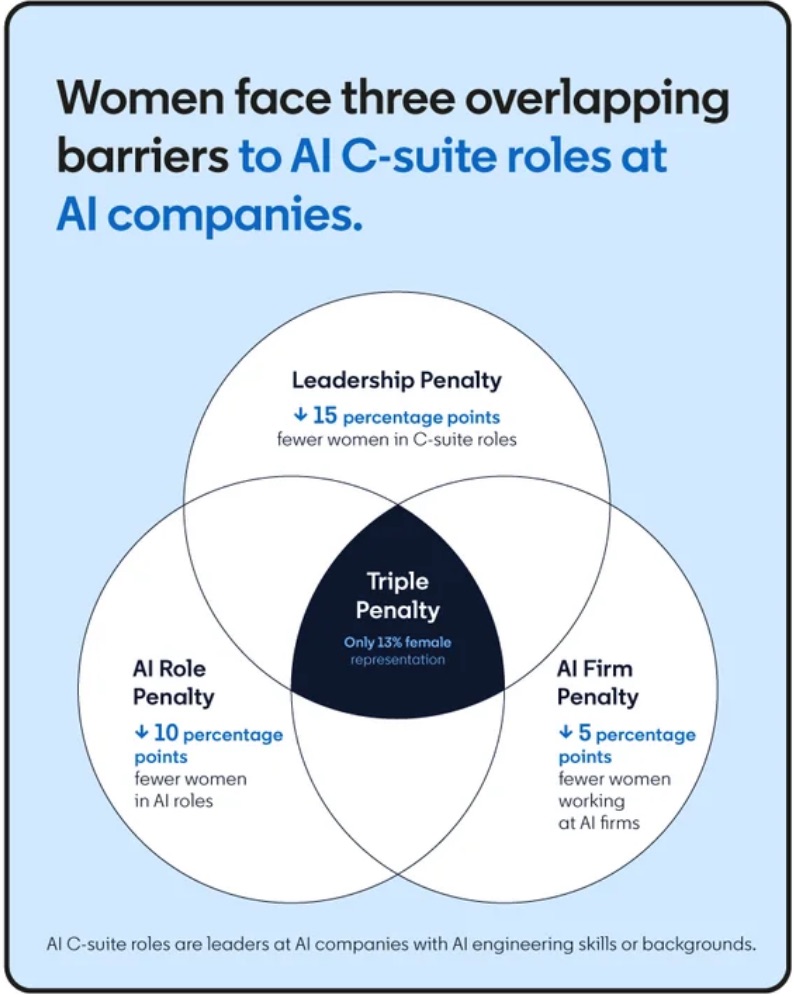
But women are far less likely to be hired into these opportunities. They accounted for just 26% of U.S. AI hires in 2025, compared with 50% of hires into non-AI occupations. The gap grows at the top: across 27 countries, women hold only 13% of C-suite AI leadership roles at AI companies.
New LinkedIn research examines both the rapid rise of AI jobs and the barriers that prevent those opportunities from reaching everyone equally. The findings suggest that while AI is becoming an increasingly important source of career growth and economic opportunity, women aren’t being afforded these opportunities.
Access to AI Opportunity is Uneven
AI is creating some of today’s fastest-growing and highest-paying jobs, but access to those opportunities is not evenly distributed. LinkedIn’s research finds gaps by both gender and education, particularly in some of AI’s highest-paying roles.
- Women accounted for just 26% of AI hires in 2025, compared with 50% of hires into non-AI occupations.
- Women’s representation is even lower in some of the highest-paying AI roles, including Head of AI (20%), Director of AI (26%), and Member of Technical Staff (18%).
- AI jobs also remain heavily concentrated among workers with college degrees. While 91% of AI workers hold a bachelor’s degree or higher, that share rises above 95% in many of the best-paid AI occupations, including Head of AI, Director of AI, and Member of Technical Staff roles.
Representation gaps don’t appear in just one place. LinkedIn’s research finds that women become less represented at multiple stages of the AI talent pipeline, with the biggest gap appearing at the leadership level.
- Women’s share in AI roles is approximately 10 percentage points lower than their share in non-AI roles.
- The AI company penalty: Women’s share of the workforce is approximately 5 percentage points lower at AI-focused companies than at comparable non-AI companies.
- The leadership penalty: The gender gap is approximately 15 percentage points wider for C-suite roles than for roles below the executive level
AI Job Postings Have Roughly Doubled Since 2023
AI hiring is growing quickly as companies put AI to work across their businesses, driving demand for workers with AI skills and expertise. But while AI is creating new opportunities, not everyone is benefiting equally. Women remain significantly underrepresented in these emerging roles, suggesting they aren’t being afforded the same access to some of the labor market’s fastest-growing and highest-paying opportunities.
- LinkedIn data finds that AI job postings have roughly doubled since 2023.
- AI Engineer has overtaken Machine Learning Engineer as the most common AI role on LinkedIn.
- VP of AI postings have increased roughly sixfold.
- Forward Deployed Engineer, a role focused on helping organizations implement AI solutions, is now the third most common AI occupation in job postings.
AI isn’t just creating new opportunities. Many of those opportunities are among the highest-paying jobs in today’s labor market. LinkedIn data shows that AI roles can command substantially higher compensation than non-AI roles, particularly in leadership and specialized technical positions.
- AI jobs typically pay more than double the compensation of non-AI jobs.
- The typical AI job posting lists approximately $177,000 in listed compensation, compared with $80,000 for the typical non-AI role.
- Some of the highest-paying AI occupations include Head of AI, Director of AI, and Member of Technical Staff roles.
LinkedIn’s Research:
FAQs
How quickly are AI jobs growing?
LinkedIn research finds that AI job postings in the U.S. have roughly doubled in recent years, making AI one of the fastest-growing segments of the labor market.
Do AI jobs pay more than non-AI jobs?
Yes. AI jobs typically pay more than double non-AI jobs. The typical AI job posting lists compensation of approximately $177,000, compared with approximately $80,000 for non-AI positions.
Who is benefiting most from AI hiring growth?
Workers in AI occupations are benefiting from strong demand and higher pay, though access remains uneven. Women and workers without four-year degrees are less represented in many of the highest-paying AI roles.
Why does representation in AI matter?
As AI becomes a larger driver of job growth, wages, and economic value creation, access to AI careers increasingly shapes who benefits from those opportunities. LinkedIn’s research suggests that expanding access will be an important challenge for employers, educators, and policymakers in the years ahead.
Are these findings based on the same dataset?
No. The AI Talent Divide analysis examines AI job growth, compensation, hiring, and education trends in the U.S., while the AI leadership analysis examines women’s representation in AI roles, AI-focused companies, and AI leadership positions across 27 countries. Together, the studies provide a broader view of who is benefiting from the growth of AI opportunity.
Join the Conversation:
Methodologies:
This analysis is based on LinkedIn platform data covering member employment histories across 24 countries and U.S. job postings listed between 2023 and 2026.
- CXO & AI Talent Analysis: Evaluates companies with at least 50 LinkedIn members in selected global markets. AI talent is defined as members holding current or former AI-classified occupations or demonstrating at least two AI engineering skills, while AI firms are identified as organizations where AI talent comprises at least 10% of the workforce.
- Job Posting Pay Analysis: Analyzes U.S. LinkedIn job postings, utilizing both system-extracted and poster-provided compensation data. All pay figures are normalized to annualized values, with range midpoints calculated from reported pay minimums and maximums to control for outliers using percentile-based metrics.
( Press Release Image: https://photos.webwire.com/prmedia/7/359163/359163-1.jpg )
WebWireID359163
This news content was configured by WebWire editorial staff. Linking is permitted.
News Release Distribution and Press Release Distribution Services Provided by WebWire.