

What Happens When the Things We Feel Are Finally Acknowledged?
What can feel strangely heavy in private can feel different once it is recognised. “Emotional Documentation” gives everyday emotional experiences a name, a record and the acknowledgement they rarely receive.
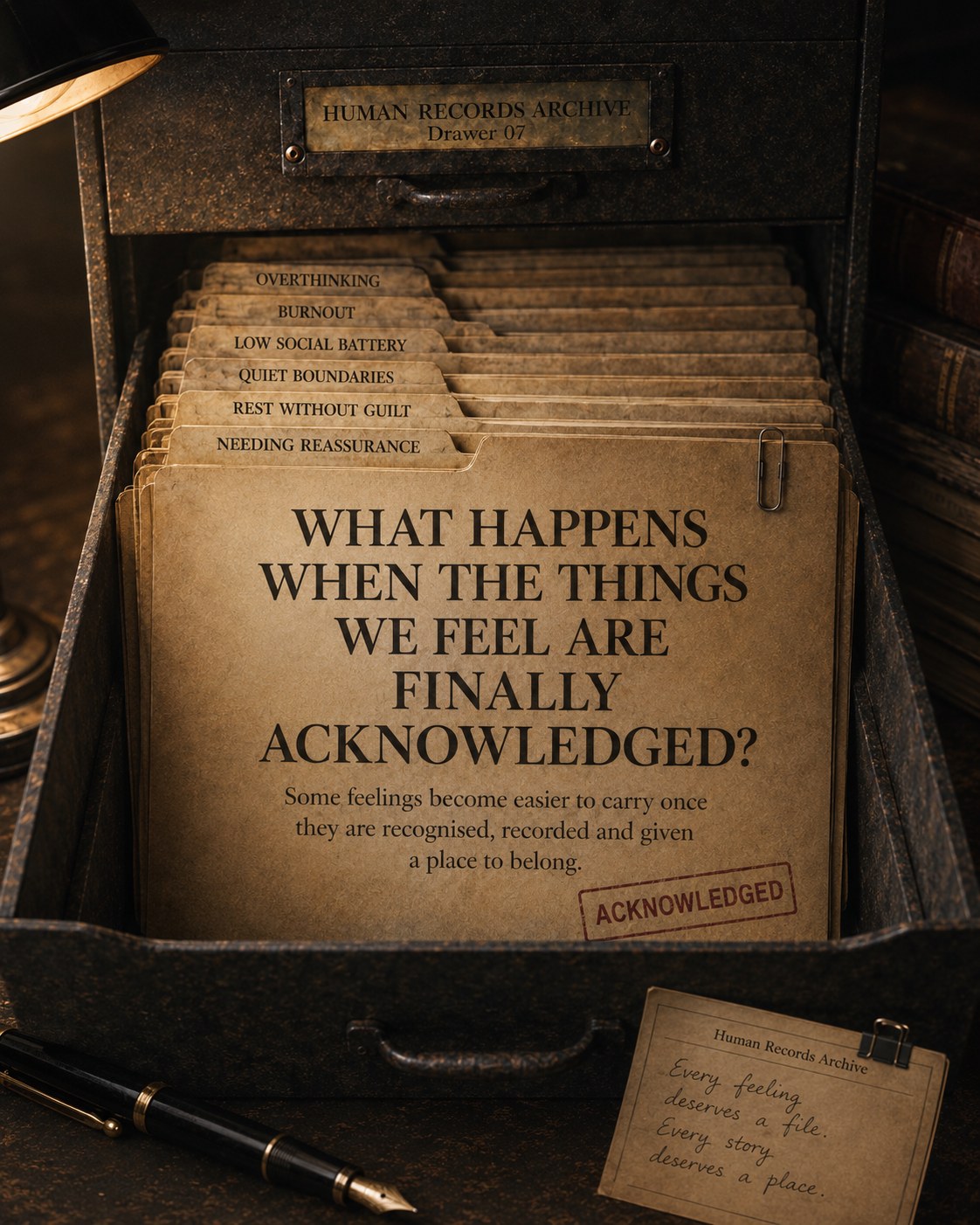
“Once an experience is named, catalogued and acknowledged, it can become a little easier to carry.” - Camelia Sandu
Modern life has produced some remarkably specific habits. People reread perfectly normal messages looking for hidden meaning. They write a reply, delete it, rewrite it, remove the exclamation mark, put it back, then decide tomorrow is a more emotionally qualified day to respond. They make plans because they genuinely want to see people, then halfway through the evening begin craving complete silence. They say “no” to something perfectly reasonable and spend the next half hour wondering whether they have somehow become a terrible person.
These moments may look small from the outside. To the person living them, they often aren’t. They can take energy, restraint, courage, patience or simply far more emotional effort than anyone else can see. Yet most pass through ordinary life without any real acknowledgement at all.
That is the premise behind “Emotional Documentation: Formal Records for Overthinking, Burnout and the Things You Don’t Say Out Loud,” a book by Camelia Sandu, writing as Luna Skye.
Instead of treating these experiences as problems requiring another self-improvement programme, the book gives them something much simpler: recognition.
Through the fictional Human Records Archive, ordinary human experiences are formally entered onto the record. Inside are notices, statements, records, declarations, certificates and incident reports for low social battery, delayed replies, quiet boundaries, rest guilt, invisible effort and the curious ability to appear completely functional while mentally operating seventeen open tabs and one unexplained alarm.
“Some experiences carry more weight when they have nowhere to go,” said Sandu. “Once they are named, catalogued and acknowledged, there is something validating about seeing them recognised. They begin to feel a little lighter to carry.”
That idea sits at the centre of “Emotional Documentation.” Not every experience needs fixing. Not every feeling needs to become a lesson or a project. Sometimes what matters, is having it acknowledged:
- It happened.
- It was acknowledged.
- It became a little easier to carry.
And perhaps there is a particular kind of relief in discovering that something which felt uniquely personal already has a file waiting for it.
“Emotional Documentation” is now available on Amazon.
( Press Release Image: https://photos.webwire.com/prmedia/106881/358865/358865-1.jpg )
WebWireID358865
 Emotional Documentation
- Overthinking And Burnout
- Low Social Battery
- People Pleasing
- Book For Overthinkers
- Contact Information
- Camelia Sandu
- Author
- Camelia Sandu
- info@inkstoryhub.com
This news content may be integrated into any legitimate news gathering and publishing effort. Linking is permitted.
News Release Distribution and Press Release Distribution Services Provided by WebWire.