

Building the New: How a Lyme Patient Advocate Landed in the NIH Director’s Office
Inside a push to strengthen scientific integrity, transparency, patient engagement and peer review across NIH
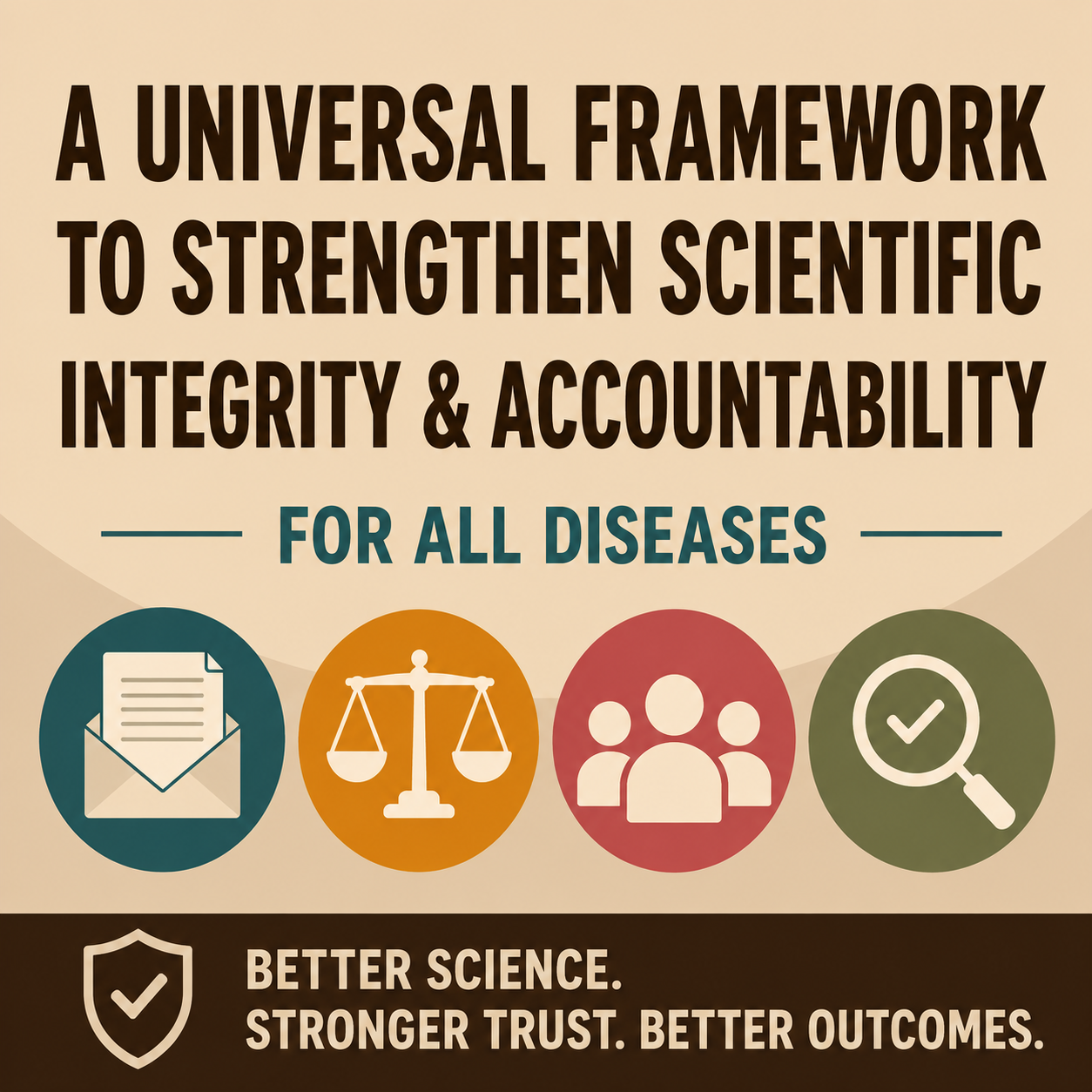
The framework embraces the principles of “gold standard science”: research that is reproducible, transparent, skeptical of its own conclusions, and free from conflicts of interest
At 7:00 a.m. on Monday, March 16, 2026, Bruce Fries, President of the Patient Centered Care Advocacy Group, emailed NIH Director Dr. Jay Bhattacharya with a comprehensive proposal: Strengthening NIH Research Standards: A Framework for Scientific Integrity, Transparency and Stakeholder Engagement.
Eighty minutes later, Bhattacharya wrote back himself, thanking Fries and asking to meet. Four days later, Fries was in the Director’s office at NIH headquarters, just the two of them, talking about how NIH decides what gets studied, who gets funded, and how patients benefit.
The proposal recommends ten standards governing scientific integrity, conflicts of interest, transparency, patient engagement, and peer review across NIH’s intramural and extramural research programs. It grew out of decades of Lyme disease advocacy, but its recommendations affect every disease NIH researches.
The View from the Director’s Chair
Jay Bhattacharya became NIH’s 18th Director in April 2025 after a distinguished career as a Stanford physician, health economist and researcher who has published more than 170 papers in peer-reviewed journals, according to his official NIH biography. Known for championing scientific rigor and transparency, he has made replication and reproducibility major priorities at NIH.
Those priorities provided common ground for the meeting, which quickly moved from the principles behind the proposal to the machinery that determines how NIH research gets funded.
Bhattacharya walked Fries through the grants review process from his own vantage point, a year into the job. Bhattacharya said that reading the email at all had been something of a fluke. Anything arriving after 7 a.m., he explained, gets routed through an administrative group first and could take a month or more to reach him, if it reaches him at all.
Fries raised a concern he had heard for years from tick-borne disease researchers: that peer review panels evaluating Lyme disease grant applications tend to draw heavily from scientists who have previously received NIH funding, while researchers and clinicians with specialized expertise or different perspectives on persistent and complex tick-borne diseases are rarely represented.
Bhattacharya told Fries that any requirement limiting reviewers to previous NIH grant recipients, if it ever existed as formal policy, is no longer in effect.
“That was an important distinction,” Fries said. “The problem may not be formal NIH policy. It may be how the system operates in practice. That is exactly the kind of gap the proposed standards are designed to address.”
The framework calls for open recruitment, term limits, stronger conflict-of-interest safeguards, and greater transparency in the peer review process.
What Lyme Disease Taught Him
Asked about his background, Fries explained how his own experience with Lyme disease had led him into patient advocacy.
“My own experience showed me what can happen when patients with complicated illnesses fall between the cracks of the medical and research establishments,” Fries said. “But I was fortunate. What ultimately motivated me was knowing how many patients are less fortunate and don’t have the resources to keep searching for answers.”
Fries told Bhattacharya that his advocacy began with the Mayday Project, organizing protests against the Infectious Diseases Society of America (IDSA) over its Lyme disease treatment guidelines and later directing that pressure toward the CDC for giving those guidelines preferential treatment.
Bhattacharya remarked that he had always thought of IDSA as something like a country club.
Fries said the deeper concern was what he described as industry capture among some of the panelists who developed guidelines maintaining that two to four weeks of antibiotics successfully treat nearly all cases of Lyme disease. Advocates have long challenged the IDSA guidelines for conflicts of interest, excluding competing scientific and clinical perspectives, discounting evidence of persistent infection after recommended treatment, and failing to adequately address patients who remain seriously ill.
Advocates have also argued that the guidelines’ influence extends far beyond a scientific disagreement. Because they have shaped clinical practice and coverage decisions, Fries said, patients whose illnesses do not fit the guidelines’ narrow framework can be misdiagnosed, dismissed, and denied coverage for medically necessary treatment. The controversy has extended to congenital Lyme disease, where advocates have challenged guideline statements they say conflict with published evidence of transplacental transmission and adverse pregnancy outcomes.
Those battles remained important, but they also reinforced a broader lesson: effective advocacy requires not only challenging what isn’t working, but developing credible alternatives and working with people inside the system to put them into practice.
Fighting the Old vs. Building the New
Fries shared a quote attributed to Socrates that helped crystallize that philosophy: “The secret of change is to focus all of your energy not on fighting the old, but on building the new.”
Bhattacharya smiled at the quote, Fries recalled, and it seemed to resonate with him.
“For a long time, much of Lyme advocacy was about fighting the old,” Fries said. “But eventually I came to believe we also had to put more energy into building something better. That means doing the homework, developing credible alternatives, bringing researchers and other stakeholders into the process, and getting workable solutions in front of the people who actually have the authority to act.”
That philosophy became the foundation of the NIH research standards proposal.
From a Lyme Disease Proposal to a Disease-Agnostic Strategy
The initiative began as a much narrower proposal to replace NIH’s intramural Lyme Disease Studies Unit with a broader Tick-Borne Disease Studies Unit.
A unit covering the broader range of tick-borne infections could study coinfections in combination, develop diagnostics capable of detecting multiple pathogens, and devote greater attention to serious tick-borne diseases that fall outside a narrow Lyme disease research structure.
But as the proposal underwent review, a fundamental limitation became clear: it focused entirely on NIH’s intramural research program while leaving the much larger extramural research system, where most NIH research funding is awarded, untouched.
According to NIH’s budget reporting, intramural research conducted in the agency’s own laboratories accounts for only about 11 to 12 percent of NIH’s research spending; roughly 82 percent supports extramural research conducted at universities and other institutions, though a significant portion covers facilities and administrative costs rather than direct research.
“That was the turning point,” Fries said. “If the underlying problems exist across NIH, the solution should establish standards that apply to all NIH research.”
The proposal was rebuilt as a disease-agnostic framework covering both NIH’s intramural research programs and the much larger extramural grant review system.
Rather than asking NIH to create special rules or protections for Lyme disease, it asks the agency to establish consistent standards for scientific integrity, conflicts of interest, transparency, patient engagement, and peer review across its research enterprise.
The disease-agnostic approach also creates common ground across disease communities, allowing advocates to support the broader framework while proposing additions specific to their own conditions.
Ten Standards for Stronger Research
The resulting framework proposes ten standards, five addressing NIH intramural Studies Units and five addressing extramural grant review, organized around five broad themes:
● Patient engagement: Give patients and other stakeholders a meaningful role in setting research priorities.
● Peer review: Broaden recruitment of qualified reviewers and establish term limits so the same voices do not dominate the process indefinitely.
● Conflicts of interest: Strengthen disclosure and management of financial and professional conflicts among researchers and reviewers.
● Independent oversight: Require regular independent review of research programs, priorities, and performance.
● Transparency and accountability: Improve public reporting and strengthen consideration of disease burden when research priorities and funding decisions are made.
The framework embraces the principles of “gold standard science”: research that is reproducible, transparent, skeptical of its own conclusions, and free from conflicts of interest—principles that closely align with Bhattacharya’s call for a “replication revolution” in biomedical research.
The framework also draws on findings from HHS Office of Inspector General reports examining NIH peer reviewer vetting and NIH oversight of outside research institutions, providing independent support for concerns that extend beyond any single disease community.
The framework itself was built collaboratively, going through months of review and revision with input from advocacy leaders, researchers, physicians, and government officials. Their feedback helped transform what began as a Lyme-specific proposal into a broader framework intended to benefit patients across disease communities.
Where It Goes from Here
Nearly thirty minutes had passed before the meeting began to wrap up. Fries thanked Bhattacharya for his time and offered to serve as a resource going forward.
Before leaving, he asked for a photo. Bhattacharya said he was good at selfies, took the iPhone and framed the photo himself. In the shot, Fries was holding a folder containing a Center for Lyme Action proposal asking HHS to recognize May as Lyme and Tick-Borne Disease Awareness Month.
“Is that for me?” Bhattacharya asked. He had already told Fries that “Bobby,” HHS Secretary Robert F. Kennedy Jr., would be the point person since the awareness month campaign would need support and coordination across multiple agencies.
“It was a brief moment, but it meant something to me,” Fries said. “Patient advocates spend a lot of time trying to get the attention of institutions that can seem impenetrable. Four days earlier I had never met Dr. Bhattacharya. Now we were sitting together talking about ways to improve biomedical research for patients.”
The framework is now before NIH leadership, and the effort is expanding beyond Lyme disease. Collaborators from a range of disease communities are sending their own letters to Director Bhattacharya, urging him to adopt the framework, proposing additions relevant to their conditions, and expressing support for his replication revolution and commitment to gold standard science.
“That’s where things stand,” Fries said. “Ten proposed standards, developed from lessons learned through Lyme disease advocacy but designed to benefit every disease NIH researches, are now before a Director whose priorities align closely with them and who has the authority to put them into practice.”
“Patient advocacy has always required both challenging what isn’t working and working with people inside the system to make it better,” Fries said. “Building the new means taking that a step further: doing the homework, developing credible alternatives, and putting workable solutions in front of the people who have the authority to act.
Read the framework:
Strengthening NIH Research Standards: A Framework for Scientific Integrity, Transparency and Stakeholder Engagement
About the Patient Centered Care Advocacy Group
The Patient Centered Care Advocacy Group works to advance evidence-based health care policy for individuals and families affected by complex and under-recognized diseases, including tick-borne illnesses.
( Press Release Image: https://photos.webwire.com/prmedia/48616/358724/358724-1.png )
WebWireID358724
 Nih
Nih- Contact Information
- Bruce Fries
- President
- Paitent Centered Care Advocacy Group
- Contact via E-mail
This news content may be integrated into any legitimate news gathering and publishing effort. Linking is permitted.
News Release Distribution and Press Release Distribution Services Provided by WebWire.