

How to Build Global Mineral Governance for Future Generations
Neither Yanacocha nor Kiruna is a critical-minerals operation. In Cajamarca, Peru, Yanacocha, South America’s largest gold mine is being extended toward copper through a proposed expansion, pitched on a metal the energy transition runs on. In Kiruna, Sweden, the world’s largest underground iron-ore mine is being repositioned around Europe’s largest known rare-earth deposit, pursued with equal urgency. Two established mines, with two initially non-critical commodities, and now with two proposed critical-mineral futures — one in the Global South, one in the Global North. Both advanced under the same auspices: development and the energy transition.
That pursuit reached the top of global politics, when the UN convened its first High-Level Meeting on critical energy transition minerals. The latest milestone in a years-long arc of UN work, from the Secretary-General’s 2024 Initiative on energy transition minerals, now coordinating system-wide action.
On a global scale, minerals are increasingly framed as either a security problem or a development opportunity — a $2 trillion opportunity, to be exact. These framings matter because they determine what counts as a solution. If minerals are a security problem, the answer is more of them, faster, from friendlier jurisdictions. If they are a development problem, the answer is to extract more and capture value at home. But if the problem is justice, the solution is entirely different. One that is referred to but never articulated.
Not All Sustainability is Understood Equally
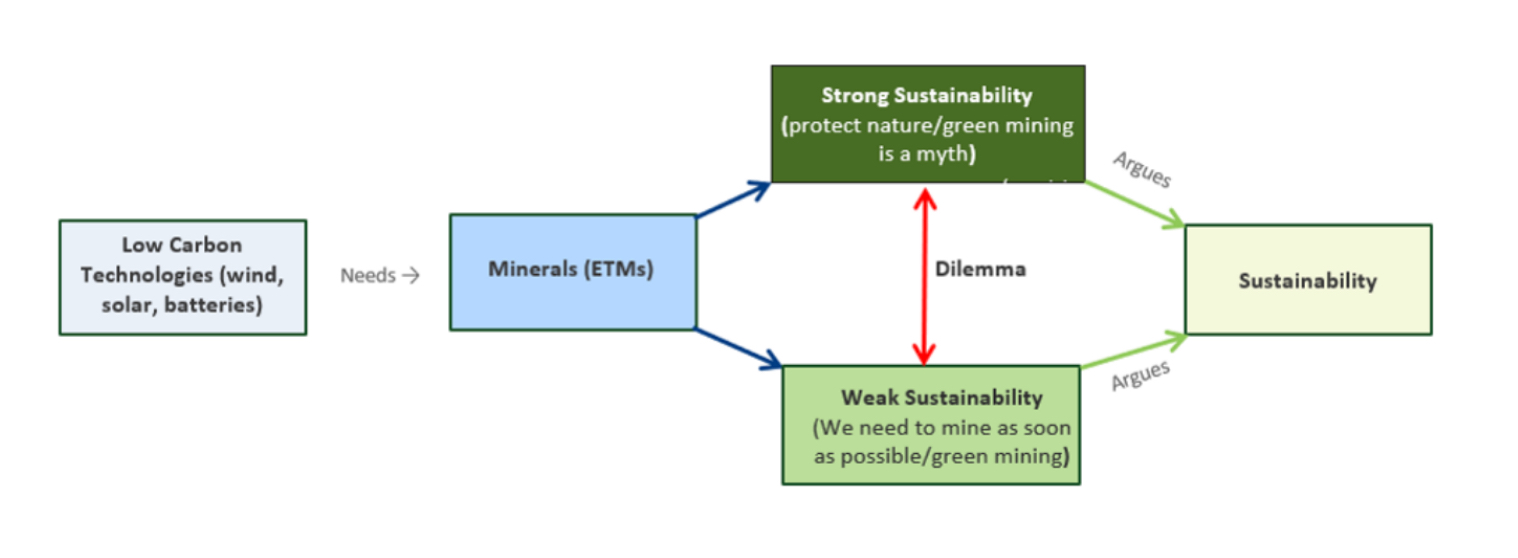
Work in this space for a few years and two broad camps emerge. In the halls of power, the common view holds that reaching net-zero requires massive amounts of so-called critical raw materials and that with responsible mining, better technology and due diligence, we can do mining “right”. Even many sustainability advocates treat a steep scale-up of extraction as the unavoidable price of decarbonisation. This is the paradigm of weak sustainability, which assumes natural capital can be substituted or offset.
However, “green mining” means little to Indigenous Peoples and local communities facing expropriation, watching their water sources be polluted, or risking criminalisation, or worse, murder for opposing a mine promoted in the name of “national security.” For these frontline defenders, s trong sustainability is often preferred: natural capital cannot be substituted, and the demand itself must be questioned.
These are archetypes, of course, and neither the corridors of power nor the communities on the ground are monolithic. Both camps do claim to champion sustainability, but they are arguing from opposite ends of the spectrum.
The Dead End of Current Global Policies
Zoom out at a global scale, and a further two strategies to resource governance emerge: one in high-income countries (HICs), and one in the producer countries, mainly low-and middle-income countries (LMICs). Yet, they both rest on a fatal assumption.
One strategy in producer countries in the Global South is to rightfully pursue “value addition”—processing and refining minerals locally rather than exporting raw ore. The G20’s Critical Minerals Framework champions this approach to create local jobs and lift export revenues. While this is a necessary correction to centuries of raw-export dependence, it is not a cure.
There’s little doubt that value addition will generate higher margins per tonne, but it does not alter who dictates the total volume, as demand remains tethered to HIC overconsumption. Yet this strategy only works as leverage when a country holds overwhelming commodity dominance, like Indonesia does with roughly half of global nickel production. However, for the long tail of producers, the threat to “process here or no ore” lacks credibility, since a price-taker in a market with many suppliers cannot withhold ore, because buyers will simply source it elsewhere. Even when successful, the added value is often captured by foreign-owned smelters. Without guaranteed tech transfers, these facilities are frequently coal-powered and locally polluting. Meanwhile, any surge in export revenue is just as likely to be undermined by debt servicing, white elephants, or elite capture.
Conversely, critical raw materials (CRMs) policies in HICs are racing to secure supply, challenging permitting rules and rolling back biodiversity protections. The G7’s recent declarations celebrate hundreds of new projects to diversify extraction away from China. The EU’s Critical Raw Materials Act aims to fast-track permits, overriding the safeguards frontline communities are owed. The United States has gone even further, implementing a web of tariffs on CRMs, taking equity in producers, and guaranteeing floor prices. China, in turn, answers with successive export controls on rare earths and other critical metals.
The Intra- and Intergenerational Justice Dilemma
The consequences of this unchecked rush are starkly unequal. The top 20% of the global population, ranked by per capita metal stock, commands roughly 60% to 75% of the world’s total metal wealth, while the bottom 20% holds a mere 1%. To close this gap and secure basic development, LMICs must inevitably increase their material consumption.
Yet, this rightful demand for equity collides with a harsh ecological reality. Humanity has already breached seven of the nine planetary boundaries, pushing biosphere integrity deep into the danger zone. Scaling up the mining required to feed this development threatens to push the planet further into the red. Compounding this injustice, these critical mineral deposits are disproportionately located on Indigenous lands, which host 54% of all related extraction projects, exacerbating the risks for frontline communities already facing intense state and corporate pressure.
We are navigating a profound intra-and intergenerational justice dilemma, because not only do we need these materials now but if we get it wrong the ultimate burden of these decisions falls upon people who are yet unborn.. Are we building a future where atmospheric cleanup is achieved through the sacrifice of vital biodiversity and Indigenous cultures? Or a world that failed to arrest global warming, leaving the Global South disproportionately impoverished?
A Dual Solution for a Global Materials Governance
Building a truly sustainable global mineral governance requires moving beyond the false choice between techno-optimistic extraction and anti-extractivism that leaves little room for development. The answer lies in a dual strategy, where both halves act as preconditions for one another.
1. Demand-Side Sufficiency in the Global North
HICs must cut their need for minerals through design and lifestyle shifts. Following the IPCC hierarchy (avoid, shift, improve), we must avoid unnecessary needs, shift to lighter ways of meeting them (like public transit over cars), improve efficiency and circularity, and only then consider supply. Yet present policy inverts this sequence and racing to expand supply and squeeze efficiency while the two highest-priority levers, avoid and shift, stay empty.
The evidence is already in. Downsizing EV batteries alone could cut material demand by 28% by 2035. When combined with a systemic shift to public transit, models demonstrate a slash of around half of lithium demand is possible. Furthermore, sobriety scenarios like France’s NégaWatt demonstrate that prioritising rail and reducing overall energy use prevents the catastrophic copper and lithium spikes projected by techno-optimist models.
Crucially, this reduction must also be driven democratically. Citizen assemblies, not industry lobbyists, should help develop binding material-footprint targets. Evidence from European citizen assemblies show that when citizen assemblies are given the power to create policies, they recommend vastly more sufficiency than national energy plans.
2. Democratic Governance in the Global South
In producer countries, extraction must be subject to public, transparent, and rights-respecting governance.
At the extraction-site scale, Indigenous Peoples and local communities are not mere stakeholders to be consulted, but rights-holders who must grant Free, Prior, and Informed Consent (FPIC). Artisanal miners must be formalised and brought up to decent standards rather than criminalised or excluded, and workers guaranteed a just transition.
However, democratic governance must also operate at the macroeconomic scale to break the “resource curse.” Treating finite mineral wealth as regular annual revenue invites corruption. Instead, proceeds must be channelled into a sovereign and permanent Intergenerational Wealth Fund. Crucially, this fund must finance Universal Basic Services (UBS) or Universal Basic Income (UBI) through diversified investment returns, not direct per-tonne extraction royalties.
This structural decoupling is vital, as it prevents the perverse incentive to endlessly mine more just to keep the checks flowing. Once the fund reaches a sustainable yield, it guarantees public well-being independently of new extraction. This financial security rewrites the social contract. When a community’s basic needs are already met, they are no longer forced by desperation to accept destructive deals, materially empowering them to demand strict environmental safeguards, insist on high-value processing with leverage, or simply say “no.”
The Synergy of the Dual Strategy
To achieve this, neither strategy will work alone. Demand reduction in the North without cooperation and governance transformation in producer countries will simply export recession to economies dependent on export s. Conversely, democratic governance in the producer countries without demand reduction in the North would be overwhelmed by a frantic, overheated market cutting deals with autocrats or corrupt politicians to get the ore.
Yet together, they unlock each other. Sufficiency calms prices and lifts the emergency, creating the political space for producer countries to govern democratically without being punished by the market. In turn, democratic governance ensures that this eased pressure translates into lasting, equitably shared wealth rather than a squandered boom. When HICs consume less, the worst projects are no longer load-bearing and can be declined, and the minerals we do extract can be reserved for genuine needs.
More importantly, the dual strategy cannotwork while producers are bled by debt servicing and conditional external finance. Kaboub and Chiriboga’s companion Roadmap profile on debt (5.1) supplies the enabling third pillar that works in synergy with the inter-and intragenerational justice (IIJ) framework: freed fiscal space is what lets a country invest in value-addition, build the fund, and/orsimply say no.
Redefining Economic Development
These questions are echoing at the highest levels of the UN. In his July 2024 report to the Human Rights Council, Olivier De Schutter, then Special Rapporteur on extreme poverty and human rights, argued that the growth-centric model has failed. This culminated in the June 2026 Roadmap for Eradicating Poverty Beyond Growth, co-constructed with the New Economies for Eradicating Poverty (NEEP) network. The Roadmap’s ecological-justice pillar explicitly develops the IIJ framework for the democratic governance of energy-transition minerals to overcome this justice dilemma.
Those who come after us cannot lobby or march for their rights, they will simply live inside whatever we decide in the next ten years. As De Schutter noted when the Roadmap launched, “Poverty is not inevitable; it is manufactured. And if governments can manufacture poverty, they can also dismantle it.”
We already know how to leave a living earth and a fairer one or future generations. The only work left is the mechanisms to do it and to do it in time to pass down, at last, something worth inheriting.
( Press Release Image: https://photos.webwire.com/prmedia/7/358556/358556-1.jpg )
WebWireID358556
This news content was configured by WebWire editorial staff. Linking is permitted.
News Release Distribution and Press Release Distribution Services Provided by WebWire.