

Naïve Raises $28.5M Series A to Build Autonomous Company Infrastructure
Naïve’s unified API gives AI agents everything they need to run entire businesses
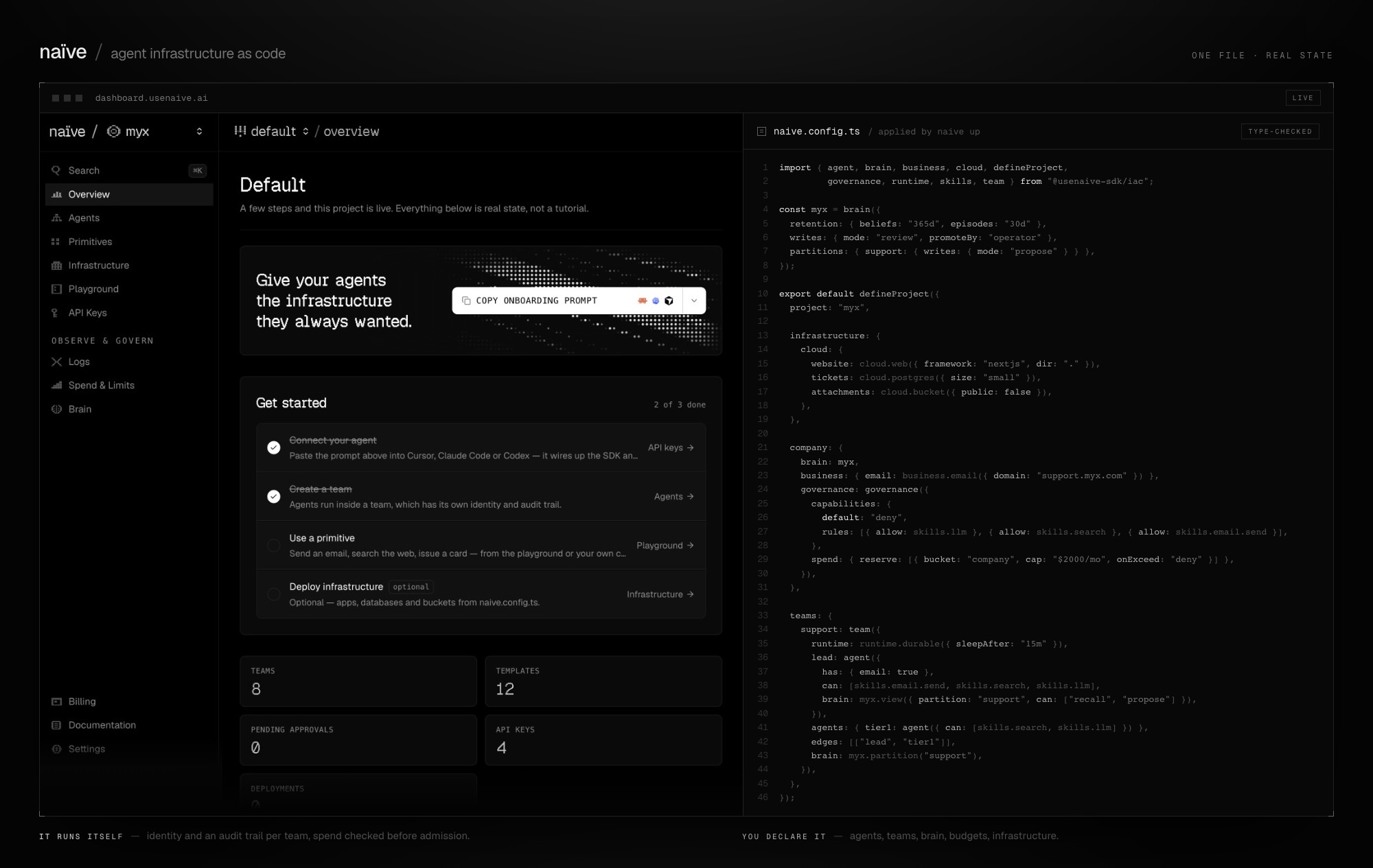
Naïve, a Palo Alto-based AI lab building the infrastructure AI agents need to run entire businesses, today announced a $28.5 million Series A led by Nexus Venture Partners, with participation from Y Combinator, Zetta, Liquid 2, and angel investors including Gokul Rajaram, Tim Zheng (Apollo), JD Sherman (former HubSpot), Gert Lanckriet (Amazon), Robert Chatwani (Docusign), and Zachary Sims (Codecademy). Naïve was founded by Sean Dorje and Dennis Zax, 20-year-old Berkeley dropouts who have been building together since they were 14. They sold their previous company, ezML, as teenagers before joining Y Combinator.
The Problem: The App Ships in an Afternoon. The Business Takes Months.
Coding agents like Claude Code and Codex can ship a working application in an afternoon. Turning that application into an operating business is still manual work, stitching together dozens of siloed API services for payments, email, phone, and incorporation, every one of them designed for human operators. Compounding the friction is a more fundamental problem: current cloud infrastructure was built for human-era software, and none of it was designed for agents.
Naïve’s Solution: One Config File, One API, the Entire Operating Stack
Developers have their coding agent write a single config file, and Naïve provisions the operating stack behind one unified API, incorporation, payment cards, email inbox, mobile phone, memory, models, and compute. A governance gateway sits in front of every action, enforcing budgets and approvals before anything executes, so developers retain authority over what their agents can spend and do.
Key platform capabilities include:
- Real-World Identity: KYC/KYB verification, LLC formation, email inboxes, phone numbers, and virtual cards, so agents can operate as distinct legal and economic entities.
- Cloud: Relational databases, hosting, compute, object storage, and authentication.
- Serverless Agents: Run Hermes, Claude Code, Codex, and Vetta as lightweight serializable state rather than as rented machines.
- Multi-Agent Orchestration: Task management, agent-to-agent communication, and scheduling.
- Inference & Model Routing: Route every call to the cheapest hosted model that can answer it, prune context to what the call actually needs, and replay reasoning agents have already solved.
- Memory: One context layer that grows with the entire company.
- Third-Party Connections: Plug into 10,000+ tools businesses already run on, including Stripe, GitHub, Supabase, and QuickBooks.
- Governance: Enforce capability policies, maintain immutable audit logs, and require human-in-the-loop sign-off before an agent executes a sensitive action.
“The last two years proved autonomous software,” said Abhishek Sharma, Partner at Nexus Venture Partners. “The next decade is about autonomous companies. Naïve gives millions of entrepreneurs and small businesses worldwide the turnkey infrastructure to build and run autonomous companies, without needing to become AI experts.”
Where the Capital Goes: Four Research Pillars
The new capital goes into frontier research. Naïve is building a lab around a simple observation: autonomous companies increasingly rely on agent loops to finish work. However, these agent loops are extremely inefficient due to frontier model lock-in, idle compute costs, and poor context management. Our vision is to maximize the work per token spent on these agent loops through 4 areas:
- Serverless Runtimes: minimize compute. Agents and their sandboxes run as V8 isolates. No VMs, no rented boxes sitting idle. Since agents spend 95% of their time waiting, you’re only billed for the milliseconds they’re actually executing. 2.3ms cold start, 1.2MB per agent.
- Inference: minimize cost per token. Every call routed to the cheapest model that can answer it, small language models for mechanical turns, batched inference for long-running agents.
- Brain: minimize input tokens. One memory layer for the company. Distills conversations into structured facts and hands each agent only the context that call needs. Beats state of the art on recall at ~11x fewer tokens per query.
- Orchestration: minimize wasted turns. Delegates work to the right subagent at the right tier instead of running everything at frontier cost. Hosted serverlessly at 1/100th the cost.
“In this next decade, agent spend is set to scale into the trillions as companies completely run on agents that finish work autonomously.” said CEO, Co-Founder Sean Dorje. “Our vision at Naive Labs is to make each token do more, so autonomous companies can become a cost-efficient reality.”
Developers can sign up today at https://usenaive.ai/.
About Naïve
Naïve is a Palo Alto-based AI lab building the foundational infrastructure for autonomous companies. Founded by Y Combinator alumni Sean Dorje and Dennis Zax, Naïve provides a unified API and serverless operating stack that equips AI agents with everything they need to run real-world businesses, from legal incorporation and virtual cards to compute, memory, and multi-agent orchestration. Naïve is rebuilding cloud computing for the agent era, enabling builders to launch secure, cost-effective autonomous workforces in seconds. Learn more at https://usenaive.ai/.
( Press Release Image: https://photos.webwire.com/prmedia/81468/358555/358555-1.jpg )
WebWireID358555
 Ai Coding
- Contact Information
- Riley Munks
- PR Advisor
- Activate PR - https://www.activate-pr.com/
- riley@activate-pr.com
This news content may be integrated into any legitimate news gathering and publishing effort. Linking is permitted.
News Release Distribution and Press Release Distribution Services Provided by WebWire.