

The Greek island rewriting marine protection
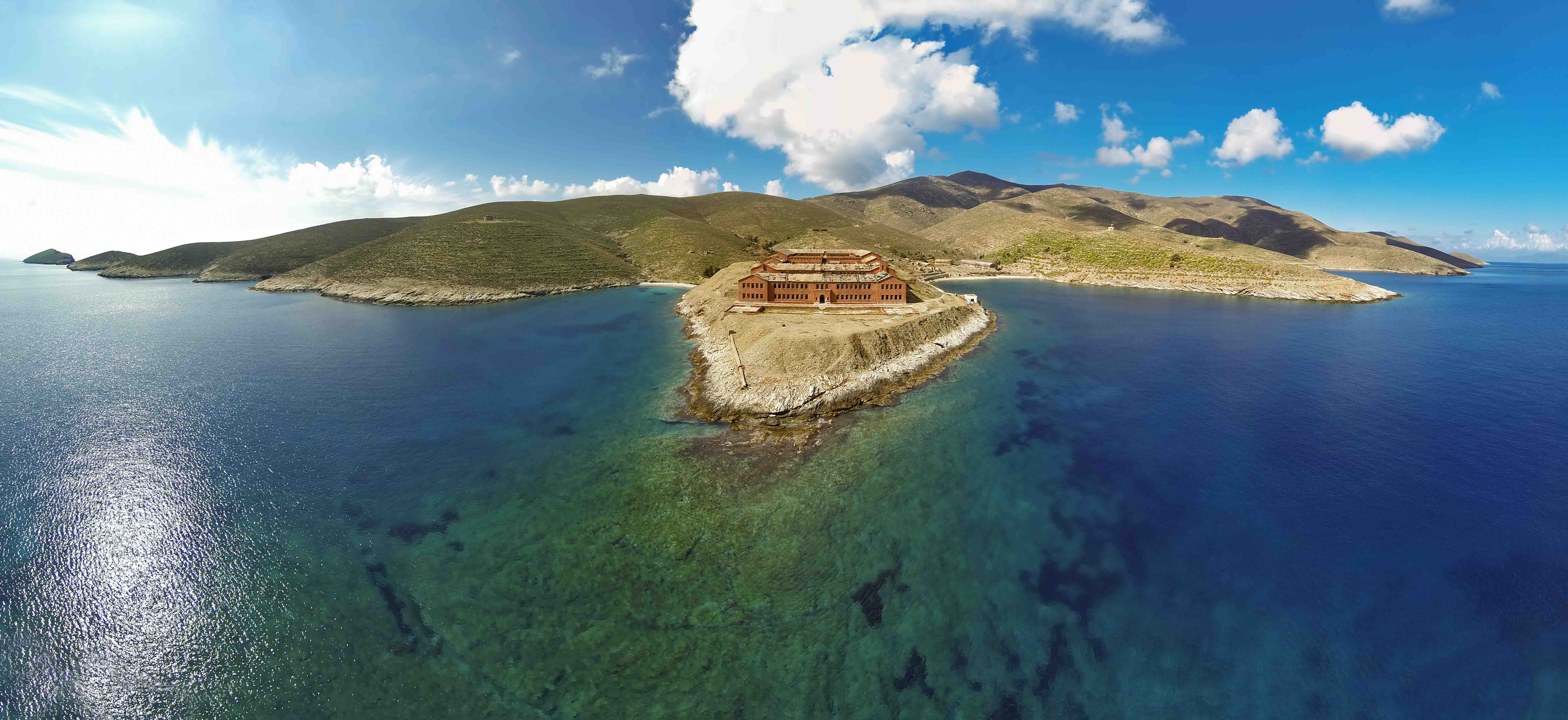
Gyaros Island, an abandoned prison once linked with exile, has become a thriving sanctuary, home to iconic seals and seabirds.
When WWF-Greece and its partners began work here 15 years ago, its waters were plagued by illegal fishing, and one of the world’s rarest marine mammals, the Mediterranean monk seal, was under threat.
Now, a historic Presidential Decree, given in April 2026, has locked a once-hidden gem of ecological beauty, history and even myth, into law. And it’s shaping conservation efforts far beyond Greece.
“This milestone was a 15-year effort to change how marine conservation works in the Mediterranean,” says Spyros Kotomatas, WWF Programme Manager for the Gyaros Marine Protected Area (MPA).
“It took unwavering support from our partners, a broad alliance, and a great deal of persistence. After many years in this field, the levels of determination needed still surprise me. In the end, success comes down to field presence, honesty, and consistency, from donors to local fishers, all working together over time.”
On the surface, the Greek island of Gyaros appears a place of abandon.
Here in the northern Cyclades, the island’s salt-bitten rock meets the Mediterranean’s murmuring tide. There’s little to hear over breaking waves, and little to see beyond large, crumbling brick buildings that trace a turbulent past along the water’s edge.
For most of its history, this island has been defined by absence. It was a prison and a place of exile for centuries, giving it the name ‘The Island of Silence’.
Now entirely uninhabited, and in almost eerie contrast, it hides a trove of astounding ecological vibrance. Below the waves, it bursts to life. Shards of sunlight dapple reefs and Posidonia meadows sway with gentle currents. Fish are returning in abundance, and an iconic species is reappearing where it once dwindled.
It’s a picture of life hard-won, as the Mediterranean Sea is one of the most used in the world. Roughly 86% of fish populations are overexploited, while vital habitats have declined over recent decades.
In the face of these strains, Mediterranean countries are safeguarding more oceans to reach the ambitious 30x30 target; a global initiative to protect at least 30% of the planet’s land and ocean by 2030.
To date, roughly 20% of Greek waters have been designated as marine Natura 2000 sites, areas protected under European rules for rare, threatened, or valuable habitats. An encouraging step, but their protection isn’t always practiced.
In Greece - and beyond - commitments on paper tend to lack conservation measures, and this was true of Gyaros. In 2011, the island’s remoteness and Natura 2000 site status still wasn’t enough to prevent illegal fishing and disturbance.
Its marine biodiversity was suffering, and, worryingly, one of the Mediterranean sea’s rarest mammals was paying the price: the Mediterranean monk seal.
Resembling a monk’s hood, thick folds of head skin give this species its name. Once commonly spotted sunbathing on shores, hunting, habitat loss and human disturbance have pushed the monk seal to retreat.
By the late 20th century, populations had shrunk into isolated pockets; even in Greece, one of its last strongholds. It’s here that the WWF Gyaros MPA Programme began to bridge the gap between nominal protection and tangible practice.
It took 15 years, and an unusually broad alliance, to get there. Government, scientists, and local fishers worked together in a participatory process, and in April 2026, it paid off. Gyaros received a Presidential Decree, the first of its kind for an MPA in more than 25 years.
A healthy population of 70 monk seals now thrives here, alongside a rich fabric of marine life.
Although the seals were integral to its protection, Spyros says research soon revealed a sweeping realm of biodiversity. “We didn’t go into the project with focus on a single species but treated the site as a whole. The ecological, cultural and social value of Gyaros required worthy efforts.
“Habitat mapping showed that over 50% of the marine area forms two priority habitats in excellent condition. Seagrass meadows and Aegean reefs support a web of life here, from invertebrates to commercially important fish.”
Seagrass meadows are allies in climate change mitigation. They stabilise seabeds, soften wave energy and reduce erosion to protect coasts from storms and sea-level rise. Their powers are amplified by Aegean rocky reefs, habitats that create a mosaic of niches for feeding, spawning and refuge.
Gyaros, once known for human struggle, has in fact always been in direct support of marine biodiversity, fisheries, climate regulation and coastline protection. And land studies teased out an equally important detail on the surface.
Gyaros is also a place of myth, known locally for its dark past, where sailors reported shrieks from the darkness. Hauntingly human, sirens of the night. But the truth, as ever, lies closer to the rock.
“It’s a bird,” says Spyros. “An important bird.” The Mediterranean shearwater, discovered through land mapping surveys at the site. “This seabird colony, with over 7,000 breeding pairs, was previously unknown. It’s potentially the second largest in the Med, and nests in the island’s coastline.”
Its presence is a clear testament of the good state of the Eastern Mediterranean Sea. “Even,” smiles Spyros, “if its nest-locating call is a little spooky.”
The project relied on unravelling threads like this one. For years, Gyaros was viewed as a lifeless island with a chilling history, but the team’s work revealed a treasure of natural value linked with local livelihoods. A place worth protecting, where human history, nature, and even legend converge in quiet but stunning complexity.
Gyaros, once known for human struggle, has in fact always been in direct support of marine biodiversity, fisheries, climate regulation and coastline protection. And land studies teased out an equally important detail on the surface.
Gyaros is also a place of myth, known locally for its dark past, where sailors reported shrieks from the darkness. Hauntingly human, sirens of the night. But the truth, as ever, lies closer to the rock.
“It’s a bird,” says Spyros. “An important bird.” The Mediterranean shearwater, discovered through land mapping surveys at the site. “This seabird colony, with over 7,000 breeding pairs, was previously unknown. It’s potentially the second largest in the Med, and nests in the island’s coastline.”
Its presence is a clear testament of the good state of the Eastern Mediterranean Sea. “Even,” smiles Spyros, “if its nest-locating call is a little spooky.”
The project relied on unravelling threads like this one. For years, Gyaros was viewed as a lifeless island with a chilling history, but the team’s work revealed a treasure of natural value linked with local livelihoods. A place worth protecting, where human history, nature, and even legend converge in quiet but stunning complexity.
What began as a single site success is influencing policy even more widely. “Instead of Greece’s typical top-down model, which is Ministry-led, often data-light and resisted locally, we chose a different route”, says Spyros.
“We established a two-year committee involving 15 stakeholders, such as ministries, regional and local authorities, fishers, tourism and scientific bodies, environmental organisations, and development agencies.”
The aim? To understand exactly what was there, its value, and how to preserve it.
By 2015, remote surveillance systems, integrating radar, cameras, and drones, were monitoring in a way Greece hadn’t seen before. It cut illegal fishing by 85% in professional fleets and nearly 60% in recreational ones.
Acknowledged by the EU LIFE Programme, the system transferred to the Greek state and is now operated by the Natural Environment and Climate Change Agency (NECCA).
Since, NECCA has launched a programme to design, fund, and implement remote surveillance systems across Greece’s entire network, covering more than 120 MPAs and marine Natura 2000 sites.
Like most conservation successes, Gyaros was built piece by piece.
In 2018, fish population research began alongside the submission of a Special Environmental Study. In 2019, Gyaros was designated an MPA, with defined zones and management. Its successes slowly became a blueprint for marine conservation, informing protected area management far beyond the island itself.
The island, its biodiversity and the broader shift it’s creating would not have been possible without pivotal partners along the way. The project has benefited from the support of the Prince Albert II of Monaco Foundation, and continues to do so with the support of the Monk Seal Alliance. Fondation Segré, MAVA, the Stelios Philanthropic Foundation, and many others have been integral over the years.
“The holistic approach we took to the area’s conservation isn’t unusual in theory but tends to be rarely practiced,” says Spyros.
“It’s highly effective but demands the balancing of resources and revisiting strategy. That was only made possible through philanthropic support at every stage. Gyaros shows us what sustained effort and the right mix of public and private support can achieve, and it’s still creating impact. We spent the last two years capturing and sharing our experiences, and Gyaros has become a model that can be applied elsewhere. It’s creating a ripple effect.”
Recovery remains fragile. Marine ecosystems take time to rebuild, and pressures continue to grow across the world’s oceans. Climate change and competing economic interests mean the gains of the past decade are not promised.
“Conservation isn’t always tangible, it’s done in offices and classrooms, through datasets and discourse,” reflects Spyros.
“It took years of constant, quiet work to connect practices with policy, communities with ecology. True, enduring impact is always a collective effort, and sometimes glacial. That’s why the backing of our partners has been, and will always be, so integral.”
Partner with WWF
WWF-Greece
Support WWF’s global conservation efforts
( Press Release Image: https://photos.webwire.com/prmedia/7/358459/358459-1.jpg )
WebWireID358459
This news content was configured by WebWire editorial staff. Linking is permitted.
News Release Distribution and Press Release Distribution Services Provided by WebWire.