

EU Global Gateway strategy: EIB and BIIC strengthen strategic agricultural value chains for benefit of Benin and Europe
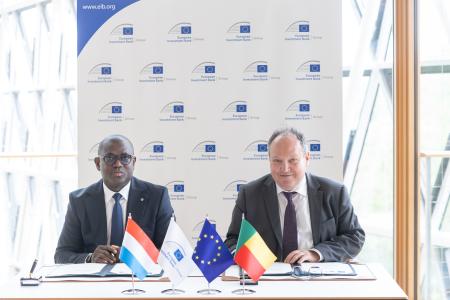
- EIB and BIIC deploy €100 million in financing, guaranteed by European Commission, in support of agricultural value chains that are key for Beninese economy and European industries.
- Operation strengthens strategic sectors – cotton/textiles, soya and cashew – that are essential for agro‑industrialisation and job creation in Benin and for security and diversification of EU supply chains in line with the EU Global Gateway strategy.
- Financing agreement signed under “Women for Stronger Communities and Growth” initiative to support economic resilience of women and communities in face of climate change and food insecurity.
- A Luxembourg-funded technical assistance programme will support the growth and sustainability of local businesses, particularly those led by women.
The European Investment Bank (EIB), via its specialised arm for development and international partnerships – EIB Global – and the Banque internationale pour l’industrie et le commerce (BIIC) today announced the start of a strategic partnership aimed at strengthening financing for Beninese small and medium-sized enterprises (SMEs) and mid-caps, with integrated agricultural value chains as the main priority.
The €100 million operation, backed by a guarantee from the European Commission, is part of the European Union’s Global Gateway strategy, which aims to reduce the investment gap in infrastructure in partner countries for smart, clean and secure connections and, in particular, to secure and diversify global supply chains while promoting high environmental and social standards and local transformation.
Strategic value chains at the heart of the partnership
The partnership, dedicated to companies in agrifood value chains in Benin, focuses primarily on three key sectors for Benin and trade with the EU:
- Cotton and textiles: A pillar of Beninese exports, this sector indirectly supplies European markets via international processing chains. Strengthening local processing capacity helps shorten and secure the EU’s textile supply chains while improving their traceability.
- Soya: With soya a key element for agrifood and animal feed in Europe, the development of local processing makes it possible to diversify supply sources and reduce dependence on certain global suppliers amid tensions on agricultural markets.
- Cashew: Because cashew is an important raw material for the European agrifood industry, moving up the value chain locally (sorting, processing) fosters more resilient, traceable value chains that comply with European requirements.
In total, at least 70% of the financing will be dedicated to these three sectors, helping to build more integrated value chains between West Africa and the EU.
The operation is part of BIIC’s strategy to strengthen its role as a preferred partner of the Beninese private sector and to provide long-term support to companies for their investment projects and working capital needs through attractive financing conditions, particularly in terms of maturity and cost of credit. BIIC was supported by OBARA Capital for the structuring and implementation of the operation.
The first beneficiaries of the cooperation include:
- Akiyo, a Beninese company specialised in trading agricultural products, in particular soya and cashew, which has received financing from BIIC to strengthen its sourcing and distribution activities. Based in the commune of Savè, it helps structure marketing channels for strategic agricultural raw materials for regional and international markets, with particular attention to female employment.
- Couleur Indigo, a textile-sector player based in Ouidah, has been supported in developing its production site for indigo-dyed fabrics. The company, in which women make up a significant proportion of the workforce, contributes to the development of a higher value‑added local textile industry, linked to the processing of Beninese cotton and integration into more sustainable value chains.
Technical assistance for sustainable agricultural value chains and women’s inclusion
A technical assistance programme, supported by Luxembourg through the Financial Inclusion Fund, will complement this partnership with a view to maximising its impact. The programme will support the upgrading of the targeted agricultural value chains by strengthening BIIC’s capacity in sustainable finance, particularly with regard to environmental, social and governance aspects. It will also support local SMEs and cooperatives, particularly those led by women and young people, in structuring bankable projects, improving their business practices and adopting recognised international standards. The programme will thereby help facilitate their access to finance and strengthen their integration into more sustainable and resilient regional and European value chains.
BIIC Chief Executive Officer Arsène M. Dansou said: “This partnership with the EIB enables us to support as a priority the agricultural value chains that structure the Beninese economy. By strengthening local processing and access to financing, we are helping to build more competitive sectors that create jobs and are better integrated into international markets. This operation also reflects the confidence of our international partners in BIIC’s soundness and in its capacity to provide long‑term support to the private sector.”
European Commissioner for International Partnerships Jozef Síkela said: “By supporting strategic agricultural value chains such as cotton, soya and cashew nut, this investment will create new opportunities for the citizens of Benin and strengthen the resilience of supply chains between Africa and Europe. It illustrates the Global Gateway approach: sustainable investment that creates local opportunities while securing the economic interests of the Europeans.”
EIB Vice‑President Ambroise Fayolle said: “This operation shows how the EIB can finance integrated agricultural value chains as part of a partnership that benefits both Benin and the EU. By strengthening local processing, we contribute to supply chains that are more competitive, more resilient and better aligned with European standards.”
Luxembourg Minister for Foreign Affairs Xavier Bettel: “Luxembourg is proud to support, through the Financial Inclusion Fund, the efforts of Beninese businesses to move up the value chain. This technical assistance will help strengthen their integration into more sustainable and inclusive international value chains.”
Luxembourg Minister of Finance Gilles Roth: “Luxembourg attaches particular importance to the development of strong, inclusive and accessible financial systems, which are an essential driver of sustainable economic growth and poverty reduction. Supporting financial inclusion in Benin means strengthening the banking sector’s capacity to support businesses, finance SMEs, mobilise investment and foster job creation in this partner country.”
Background information
About the EIB
About EIB Global
The European Investment Bank (EIB) is the long-term lending institution of the European Union owned by its Member States. It is active in more than 160 countries and provides long-term finance for individual projects and strategic partnerships contributing to EU priorities and policy goals.
EIB Global is the EIB Group’s specialised arm dedicated to increasing the impact of international partnerships and development finance. EIB Global is designed to foster strong, focused partnership within Team Europe, alongside fellow development finance institutions, and civil society. EIB Global brings the Group closer to local people, companies and institutions through our offices across the world.
High-quality, up-to-date photos of our headquarters for media use are available here.
About the Banque internationale pour l’industrie et le commerce
The Banque internationale pour l’industrie et le commerce (BIIC) is a commercial bank serving individuals, professionals, SMEs and large companies.
Created in 2020 from the merger of two Beninese banking institutions, it established itself in 2022 as the market leader according to key financial indicators, with share capital of 82.5 billion West African CFA francs (€125.8 million) to date.
A leading player in Benin’s economic development, BIIC supports its clients through a comprehensive range of banking services. It backs major projects in infrastructure, industry and agricultural value chains while promoting an inclusive vision of finance through its flagship programmes dedicated to entrepreneurship and economic empowerment: “BIIC avec ELLES” and “PME BOOST”.
Since April 2025, BIIC has been listed on the West African Regional Stock Exchange (BRVM), underscoring its commitment to transparency and its ambition to make the brand a benchmark bank in the pan‑African banking landscape.
About the European Union’s Global Gateway strategy
“Global Gateway” is the EU’s offer to reduce global investment gaps, foster smart, clean and secure connections in the digital, energy and transport sectors and strengthen health, education and research systems.
The Global Gateway strategy embodies a “Team Europe” approach that brings together the EU, its Member States and the European development finance institutions. Together, they have already mobilised more than e300 billion in public and private investments since 2021 in order to build links with partner countries rather than dependencies.
About the European Union’s priorities in Benin
The EU supports Benin’s sustainable and inclusive development. This support is in line with the government’s 2021‑2026 action programme, its 2018‑2025 national development plan and the EU’s Global Gateway strategy.
This partnership, set out in the 2021‑2027 EU‑Benin Multiannual Indicative Programme, aims to foster a more prosperous and safer society. It supports the country’s efforts in economic transformation and job creation through investments in energy, transport, agribusiness and vocational training; territorial development and security in the north; as well as increased access to sustainable finance.
In Benin, Team Europe brings together the EU, the EIB, Belgium, France, Germany, Luxembourg and the Netherlands.
Through its Neighbourhood, Development and International Cooperation Instrument (NDICI – Global Europe), the EU has allocated an initial envelope of €255 million to Benin for the period 2021‑2024 under the national programme. The envelope for the 2025‑2027 period amounts to €172 million.
Benin also benefits from additional allocations and participation in multi‑country, regional, continental or global projects, in particular under the regional programme for sub‑Saharan Africa, the thematic programme under NDICI – Global Europe, and other financial instruments.
( Press Release Image: https://photos.webwire.com/prmedia/6/357644/357644-1.jpg )
WebWireID357644
This news content was configured by WebWire editorial staff. Linking is permitted.
News Release Distribution and Press Release Distribution Services Provided by WebWire.