

App Store ecosystem reaches record $1.4 trillion as developers continue to thrive globally
Apps featuring consumer-facing AI saw 4x more growth in billings in 2025
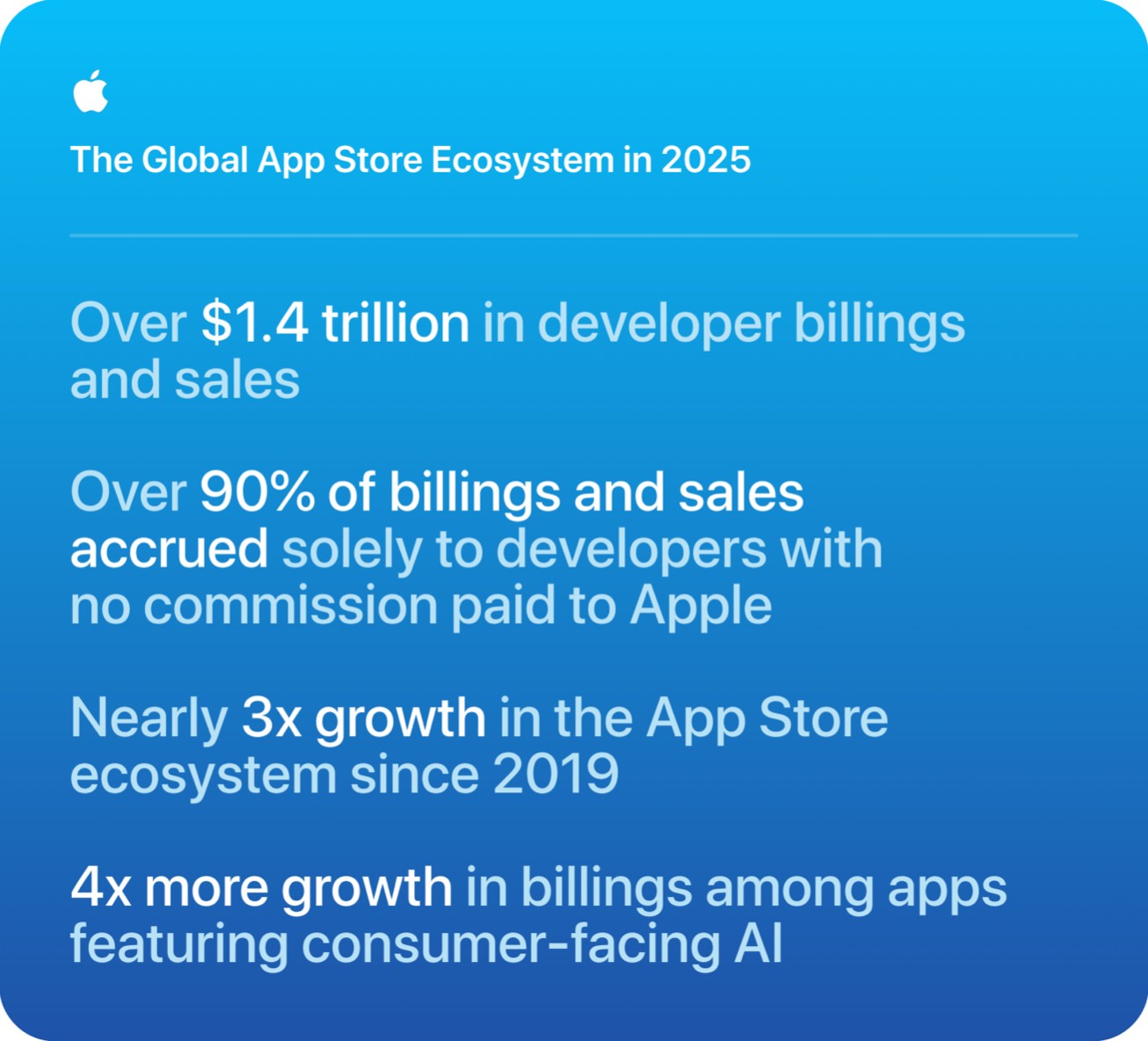
Apple announced the global App Store ecosystem facilitated over $1.4 trillion in developer billings and sales in 2025, according to a new study by economists at Analysis Group. For more than 90 percent of the billings and sales facilitated by the App Store ecosystem, developers did not pay any commission to Apple. Since 2019, the size of the App Store ecosystem has nearly tripled, as the App Store remains the safest and best place for users to discover and download apps. The App Store continues to support developers as they build new experiences for users around the world, including apps that use emerging technologies such as artificial intelligence (AI). In 2025, more than 40 of the top 100 apps on the storefront featured consumer-facing AI capabilities, and those apps saw stronger billing growth than other top 100 apps.
“Developers are the heartbeat of the App Store, and this year’s incredible milestone is a testament to their boundless creativity,” said Tim Cook, Apple’s CEO. “We are deeply committed to providing developers with the tools, technologies, and trusted platforms they need to build for the future. Together, developers are creating apps that enrich the lives of users around the world.”
An Engine of Global Commerce for Developers
The new study reflects the sustained growth of the App Store ecosystem and the economic opportunity it offers developers — a testament to the role apps continue to play in people’s lives. In 2025, sales of physical goods and services accounted for $1.1 trillion, fueled by the continued growth of grocery, food delivery and pickup, general retail, and travel. Developer billings and sales for digital goods and services totaled $149 billion, driven by games, enterprise apps, and video streaming apps. In-app advertising revenue from ads placed by developers in their apps was $151 billion.
The App Store saw over 850 million average weekly users spanning 175 countries and regions, helping developers grow their businesses and reach new customers around the world with the click of a button. Users increasingly relied on apps to purchase groceries, boost productivity, maintain their health and fitness, and stay connected with friends and family.
AI Is Accelerating App Innovation for Developers and Users
Across the App Store, AI is becoming an increasingly integral part of how apps are experienced. New and existing apps across a wide range of categories are evolving to offer richer features and capabilities to users. From health and fitness apps that deliver personalized recommendations using on-device intelligence, to photo and video editing apps with AI-powered creative features, and productivity tools that leverage powerful, cloud-based AI models to automate complex tasks — the integration of AI into everyday apps is creating new opportunities for developers.
Around the world, developers of all sizes continue to bring even more intelligent experiences to their apps through Apple technologies like the Foundation Models framework. By tapping into the on-device large language model at the core of Apple Intelligence, developers can create new intelligent features that protect users’ privacy and are available offline, all while using AI inference that is free of cost.
AI is also making app development more accessible than ever before. Developer tools with AI coding features, such as Xcode, are enabling a broader range of creators to design, build, and launch apps. Agentic coding in Xcode 26, for example, can work with greater autonomy toward a developer’s goals, giving them the power to streamline workflows, iterate faster, and bring ideas to life.
Global Growth, Regional Momentum
The strength of the App Store ecosystem in 2025 was reflected not just globally, but across major regions throughout the world. In the last six years, billings and sales facilitated by the App Store have more than doubled in China, and more than tripled in the U.S. and Europe.
Physical goods and services accounted for the majority of total billings and sales in every region, with general retail ranking as the number one category across all markets. Beyond retail, local consumer habits drove distinct regional trends. Travel was the second-largest category of spending in physical goods and services in the U.S., Europe, Japan, Australia, New Zealand, and Brazil. In Korea, food delivery and pickup took the second spot. And in China, grocery and food delivery became the second- and third-largest categories, respectively.
These distinct regional trends highlight how the App Store ecosystem supports developers on a global and local scale. By supporting large universal categories like retail alongside highly specific local demands like regional food delivery and travel, the App Store provides a trusted marketplace where developers of all sizes can build businesses that cater to the everyday needs of their communities.
Invested in Developers. Everywhere.
Apple remains deeply committed to equipping developers with the tools, resources, and support they need to build, grow, and scale successful businesses on the App Store. Developers benefit from a broad ecosystem of capabilities across the development life cycle — from building and testing apps with Xcode and TestFlight, to understanding performance with App Analytics, to reaching users through features like custom product pages and App Store editorial across global storefronts. Apple also invests in platform technologies, commerce systems, and distribution infrastructure that help developers build secure apps, offer digital goods and subscriptions, and scale their businesses globally. Each year, Apple continues to invest in expanding its frameworks with powerful new APIs and technologies that enable developers to create innovative, high-quality experiences across Apple platforms.
In 2025, Apple Developer Centers hosted thousands of developers in the U.S., China, India, and Singapore. Opening later this year, a new Apple Developer Center in Berlin will also serve a large and vibrant developer community throughout Europe. With nearly 20 Apple Developer Academies in Brazil, Indonesia, Italy, Saudi Arabia, South Korea, and the U.S., along with dozens of Apple Foundation Programs, Apple continues to equip the next generation of developers with foundational skills in coding, AI, design, and marketing.
Apple also offers developers a variety of online and in-person programs, including Meet with Apple sessions, appointments and labs, and access to Apple Support via phone and email in nine languages. Resources like Pathways and Apple Developer Forums help developers connect within the community and easily access tools, documentation, and videos to create their best products on Apple’s platforms.
Next week, during Apple’s annual Worldwide Developers Conference, Apple will offer a first look at exciting new features, APIs, and technologies that will further empower developers to create powerful experiences across Apple platforms. Developers and students will have access to more than 100 new video sessions about tools, technologies, and design; take part in Group Labs; and join conversations on the Apple Developer Forums. All WWDC content will be available on the Apple Developer app, website, and YouTube channel. Developers can also follow the conference worldwide on LinkedIn, WeChat, and bilibili.
( Press Release Image: https://photos.webwire.com/prmedia/7/355780/355780-1.jpg )
WebWireID355780
This news content was configured by WebWire editorial staff. Linking is permitted.
News Release Distribution and Press Release Distribution Services Provided by WebWire.