

Strange winds reveal strongest hints yet of magnetic activity in exoplanets
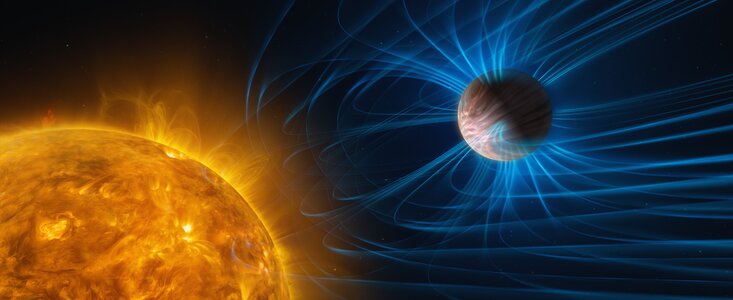
A team of astronomers has found the strongest evidence yet that some planets outside our Solar System may be magnetic. Using the European Southern Observatory’s Very Large Telescope (ESO’s VLT) and the Gemini North telescope, the researchers measured wind speeds on seven very hot, Jupiter-like exoplanets. The observations revealed that the winds on these planets are most likely governed by magnetic fields, providing the first robust measurement of magnetism on planets outside the Solar System.
“This breakthrough opens a completely new window on exoplanet research. It’s the first time we can compare the magnetic environments of other worlds — a key step toward ultimately understanding which planets can stay alive, keep their water, and perhaps even, one day, host life as we know it,” says Julia Seidel, an astronomer at the Laboratoire Lagrange, Observatoire de la Côte d’Azur, France and lead author of the study published today in Nature Astronomy.
Earth’s magnetic field influences our atmosphere in complex ways, and is therefore a key factor in understanding what keeps the planet habitable for life. Magnetic fields are also present in other Solar System planets, like Jupiter and Saturn. However, for the past 15 years, no one succeeded in directly measuring the strength of the magnetic fields of exoplanets — until now.
The team, however, didn’t set out to measure magnetic fields but, rather, winds. They measured wind speeds on seven exoplanets orbiting different stars: gas giants like Jupiter, but each tidally locked to its host star and very close to it. Just as we always see only one side of the Moon, these planets always keep one face towards the star, resulting in a scorching hot day side and a freezing cold night side. This temperature difference creates a climate completely different from the one on our planet, with extremely strong winds. The wind speeds in their sample ranged from around 7200 km/h to over 25 000 km/h; in comparison, the fastest winds measured on Jupiter reach speeds of around 1500 km/h.
“In the beginning we set out to check if the atmospheric winds behaved the same way for all hot planets,” explains Seidel, who was previously an astronomer at ESO in Chile. For their measurements, the team used data from the ESPRESSO instrument on ESO’s VLT, in the Chilean Atacama Desert, and from a similar instrument on the Gemini North telescope in Hawaiʻi, USA. (The VLT is an ESO telescope while Gemini North is one half of the International Gemini Observatory, partly funded by the U.S. National Science Foundation (NSF) and operated by NSF NOIRLab.)
But when they looked at how the wind speeds varied with planet temperature, they saw a very intriguing pattern emerge: the hotter the planet, the slower the wind. “This is totally counter intuitive because, all things being equal, hot planets have more energy to accelerate the winds! Something must happen that slows down the wind speeds for hotter objects,” says study co-author Vivien Parmentier, a professor at the Laboratoire Lagrange.
The team concluded that the most consistent explanation for this mystery is the presence of planet-wide magnetic fields, since these fields can work as a brake, slowing down the motion of charged particles in the atmosphere. The data therefore allowed the researchers to infer the strength of the magnetic field in each of the studied planets. They found them to be comparable in strength to those found in our Solar System: approximately four times as strong as Saturn’s or about half the strength of Jupiter’s.
Such strong magnetic fields could affect more than just the wind on these distant planets. “Here on Earth, we know the beauty of the northern and southern lights, where particles from the Sun hit our magnetic field and are guided toward the poles, colliding with gases in the atmosphere to produce colourful displays of green, pink, and purple,” explains study co-author Bibiana Prinoth, a former PhD student at Lund University, Sweden, now an astronomer at ESO in Garching, Germany. On the studied exoplanets, the magnetically driven aurorae could be even more dramatic. The team eagerly anticipates the arrival of ESO’s Extremely Large Telescope, which will help to characterise not only large, Jupiter-like exoplanets but also smaller ones like Earth, possibly even detecting gases that could produce aurorae on these distant worlds. Prinoth says: “I like to imagine that some of these worlds have a sky filled not only with stars, but with vast curtains of colourful light dancing across a planet that’s half in perpetual day and half in endless night.”
More information
This research was presented in a paper to appear in Nature Astronomy (doi:10.1038/s41550-026-02870-1).
The team is composed of Julia V. Seidel (European Southern Observatory, Santiago, Chile [ESO Chile]; Université Côte d’Azur, Observatoire de la Côte d’Azur, CNRS, Laboratoire Lagrange, France [Lagrange]), Vivien Parmentier (Lagrange), Bibiana Prinoth (Lund Observatory, Division of Astrophysics, Department of Physics, Lund University, Lund, Sweden [LU]), Thea Hood (Lagrange), Nishil Mehta (Lagrange), Valentin De Lia (Lagrange), Brian Thorsbro (Lagrange, LU), Konstantin Batygin (Division of Geological and Planetary Sciences, California Institute of Technology, USA), Tristan Guillot (Lagrange), Ragnar van den Broeck (Lagrange), Florian Debras (IRAP, Université de Toulouse, Toulouse, France), Daniel D. B. Koll (School of Physics, Peking University), Thaddeus Komacek (Department of Physics (Atmospheric, Oceanic and Planetary Physics), University of Oxford, Oxford, UK [Oxford]), Hayley Beltz (Department of Astronomy, University of Maryland, College Park, USA), Emily Rauscher (Department of Astronomy and Astrophysics, University of Michigan, MI, USA), Lorenzo Pino (INAF - Osservatorio Astrofisico di Arcetri, Florence, Italy), Matteo Brogi (Dipartimento di Fisica, Università di Ferrara, Ferrara, Italy; INAF – Osservatorio Astrofisico di Torino, Turin, Italy), Joost P. Wardenier (Département de Physique, Institut Trottier de Recherche sur les Exoplanètes, Université de Montréal, Canada [iREx]), Jacob L. Bean (Department of Astronomy & Astrophysics, University of Chicago, Chicago, USA [Chicago]), Björn Benneke (iREx and Department of Earth, Planetary, and Space Sciences, University of California, Los Angeles, CA 90095, USA), Jean-Michel L. B. Desert (Anton Pannekoek Institute for Astronomy, University of Amsterdam, Amsterdam, Netherlands), Pablo Drake (Lagrange), Siddharth Gandhi (Department of Physics, University of Warwick, Coventry, UK and Centre for Exoplanets and Habitability, University of Warwick, Coventry, UK), Mark Hammond (Oxford), David Kasper (Chicago), Michael R. Line (School of Earth and Space Exploration, Arizona State University, Tempe, USA [SESE]), Elspeth Lee (Center for Space and Habitability, University of Bern, Bern, Switzerland), Stefan Pelletier (Observatoire astronomique de l’Université de Genève, Versoix, Switzerland), Andreas Seifahrt (International Gemini Observatory/NSF NOIRLab, Tucson, USA), Adrien Simonnin (Lagrange), Peter Smith (SESE), and Kevin B. Stevenson (JHU Applied Physics Laboratory, Laurel, USA)
The European Southern Observatory (ESO) enables scientists worldwide to discover the secrets of the Universe for the benefit of all. We design, build and operate world-class observatories on the ground — which astronomers use to tackle exciting questions and spread the fascination of astronomy — and promote international collaboration for astronomy. Established as an intergovernmental organisation in 1962, today ESO is supported by 16 Member States (Austria, Belgium, Czechia, Denmark, France, Finland, Germany, Ireland, Italy, the Netherlands, Poland, Portugal, Spain, Sweden, Switzerland and the United Kingdom), along with the host state of Chile and with Australia as a Strategic Partner. ESO’s headquarters and its visitor centre and planetarium, the ESO Supernova, are located close to Munich in Germany, while the Chilean Atacama Desert, a marvellous place with unique conditions to observe the sky, hosts our telescopes. ESO operates three observing sites: La Silla, Paranal and Chajnantor. At Paranal, ESO operates the Very Large Telescope and its Very Large Telescope Interferometer, as well as survey telescopes such as VISTA. Also at Paranal, ESO will host and operate the south array of the Cherenkov Telescope Array Observatory, the world’s largest and most sensitive gamma-ray observatory. Together with international partners, ESO operates ALMA on Chajnantor, a facility that observes the skies in the millimetre and submillimetre range. At Cerro Armazones, near Paranal, we are building “the world’s biggest eye on the sky” — ESO’s Extremely Large Telescope. From our offices in Santiago, Chile we support our operations in the country and engage with Chilean partners and society.
Links
- Research paper
- Photos of the VLT
- NSF NOIRLab press release
- Find out more about ESO’s Extremely Large Telescope on our dedicated website and press kit
- For journalists: subscribe to receive our releases under embargo in your language
- For scientists: got a story? Pitch your research
( Press Release Image: https://photos.webwire.com/prmedia/7/355651/355651-1.jpg )
WebWireID355651
This news content was configured by WebWire editorial staff. Linking is permitted.
News Release Distribution and Press Release Distribution Services Provided by WebWire.