

Fashion brands urge governments to fix the economics of resale and repair
-
Arc’teryx, Etsy, H&M Group, Primark, Vinted and Zalando among 69 organisations urging governments to unlock circular fashion’s multi-billion dollar potential.
-
Call for policy changes across the EU, US and Canada to incentivise circular business models.
-
New Ellen MacArthur Foundation report shows targeted changes could raise gross profit margins up to 55% for resale and 41% for repair.
Some of fashion’s biggest names are calling on governments to fix the economics of resale and repair, as new Ellen MacArthur Foundation research suggests the current system is stacked against circular business models.
Nearly 70 fashion and textile organisations, including Arc’teryx, Decathlon, Etsy, H&M Group, Lacoste, Primark, Reformation, ThredUp, Vestiaire Collective, Vinted and Zalando, have signed a statement urging governments in the EU, US and Canada to implement targeted changes.
The statement says a multi-billion dollar circular fashion opportunity is being held back by a system which makes producing new clothes more profitable than repairing or reselling existing ones. It calls for three concrete policy changes:
-
Reduced VAT in the EU and eliminated sales tax in North America on resold products and repair services.
-
Lower labour taxes in the EU and tax credits in North America for businesses creating jobs in resale and repair.
-
Extended Producer Responsibility (EPR) to fund the infrastructure needed to collect and sort clothing at scale.
Endorsing the statement, Leyla Ertur, Chief Sustainability Officer at H&M Group, says:
“Resale keeps products in use while meeting customer demand for more affordable and sustainable choices. But today, this business model is still economically penalised.
“If governments are serious about circularity, they need to act by removing double taxation, reducing labour costs, and removing other barriers that hold resale back. Fixing the economics of resale is one of the fastest and most concrete ways to scale circularity in fashion.”
Marianne Gybels, Senior Director of Sustainability at Vinted, added:
“To make circular businesses like second-hand the first choice, they have to consistently deliver on what matters most to consumers – being reliable, affordable, and easy to use. We’re already seeing this shift across Europe, where buying and selling second-hand has become part of everyday life, with significant room to grow further.
“To unlock its full potential, policy should support business models that make circular choices more accessible. This helps second-hand to scale further and provides consumers high-quality, affordable alternatives that are significantly better for climate impact than buying new.”
The business statement emerges from The Fashion ReModel, a project led by the Ellen MacArthur Foundation supporting brands, platforms, and retailers to scale circular business models and explore ways they can make money without making new clothes.
Reported revenue growth from the first year of the initiative suggests that participating brands, retailers, and platforms, are scaling revenue from resale, rental, repair and remaking four times faster than broader revenue across the rest of their participating business. Yet for all 13 participants, this growth represents a small share of overall revenue.
Resale and repair businesses are often burdened with high labour costs and face taxes on items at every transaction rather than just at the original point of sale, creating a system which favours new production over keeping clothes in use.
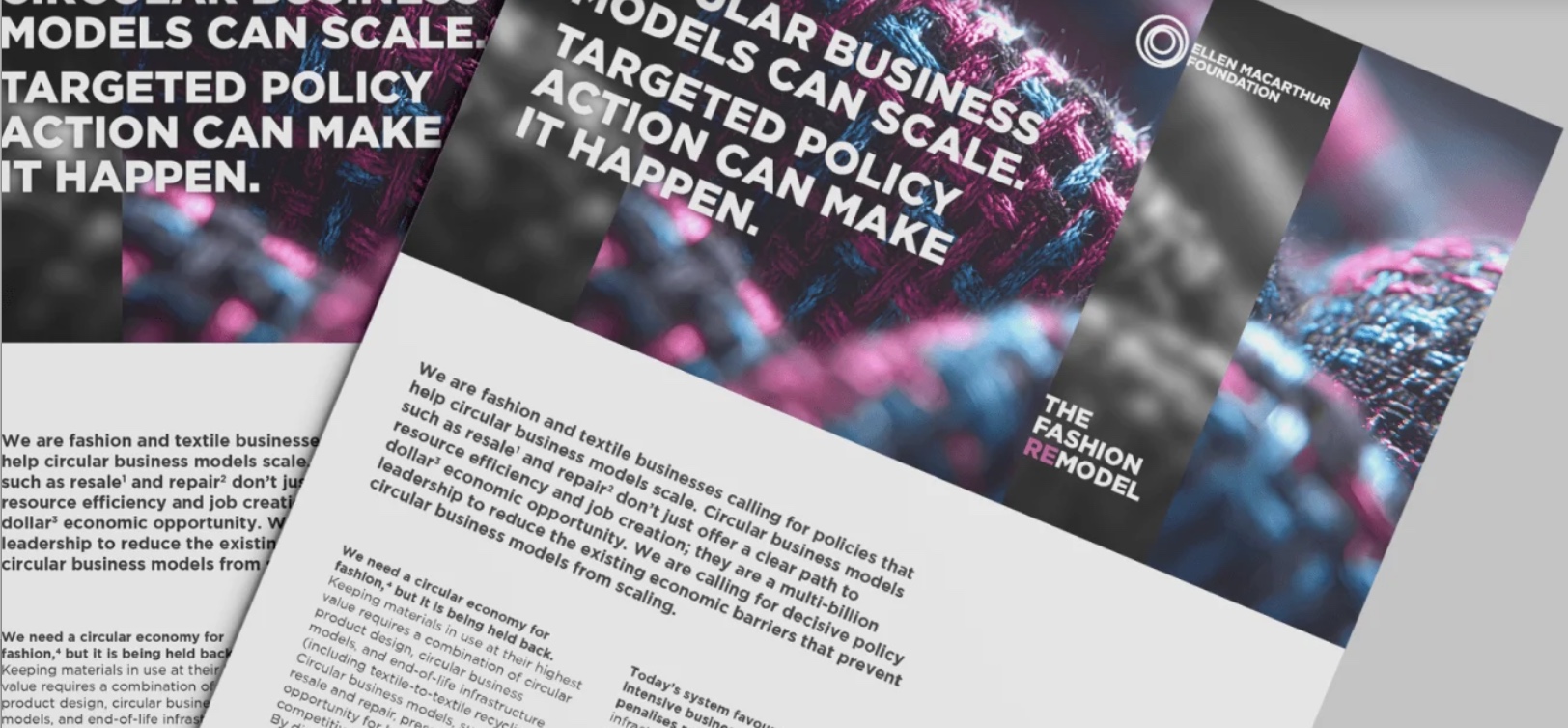
The call from businesses is backed by a new report from the Foundation – The New Bottom Line: Policy levers to scale resale and repair for fashion – which describes the impact of the three targeted government actions on resale and repair.
Targeted changes could raise gross profit margins to up to 55% for resale and around 41% for repair – in a market projected to reach $393 billion by 2030, growing at twice the pace of the wider industry.
The policy mix could help circular business models to scale, creating local jobs in repair, sorting, logistics, and retail, while reducing carbon emissions and pressures on overstretched waste systems.
Mark Buckley, Fashion and Textiles Lead at the Ellen MacArthur Foundation, says:
“Fashion’s potential to become more circular is significant, but the economics are stacked against resale and repair. Businesses are incentivised to use new resources rather than invest in keeping clothes in use for longer.
“Our research shows targeted policy adjustments – using existing policy levers – could materially improve the economics and unlock a multi-billion dollar opportunity.”
For further information, please visit www.ellenmacarthurfoundation.org
Notes to editors
Launched in 2010, The Ellen MacArthur Foundation is a global charity accelerating the transition to a circular economy – one that eliminates waste, keeps materials in use, and regenerates nature to create a resilient system that benefits business, people, and the environment. Our ambition is to deliver systemic change in the areas of fashion and textiles, critical minerals, and plastics and packaging, by 2030.
( Press Release Image: https://photos.webwire.com/prmedia/7/355092/355092-1.jpg )
WebWireID355092
This news content was configured by WebWire editorial staff. Linking is permitted.
News Release Distribution and Press Release Distribution Services Provided by WebWire.