

Where mountains whisper old stories and new dreams
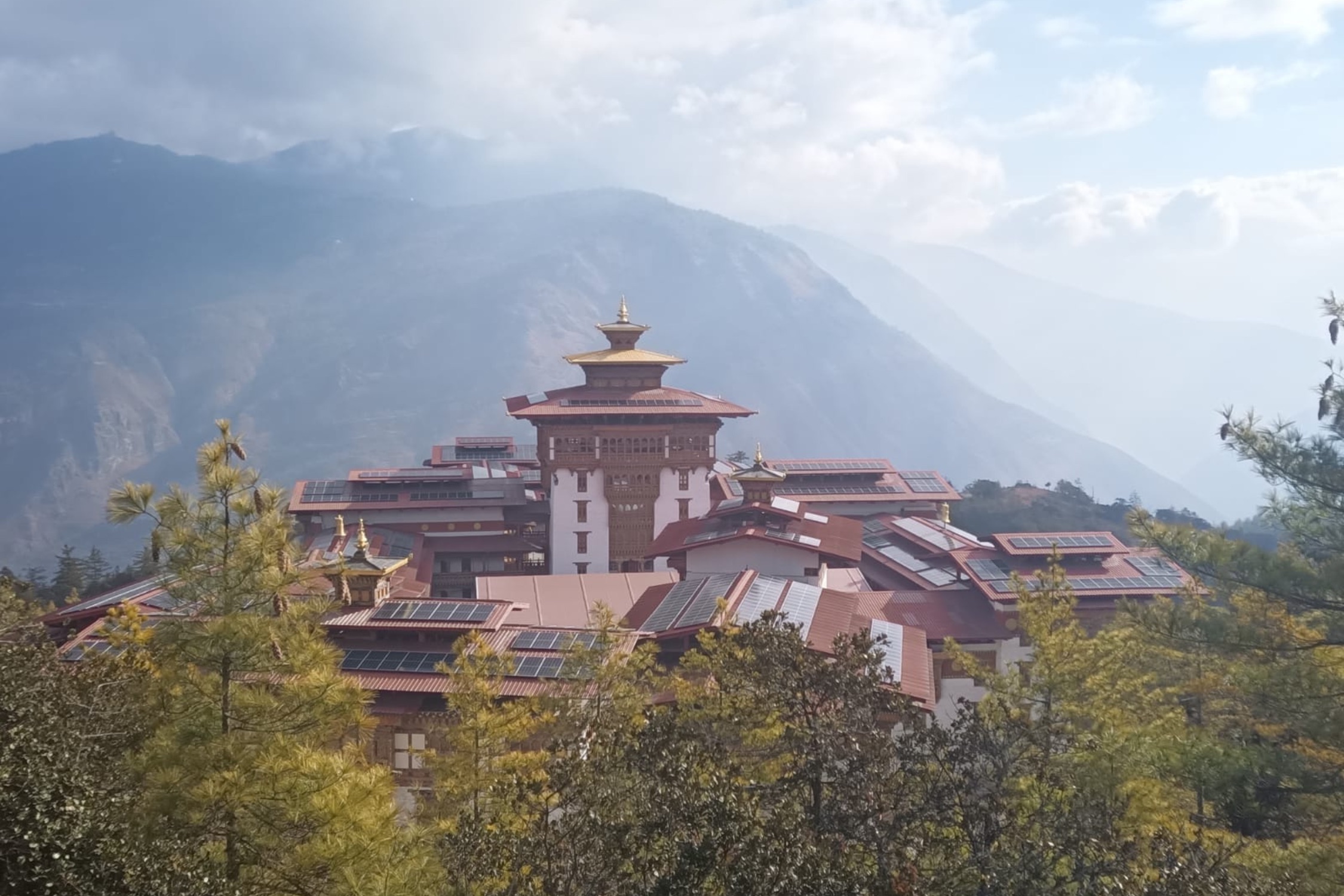
For six years, a solar engineer has delivered transformative energy solutions in Bhutan’s most remote communities. Now, after training with Swiss experts through WWF, he’s ready to chase his dreams for Bhutan’s solar future.
In the town of Trashigang, life moves to the rhythm of wind and prayer flags, and the mountains seem to whisper old stories.
That’s how Ngawang Gyeltshen describes his hometown in Bhutan, where people are warm and gentle despite the cold winters. “Smiles come easily there,” he explained. “Strangers greet you like friends, and tea is offered before questions are asked.”
Gyeltshen is a solar engineer now living in Thimphu City, Bhutan’s capital, with his spouse and one-year-old daughter. He enjoys painting and spending quiet evenings with family and friends among the hushed murmurs of the mountains. By day, he brings solar-powered solutions to Bhutanese communities and businesses – a fulfilling career that he’s pursued for over six years.
Transforming lives with solar
It all started with a water heating project at a rural nunnery. Before, the women couldn’t access hot water without burning firewood. He then visited one of the country’s most remote schools, located 4500 metres above sea level, where they could only burn yak dung to generate light and heat. In this place far beyond the grid’s reach, solar power was a transformational resource for better living.
“I saw first-hand how solar could change lives. That experience inspired me to dedicate my career to solar development and sustainability.”
Now, Gyeltshen has been part of more than 46 solar projects, installing thermal heating and photovoltaic systems that keep people warm and rooms bright. He’s also helped WWF to solarize their office space, a remote ranger station and a training site for a vocational school. His favorite part of the job is working with communities and seeing how renewable energy improves their lives. In his eyes, solar energy is the light of Bhutan’s future.
“By embracing the sun, Bhutan can build a cleaner, stronger and more self-reliant future – one where light never fades, even in the heart of winter,” Gyeltshen said.
His commitment to the work only grew with time. In 2025, he accepted a once-in-a-lifetime opportunity to go to Switzerland for an internship at Hassler Energia, a company with 40 years of experience pioneering solar technology. Funded by the company and WWF’s Energizing Communities and Conservation (ECCo) programme, the experience would enhance his solar skills and knowledge to bring back to Bhutan. Mere weeks after the birth of his daughter, Gyeltshen took a leap of faith – trading the breathing peaks of Bhutan for the unfamiliar slopes of Graubünden, Switzerland.
New ideas from a world away
For two months, Gyeltshen lived on the other side of the world and absorbed the knowledge he needed to build his homeland’s solar future.
“Every panel we install is a small step toward a greener and more equitable Bhutan,” he shared. “The future of Bhutan’s development lies in combining our traditional values of harmony with nature and modern clean technologies like solar.”
Bhutan’s solar journey will have its challenges, but thanks for Gyeltshen’s learning exchange, he’s better equipped to tackle complex issues by adapting approaches abroad.
“I’ve been applying what I learned in Switzerland to our local context, especially around system efficiency and maintenance standards,” he explained. “One major idea was implementing better training and quality assurance processes. I’ve started organizing small teams to share and implement what I learned about Swiss precision, safety culture and system monitoring tools.”
His mind was also opened to new possibilities. For instance, Gyeltshen and others in Bhutan previously believed that solar installations could not be done on tile roofs. Seeing how it’s being accomplished in Switzerland, he can implement the same practices at home.
Brighter homes, brighter dreams
As applications and understanding of solar grow, the well-being of nature and communities grow too. Less dependence on burning firewood means forests are safer and carbon emissions are lower.
Plus, people have more time for employment and education when free from the daily task of collecting firewood. “Students in rural areas study at ease without having to use kerosene lamps and candles,” Gyeltshen reflected.
Slowly but surely, a better future is coming to light as solar fulfills energy needs that other systems cannot. That’s why Bhutan is striving for 5,000 MW of solar power by 2040.
“Our mountains gift us the power of rivers, yet many of our remote communities still live beyond the reach of the grid,” says Gyeltshen. “And in winter, when some hydropower plants slow or shut down, the nation feels the quiet strain of reduced energy. In those moments, the sun becomes our steadfast ally. Solar power shines when the rivers rest, ensuring every village, every home, and every dream can stay bright.”
Indeed, Gyeltshen’s dream has stayed bright – each day that the sun rises over the horizon’s humming mountains, he comes one day closer to the future he envisions. One panel at a time, the work goes on.
This solar internship, made possible by Hassler Energia and WWF’s ECCo programme, will bring two more engineers to Switzerland this summer. ECCo has also supported on-the-ground training programmes in Bhutan, Cambodia, Madagascar and Central African Republic to help technicians and engineers like Gyeltshen build their solar skills.
Discover more
Solar power and women’s power: Sustaining livelihoods in the Amazon
Women’s solar education brightens homes and education
Quiet currents of change in the Sundarbans
Elephants, energy and football in the forest
( Press Release Image: https://photos.webwire.com/prmedia/7/354961/354961-1.jpg )
WebWireID354961
This news content was configured by WebWire editorial staff. Linking is permitted.
News Release Distribution and Press Release Distribution Services Provided by WebWire.