

Becoming America: How science shaped a nation, supported by Griffin Catalyst, to open at the Science Museum this October
- This major free exhibition will explore how science and technology shaped what would become the United States of America, sharing a unique perspective on a pivotal time in history.
- Becoming America: How Science Shaped a Nation, supported by Griffin Catalyst, will open at the Science Museum in London to mark 250 years since the signing of the Declaration of Independence and the founding of the United States.
- A rare surviving copy of the Declaration, notable items used by King George III and George Washington, and a pioneering map made by Benjamin Franklin will be among over a hundred objects on display in an exhibition created with the support of the Library of Congress.
Becoming America: How Science Shaped a Nation, supported by Griffin Catalyst
23 October 2026 – 25 April 2027 Free, ticketed
The Science Museum announced Becoming America: How Science Shaped a Nation, supported by Griffin Catalyst. This significant free exhibition will reveal how science and technology shaped the land, peoples and identity as the United States of America came into existence. The exhibition will examine interwoven stories of how Anglo-American colonists, enslaved and free people of African descent, and Indigenous Americans used their knowledge, skills and tools to live, cultivate the land and exert power. Through remarkable maps, stunning paintings and scientific instruments and artefacts, Becoming America will chart four decisive decades in the history of North America: beginning in the 1760s, when Britain took over territorial control from France, through the founding of the United States to the first US presidency in 1790s.
Visitors will have the opportunity to get up close to one of the most famous texts in the Western world, a rare surviving first print of the Declaration of Independence from 1776. More than a hundred objects will be on display in the exhibition, from an exceptional map by Benjamin Franklin, which was the first to chart the Atlantic Gulf Stream, to a ten-foot-long traditional Indigenous dugout canoe and a painting depicting an excavation of a prehistoric mammal which became a symbol of national pride for the United States.
Visitors will encounter King George III and George Washington, representative figures of power in Britain and America, through stories about their keen personal interest in science and technology. For example, both leaders were inspired by and engaged in agricultural innovations, with documents demonstrating how they introduced innovations to crop rotation in their respective farms at Windsor and Mount Vernon, a system which benefitted landowners on each side of the Atlantic.
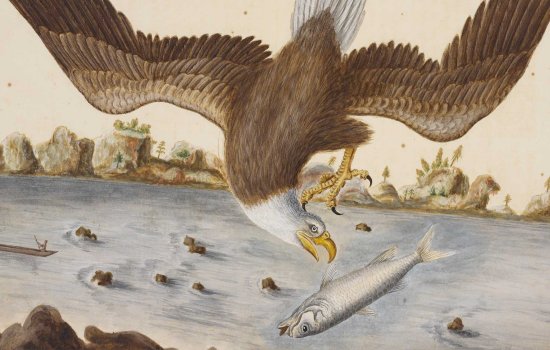
An illustration of a now familiar icon of the United States, which became the national emblem in 1782, will also be on display. Owned by King George III, this watercolour illustration by English naturalist Mark Catesby depicts a bald eagle dramatically plunging towards a fish, its spread wings stretched across the width of the picture. The image is from what is considered the first published book to survey American flora and fauna, which was printed between 1729 and 1747, and also had a place in George Washington’s library.
The exhibition will culminate with visitors able to closely examine a document that established the United States. On display will be a rare surviving Dunlap print of the Declaration of Independence, printed in 1776, the year the historic Declaration was written and signed. The Declaration was influenced by European scientific and philosophical thinking, and this official printed copy features the printer’s name, John Dunlap. Slightly longer than a sheet of A4 paper and mostly written by Thomas Jefferson, the Declaration’s contents continue to reverberate to this day, with memorable passages such as: ‘We hold these Truths to be self-evident, that all Men are created equal […] with certain unalienable Rights, that among these are Life, Liberty, and the Pursuit of Happiness.’
Sir Ian Blatchford, Director and Chief Executive of the Science Museum Group, said: This major exhibition will provide a surprising and alternative exploration of the founding of the United States in this 250th anniversary year, examining how science and technology shaped this nation, its people and the land at a pivotal moment in history. I have no doubt the exhibition’s unexpected stories will surprise our visitors and add greater depth to the shared history between our nations.’
The exhibition will shed light on scientific knowledge and technologies developed in 18th century North America by people of African descent and Indigenous nations, focusing on the Haudenosaunee Confederacy. This alliance of several nations has been described as one of the world’s oldest participatory democracies. Visitors will discover more about Indigenous practices and technologies, from canoes to agricultural techniques, and can see the popular almanac written by Benjamin Banneker, a freeborn astronomer, mathematician and surveyor of African descent who worked on the new capital, Washington DC.
Stories of everyday life for the peoples of North America are also showcased in the exhibition as they developed a better understanding of the world around them. A rare copy of a map by Benjamin Franklin charting the Gulf Stream will be on display. When Franklin realised letters took longer to travel to North America from Britain than in the other direction, he enlisted the help of his whaler cousin Timothy Folger to understand the discrepancy. As a result, they mapped the Gulf Stream, becoming the first to name and record this important oceanic current, which had a significant impact on transatlantic navigation.
Scientific surveys of the sea and land led to the creation of maps which gained political significance beyond the physical boundaries they might represent. On display will be a surveyor’s compass believed to have been used to define the Mason-Dixon Line. While the survey began as a way to settle a boundary dispute between the families governing Pennsylvania, Maryland and Delaware, the line later came to symbolise the border between the Civil War North and South of the United States and has become part of the country’s cultural identity.
Trade, conflict, slavery and resistance all played a role in how knowledge was carried, exchanged and shaped. The exhibition will explore the ways in which enslaved women used their botanical and horticultural knowledge to feed and heal their communities. On display will be okra seeds, collected in 1688 in Barbados. This native African plant was most likely brought to America and the Caribbean via the transatlantic slave trade. Okra became a key ingredient of African diasporic cuisines in America and was also used for its medicinal properties, from treating cold chills to contraceptive purposes.
Indigenous groups had long-established knowledge of how to adapt to North America’s varied terrain and navigate its waters. Canoes were an essential Indigenous American transport technology that facilitated fishing, trade, and connections. Specific canoe designs were tailored for travel through rivers, lakes and the ocean. On display will be a mishoon (dugout canoe), commissioned for the exhibition and crafted using traditional fire methods by a Mashpee Wampanoag maker. Made from a single tree, this type of canoe was perfect for navigating around the east coast, with the largest able to hold up to 40 people.
The need to provide food and sustenance for a growing population shaped the land of North America. Indigenous groups would start controlled fires to manage the landscape and encourage the growth of useful plant species, a technique which can positively impact ecosystems and is still in use today. The exhibition will also show how George Washington was strongly influenced by the British Agricultural Revolution, displaying tools and plans for more productive and mechanised agriculture used at his Mount Vernon farms.
Becoming America will also outline how science was used to help shape a national identity for the United States. On display for the first time in the UK will be a painting showing an excavation of a mastodon, an ice age relative of the elephant. Charles Willson Peale, the painter and scientist who led the excavation, went on to reassemble its skeleton in his museum in Philadelphia, one of the first public museums in the United States. Through popularising the science and history of this young nation, Peale helped nurture a national pride in its land and the scientific prowess of its people.
Becoming America: How Science Shaped a Nation, supported by Griffin Catalyst, will open at the Science Museum from 23 October 2026 to 25 April 2027. This free exhibition has been made possible thanks to the generous support of Kenneth C. Griffin and Griffin Catalyst (Title Funder), The Blavatnik Family Foundation (Major Funder), Sir Ian Blatchford and Jeremy Rosenblatt. The exhibition features historic items from the Science Museum Group Collection and remarkable objects on loan from Mount Vernon, the Library of Congress, the American Philosophical Society, the National Trust, British Museum, Royal Collection Trust and The National Archives.
Notes to Editors
For further information or to arrange interviews please contact Laura Nebout in the Press Office at laura.nebout@sciencemuseum.ac.uk or 020 7942 4733.Images are available to download via this WeTransfer link.
About the Science Museum
The Science Museum is part of the Science Museum Group, the world’s leading group of science museums that share a world-class collection providing an enduring record of scientific, technological and medical achievements from across the globe. Over the last century the Science Museum has grown in scale and scope, inspiring visitors with exhibitions covering topics as diverse as robots, codebreaking, cosmonauts and superbugs. The Science Museum was named a winner of the prestigious Art Fund Museum of the Year prize for 2020. www.sciencemuseum.org.uk. Follow on X, Facebook and Instagram.
About Griffin Catalyst
Griffin Catalyst is the civic engagement initiative of Citadel founder and CEO Ken Griffin, encompassing his philanthropic and community impact efforts. Tackling the world’s greatest challenges in innovative, action-oriented, and evidence-driven ways, Griffin Catalyst is dedicated to expanding opportunity and improving lives across six areas of focus: Education, Science & Medicine, Upward Mobility, Freedom & Democracy, Enterprise & Innovation, and Communities. For more information, visit griffincatalyst.org.
About The Blavatnik Family Foundation
Led by Sir Leonard Blavatnik, founder of Access Industries, the Blavatnik Family Foundation promotes innovation, discovery and creativity to benefit the whole of society. Through the Foundation, the Blavatnik family has contributed over $1.3 billion globally to advance science, education, arts and culture, and social justice. The Blavatnik Family Foundation has also supported more than 180 leading cultural organisations, including the National Gallery, National Portrait Gallery, Royal Academy, V&A, Courtauld, Tate Modern, and English Heritage. www.blavatnikfoundation.org
About South Ken Culture Quarter
Welcoming more than 20 million visitors a year to 22 iconic institutions, South Ken Culture Quarter is where cultural, scientific, and creative worlds collide, creating a destination for the most curious minds. Home to London’s world-leading museums, parks, cultural venues, and educational institutions, all just a short walk from one another, this is a place where ideas come to life, every single day. Founded from the proceeds of the Great Exhibition of 1851, the UK’s first cultural quarter, in the heart of South Kensington, is built on history but focused on the future. southkenculturequarter.com
FAQs
Is the Becoming America exhibition free?
Yes, entry to the Becoming America exhibition is free. However, visitors are required to book a timed entry ticket in advance via the Science Museum website.
Is the Declaration of Independence on display in the exhibition real?
Yes. Visitors to Becoming America will be able to see an authentic surviving Dunlap printing of the Declaration of Independence from 1776. Printed by John Dunlap shortly after the Declaration was adopted, only a small number of them survive today.
Is Becoming America an exhibition about the American Revolution?
While the American Revolution forms part of the historical backdrop to the exhibition, it is not the focus of the exhibition. Becoming America will uncover the science that shaped and was shaped by land, peoples and power towards the emergence of the United States. The exhibition will examine how different systems of knowledge, from navigation to agriculture influenced everyday life, power and nation-building in 18th century North America.
What time period does this exhibition cover?
The exhibition will focus on four transformative decades in North American history, spanning from the 1760s to the 1790s. Beginning with Britain’s acquisition of French territories in North America after the Seven Years’ War, the exhibition traces the scientific, technological and cultural developments that shaped the founding of the United States and concludes with the country’s first presidency in the 1790s.
Why is the exhibition opening in 2026?
The exhibition opens in 2026 to coincide with the 250th anniversary of the signing of the Declaration of Independence on 4 July 1776.
Looking to visit? Find out more on the Becoming America webpage.
If you have a ticket or visit enquiry, please get in touch with our Contact Centre. To request media interviews or assets from the press team, visit the Press Office.
( Press Release Image: https://photos.webwire.com/prmedia/7/354690/354690-1.jpg )
WebWireID354690
This news content was configured by WebWire editorial staff. Linking is permitted.
News Release Distribution and Press Release Distribution Services Provided by WebWire.