

What shaped our thinking at Global Fashion Summit – and what we brought back
At this year’s Global Fashion Summit, much of the conversation centred on how to decarbonise a complex global industry. But beneath the technical discussions sits a more fundamental question: who is included in that transition, and on what terms?
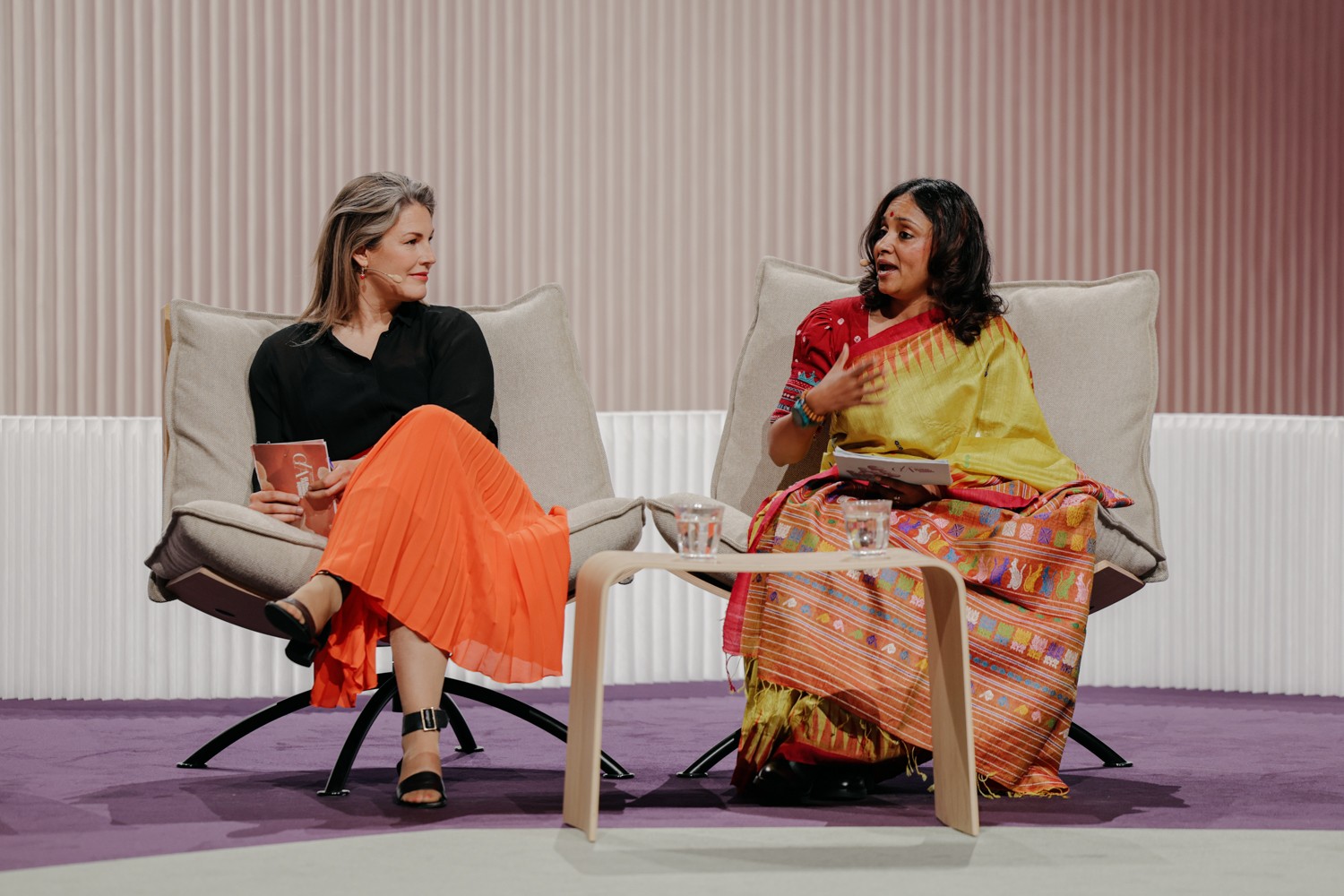
The panel “Decarbonising fashion for people”, featuring Anna Gedda, CEO of H&M Foundation, and Aarti Mohan, Co-founder and Partner at Sattva Consulting covered how decarbonisation, climate, adaptation, and social equity are deeply interconnected in manufacturing hubs.
The discussion highlighted the tension of social impact in the climate work, and the frictions and opportunities of doing both simultaneously with the below key take aways.
No Adaptation, no transition. If the workforce cannot transition with the industry, the industry will not transition at scale or will do so in ways that are difficult to sustain. Climate mitigation and adaptation are already intertwined in manufacturing contexts. Treating them separately risks slowing down both.
Many actors need to move together. Progress does not come from engaging stakeholders one by one, it depends on early alignment between suppliers, brands and workers. Suppliers drive implementation, brands shape incentives, and workers determine whether solutions function in practice. Without that alignment, solutions risk being either unworkable on the ground or disconnected from commercial realities. Also government and financial actors must be engaged. Without policy, infrastructure and capital things cannot scale.
How worker perspectives can shape better outcomes. In terms of authentic worker influence, the conversation moved beyond consultation towards what it means to embed worker input into decision-making. This includes involving workers in the design of transition strategies, creating structures for ongoing social dialogue, and linking their input to real incentives and decisions.
Anna Gedda brought up a concrete example of the above in H&M Foundation’s collective impact initiative Oporajita. Oporajita focuses on incorporating workers’ perspectives into its activities, while also supporting manufacturers on their individual decarbonisation journeys. It combines climate adaptation with mitigation and works toward systemic change.
Adding perspectives to shape the conversation
To promote a just and fair transition for the textile industry, a wide range of voices across the value chain need to be involved and heard, and solutions need to be designed together with those closest to implementation. The H&M Foundation works to facilitate that diverse perspectives are part of shaping industry conversations. Together with the Global Fashion Agenda we were supporting voices at the Global Fashion Summit 2026 that reflect different parts of the system.
Early-stage innovators from the Global Change Award Top 20 finalists 2026:
• Md. Ridwan Hossain, Co-Founder, ThreadBridge, Bangladesh • Henry Kavuma, Founder, Living Carbon Capture Dye Systems, Uganda
From system-level and implementation perspectives:
• Aarti Mohan, Co-founder and Partner, Sattva Consulting, India • Rawnak Jahan, Director, Women and Youth Program, CARE Bangladesh
• Dr. Harshita Umesh, Medical doctor and social impact advocate, India • Farhana Islam, Quality Inspector Tusuka Apparels Ltd, Bangladesh
We saw this as an important opportunity to give space to voices that are often underrepresented in these conversations, bringing in new perspectives and highlighting solutions from the ground. We already know what needs to be done; the challenge is understanding how to do it. By bringing in perspectives from across the value chain into the conversations where decisions are shaped, we hope to see more direct discussions, earlier identification of barriers, and solutions that are more grounded in practice.
Our reflections from the summit
Colleagues across the Foundation engaged in conversations, roundtables and meetings throughout the Summit. One general reflection that we have is that we are shifting from a situation where climate has mainly been a long-term, reputation-driven issue to one that is operational and existential here and now. For example, climate change is already causing heat stress which doesn’t just threaten sustainability targets, but the ability to produce, the health of the workforce, and ultimately delivery capacity. Meaning capital will be redirected from purely CO₂ reduction to solutions that protect people and operations (e.g. cooling, water, working conditions). Thus, resilience will become a competitive advantage; companies that can secure production under extreme climate conditions manage better.
Financing the transition
It was clear throughout the conference that financing sustainability, to ensure it becomes an operational reality, is more important than ever. The discussion highlighted that we cannot rely on the moral imperative alone to drive change. Instead, sustainability needs to be treated as a core business area, integrated into operations and backed by the financial resources it requires.
A strong signal of this is that “just transition” is no longer confined to the CEO agenda only; it has firmly entered the CFO’s room. It starts to shape how capital is allocated, how risks are assessed, and how investments are prioritised. It gets embedded into financial models, business cases and performance tracking.
At the same time, many key sustainability areas, such as decarbonisation, circularity and a just transition, come with investment needs far beyond the ordinary. This underlines the importance of collaboration and the need to utilise a broader ecosystem, where all actors, including suppliers, brands, investors, governments and philanthropic organisations, play their part.
( Press Release Image: https://photos.webwire.com/prmedia/7/354601/354601-1.jpg )
WebWireID354601
This news content was configured by WebWire editorial staff. Linking is permitted.
News Release Distribution and Press Release Distribution Services Provided by WebWire.