

Shaping industry conversations
When key actors are missing from industry conversations, solutions risk being unrealistic, ineffective, or unjust. Our work to ensure that critical perspectives shape decisions is not a question of representation, it is a precondition for an effective and just industrial transformation.
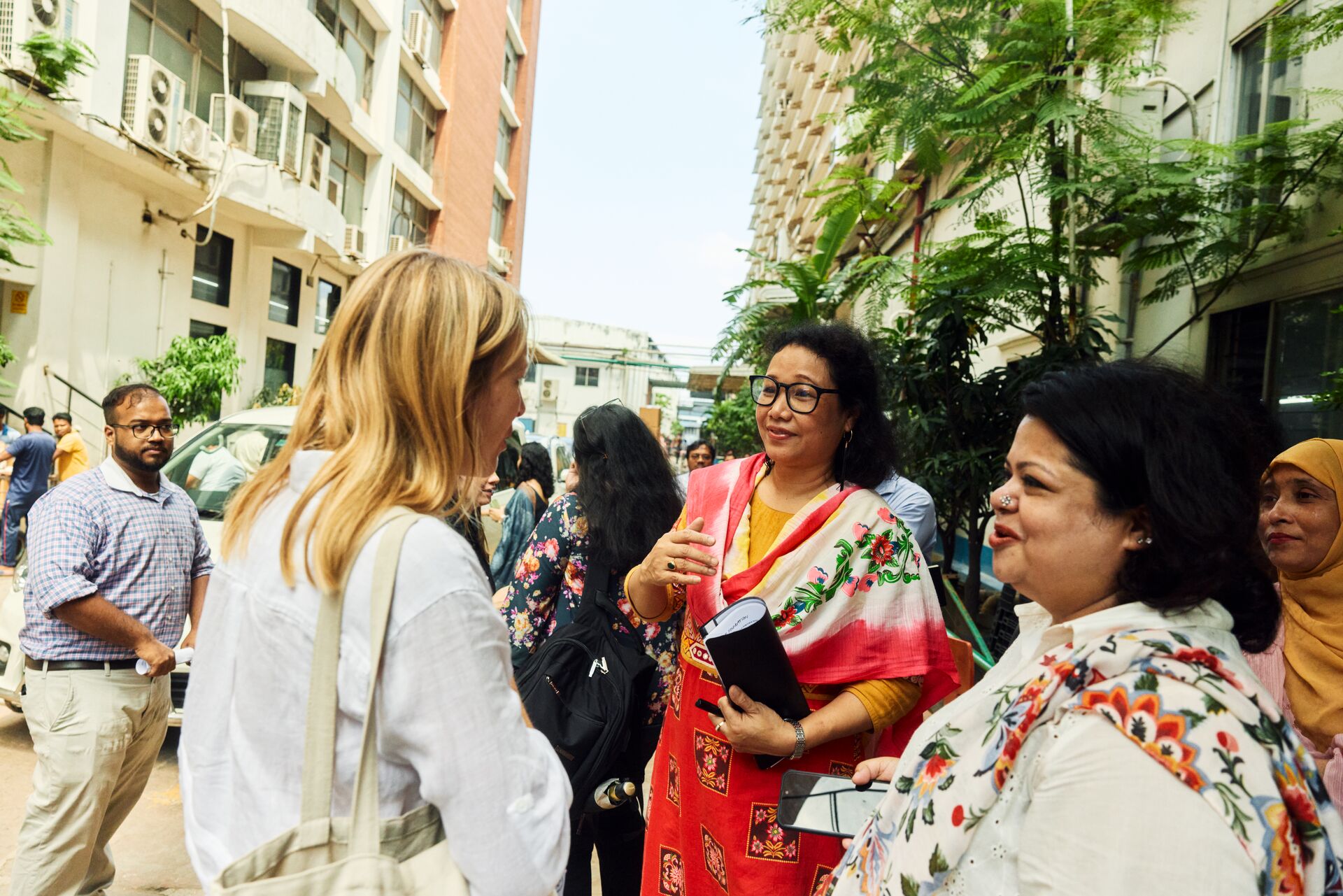
To promote a just and fair transition for the textile industry, a wide range of voices across the value chain need to be involved and heard, and solutions need to be designed together with those closest to implementation. The H&M Foundation works to facilitate that diverse critical perspectives are part of shaping industry conversations to ensure an effective and just supply-chain decarbonisation journey.
Our support works in three ways:
• We provide access and funding to relevant industry spaces through facilitation of access and participation, travel funding, ticket funding, personal support and network access.
• We build capacity so the contributing actors are well equipped to provide perspectives and influence conversation outcomes. This includes speaker and narrative support, strategic introductions and follow-up facilitation.
• We aim to influence the industry narrative by challenging how agendas are framed and who’s heard, so that diverse critical perspectives shape how problems and solutions are understood.
We start by looking at the conversation or arena, then we ask; who is influenced by its discussions and solutions? Who is implementing the solutions? Who is influencing decisions, and who is not present, and why?
This helps us move from fixed target groups to a more situational and strategic approach, because the gaps vary depending on the context and arena. In some conversations, manufacturers or workers are missing. In others, brands, small and local businesses, or actors from the informal sector may not be heard. For example, manufacturers and garment workers hold critical knowledge about production processes, workforce dynamics and climate vulnerability.
The Global Fashion Summit 2026
Across conferences and summits, strategies are often shaped without the people who are closest to implementation. By helping to bring in perspectives from across the value chain into the conversations where decisions are shaped, we hope to see more direct discussions, earlier identification of barriers, and solutions that are more grounded in practice. Building on our collaboration last year, we are continuing this work at Global Fashion Summit 2026 in collaboration with Global Fashion Agenda. The voices supported to participate this year reflects different parts of the system from innovation to implementation.
From the Global Change Award Top 20 finalists 2026:
• Md. Ridwan Hossain, Co-Founder, ThreadBridge, Bangladesh • Henry Kavuma, Founder, Living Carbon Capture Dye Systems, Uganda
These are early-stage innovators working on solutions the industry needs, but who rarely have access to the forums where adoption pathways are discussed.
To promote a just and fair transition for the textile industry, a wide range of voices across the value chain need to be involved and heard, and solutions need to be designed together with those closest to implementation. The H&M Foundation works to facilitate that diverse critical perspectives are part of shaping industry conversations to ensure an effective and just supply-chain decarbonisation journey.
Our support works in three ways:
• We provide access and funding to relevant industry spaces through facilitation of access and participation, travel funding, ticket funding, personal support and network access.
• We build capacity so the contributing actors are well equipped to provide perspectives and influence conversation outcomes. This includes speaker and narrative support, strategic introductions and follow-up facilitation.
• We aim to influence the industry narrative by challenging how agendas are framed and who’s heard, so that diverse critical perspectives shape how problems and solutions are understood.
We start by looking at the conversation or arena, then we ask; who is influenced by its discussions and solutions? Who is implementing the solutions? Who is influencing decisions, and who is not present, and why?
This helps us move from fixed target groups to a more situational and strategic approach, because the gaps vary depending on the context and arena. In some conversations, manufacturers or workers are missing. In others, brands, small and local businesses, or actors from the informal sector may not be heard. For example, manufacturers and garment workers hold critical knowledge about production processes, workforce dynamics and climate vulnerability.
The Global Fashion Summit 2026
Across conferences and summits, strategies are often shaped without the people who are closest to implementation. By helping to bring in perspectives from across the value chain into the conversations where decisions are shaped, we hope to see more direct discussions, earlier identification of barriers, and solutions that are more grounded in practice. Building on our collaboration last year, we are continuing this work at Global Fashion Summit 2026 in collaboration with Global Fashion Agenda. The voices supported to participate this year reflects different parts of the system from innovation to implementation.
From the Global Change Award Top 20 finalists 2026:
• Md. Ridwan Hossain, Co-Founder, ThreadBridge, Bangladesh • Henry Kavuma, Founder, Living Carbon Capture Dye Systems, Uganda
These are early-stage innovators working on solutions the industry needs, but who rarely have access to the forums where adoption pathways are discussed.
Aarti Mohan brings a critical perspective on what it means to decarbonise in a way that is also fair. As she has pointed out, the transition risks deepening inequality if it focuses only on emissions and not on the people behind the system.
Rawnak Jahan represents the reality of that system. Through Oporajita, she works directly with woman garment workers in Bangladesh where more than five million people power the industry, many of them women facing structural barriers and increasing climate pressure. Her work focuses on what a just transition looks like in practice: building skills, improving working conditions, and ensuring workers have a voice in decisions that affect their future.
Farhana Islam, garment worker and quality inspector at Tusuka Apparels Ltd and involved in Oporajita, was also set to participate. Following visa constraints, she will contribute through a recorded message. Her experience reflects what is often missing from global conversations the perspective of those directly affected by both industry shifts and climate impacts. After participating in Oporajita, Farhana has developed leadership skills, clearer career ambitions, and greater agency in both her work and personal life.
Dr. Harshita Umesh brings a perspective that is often overlooked in industry discussions: the intersection between health, social systems and climate. With a background in medicine and recognised for her work in community health and social initiatives, she has focused on how structural challenges affect people’s wellbeing and access to opportunity. From occupational health risks to broader social impacts, her perspective reinforces the need to design solutions that consider people’s lives, not just production systems.
These are not “new voices”, rather they are experienced actors with deep, practical knowledge of the industry and beyond. And when voices like these are included in strategy design and industry discussions, decarbonisation pathways can become feasible, equitable and competitive.
( Press Release Image: https://photos.webwire.com/prmedia/7/354303/354303-1.jpg )
WebWireID354303
This news content was configured by WebWire editorial staff. Linking is permitted.
News Release Distribution and Press Release Distribution Services Provided by WebWire.