

AirAsia X Records Strong 1Q2026 Operating Performance With Passenger Growth of 9% YoY
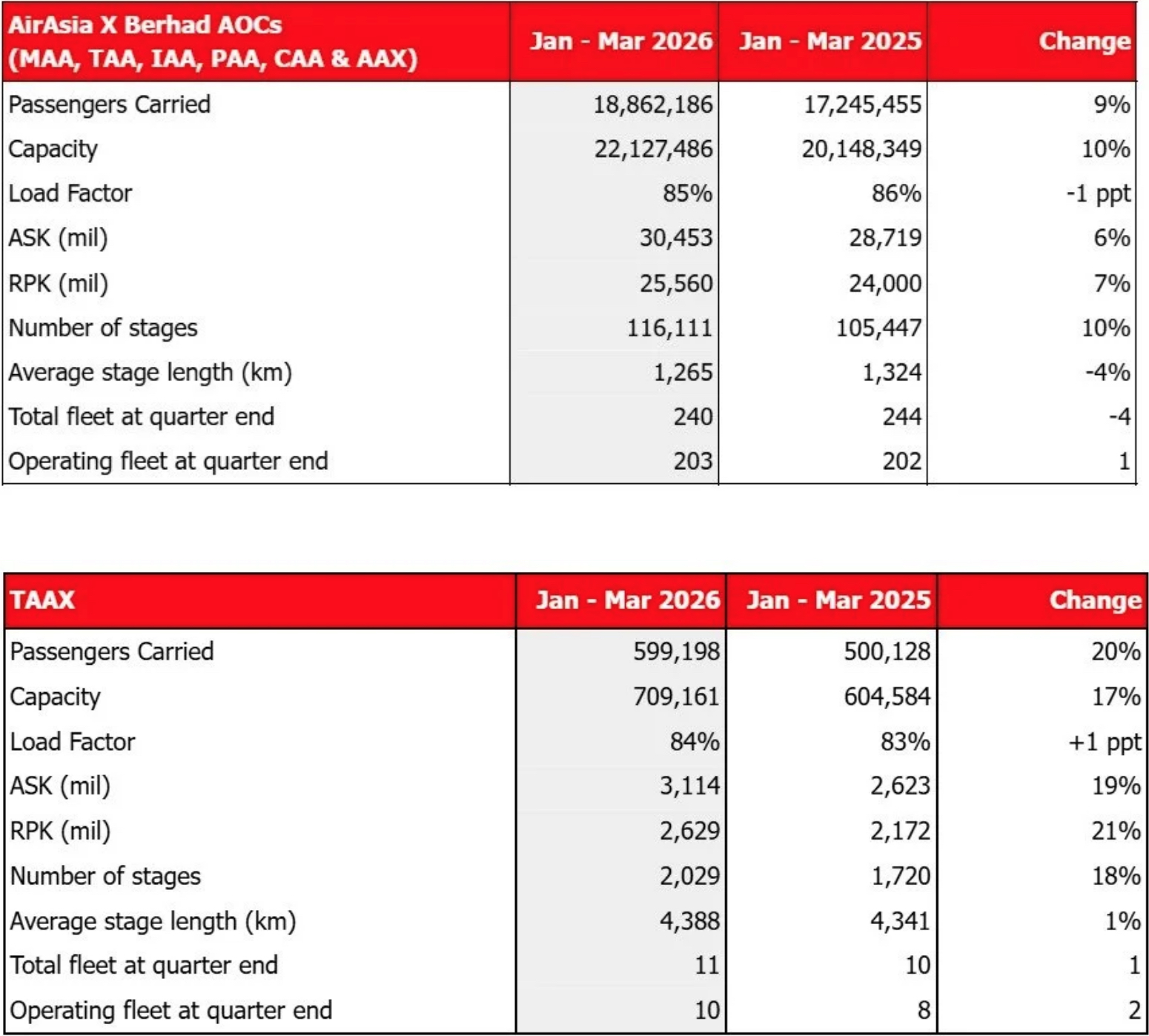
AirAsia X Berhad (“the Group”) has announced its preliminary operating statistics for the First Quarter of 2026 (“1Q2026”). This represents the inaugural consolidated report for the Group following the successful acquisition of the AirAsia aviation assets, bringing together all AirAsia branded airlines under a single listed entity.
The Consolidated Air Operating Certificates (“AOCs”), comprising AirAsia Malaysia, AirAsia Thailand, AirAsia Indonesia, AirAsia Philippines, AirAsia Cambodia, and AirAsia X Malaysia, demonstrated significant operational synergy, carrying approximately 18.9 million passengers during the quarter, up by 9% year-on-year (“YoY”). This performance indicates sustained demand across the network as passenger growth remains aligned with a 10% YoY increase in capacity to 22.1 million seats. The Consolidated AOCs have now recovered capacity to 98% of pre-pandemic levels, with a robust load factor of 85%.
A key driver of the performance was the surge in domestic demand, which saw double-digit YoY growth in both passengers carried and capacity across Malaysia, Thailand, Indonesia and the Philippines. On the international front, the Group’s focus on North Asia maintained solid momentum. Major routes to China from both Malaysia and Thailand performed well, with load factors for these sectors recorded at 85% for the quarter. The Group continues to leverage its dominant position in the China-Asean travel corridor, capturing consistent demand across key primary and secondary cities.
The Group showed remarkable operational agility in March 2026, the first month following the onset of heightened geopolitical tension and increasing jet fuel prices. In March alone, the Consolidated AOCs carried 6.3 million passengers, a 19% YoY increase which surpassed the 15% YoY increase in capacity. This performance was driven by the festive period, where the Group’s commitment to providing the best value to guests allowed it to capture a significant growth in regional travel.
Notably, the load factor for March increased by 2 percentage points YoY to 84%. While the Group had strategically adjusted fares and fuel surcharges to manage escalating fuel costs, AirAsia remained the preferred choice for guests prioritising affordable and reliable connectivity during this peak period. Furthermore, by positioning its network as a critical alternative for redirected global traffic flows between Europe and Asia, the Group captured a surge in demand on its Central Asia corridors, benefitting from a strong “fly-thru” effect across the broader Asean network.
The Group’s associate, AirAsia X Thailand (“TAAX”) carried 599,198 passengers during the quarter, representing a 20% YoY increase. The associate recorded a solid load factor of 84%, reflecting a 1 percentage point improvement YoY. This performance highlights the successful optimisation of the long-haul network following its strategic hub relocation to Don Mueang International Airport in late 2024. Market demand remained sound across key destinations, supported by the expansion of its operating fleet and increased frequencies to North Asia and India.
The Consolidated AOCs increased the operating fleet by 1 YoY to 203 aircraft, and closed the quarter with a fleet of 240 aircraft. TAAX’s fleet size stood at 11.
Bo Lingam, Group CEO of AirAsia X, said: “This first quarter of 2026 validates the strength of our consolidated model. Our RPK growth of 7% surpassed ASK growth of 6%, clearly demonstrating the success of our network optimisation, ensuring capacity is deployed where demand is strongest. In response to external fuel pressures, we moved decisively in March to manage our margins through adjusted fares and fuel surcharges.
Crucially, we have seen no significant signs of demand disruption. Our March load factor actually increased YoY, as our guests prioritised the value and connectivity we provide during the Raya and Lebaran peak. Looking ahead, this momentum has carried into April, with forward bookings remaining firm across our core network. Our priority is to maximise the productivity of our active fleet while keeping our integrated network lean and adaptable. By prioritising high-yield corridors and maintaining disciplined cost management, we are prepared to navigate the uncertainties of the months ahead with resilience and agility.”
Definition of Terms:
-
Passengers carried represent the number of earned seats flown. Earned seats comprise seats sold to passengers (including no-shows) and seats provided for promotional purposes
-
Capacity measures the number of seats flown
-
Load factor is calculated as Passengers Carried divided by Capacity
-
Available Seat Kilometres (ASK) measures an airline’s passenger capacity. Total seats flown multiplied by the number of kilometres flown
-
Revenue Passenger Kilometres (RPK) is a measure of the volume of passengers carried by the airline. Number of passengers multiplied by the number of kilometres these passengers have flown
-
Number of stages is equivalent to number of flights flown
-
The number of total aircraft is at quarter end
-
The number of operational aircraft at quarter end excludes operational and maintenance spares
( Press Release Image: https://photos.webwire.com/prmedia/7/353125/353125-1.jpg )
WebWireID353125
This news content was configured by WebWire editorial staff. Linking is permitted.
News Release Distribution and Press Release Distribution Services Provided by WebWire.