

The Prestigious Asi Bertone Collection Returns to Turin, to the Heritage Hub
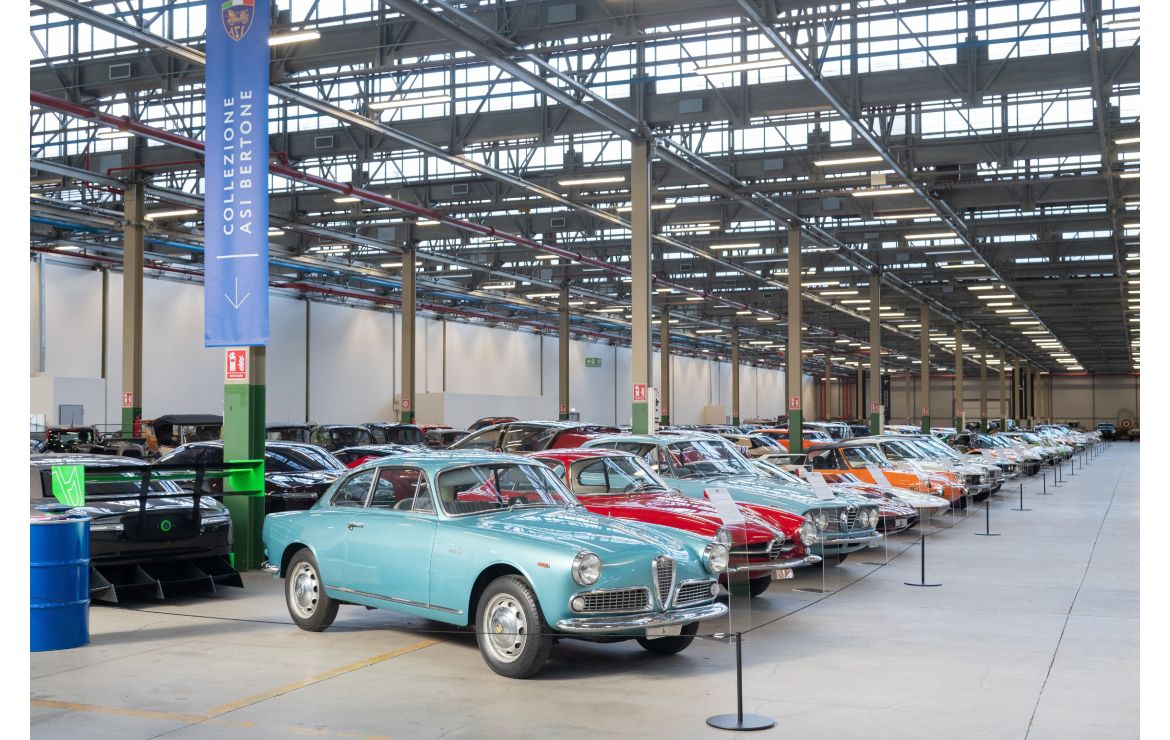
- The return of the ASI Bertone Collection to Turin restores a fundamental piece to the city’s industrial and stylistic heritage, bringing “home” one of the most iconic collections in international car design.
- Welcoming the collection is the “new” Heritage Hub, which over the past year has undergone a period of profound transformation and enrichment through a reorganized exhibition route and new visiting formats, further strengthening the dialog between industrial identity, automotive culture and the Piedmontese capital.
- Sixty-six Bertone masterpieces, spanning from the 1960s to the early 2000s, shape a unique narrative of radical visions, design experimentation and creative freedom beyond the constraints of production.
- The agreement between ASI and Heritage Hub turns a preservation initiative into a living cultural project, open to the general public and able to enhance the value of Italy’s automotive system, particularly that of Piedmont.
Yesterday, the Heritage Hub in Turin hosted the inauguration of the new display dedicated to the ASI Bertone Collection, which can rightly be regarded as one of the most significant collections in international automotive design. A long-awaited and much sought-after return, one that further enriches Turin’s motoring and cultural offering and marks a natural meeting point between two complementary heritages in the stylistic and technical evolution of what is proudly “made in Turin”.
Testifying to the project’s cultural value and its strong ties to the local area, the official ceremony was attended by Andrea Tronzano, Councillor for the Piedmont Region, Alberto Scuro, President of ASI, and Roberto Giolito, Head of Heritage Hub Italy, together with leading names in car design who played a key role in some of the most important chapters of the Bertone Style Centre: from Giorgetto Giugiaro to Luciano D’Ambrosio, from Giuliano Biasio to David Wilkie, and Mike Robinson.
Thanks to the agreement between the Automotoclub Storico Italiano and the Heritage Hub, from now on the general public will also be able to admire the Bertone Collection, acquired and placed under ASI protection in 2015. The display features 66 models created between the 1960s and the early 2000s, including iconic production cars, styling models, prototypes and show cars representing twenty international automotive brands with which Bertone had established successful collaborations. Each piece tells a story of manufacturing excellence, relentless creative research and the evolution of the concept cars developed by the Bertone Style Centre in every decade. Taking advantage of the opportunity to shape vechicles not intended solely for mass production, Bertone’s designers boldly reimagined vehicle architecture, drawing on universal ideas of line and perfect form. The initiative forms part of a period of far-reaching reorganization of the exhibition space at Via Plava 80, within the historic Mirafiori complex, launched over the past twelve months to make the visitor experience even more engaging. This has given rise to the “new” Heritage Hub, now more accessible and even more structured, further strengthening one of its core missions: to tell the story of and preserve “the cars of Turin” - those vehicles, ideas and visions that made the Piedmontese capital one of the most influential centres in the automotive history. This is borne out by a collection unlike any other, comprising more than 300 vehicles from the Group’s Italian brands, encapsulating over 120 years of innovation and Made in Italy style, and giving shape to a coherent, continuous narrative spanning eras and languages: from historic models to more recent ones, from production cars to one-off examples and prototypes unique in the world.
And so the “new” Heritage Hub is born—now more accessible and even better organized—further: More specifically, to make the visitor experience even more immersive, the eight thematic sections of the exhibition route have been reorganized since last year. Within each space, eight key vehicles are displayed in chronological order, accompanied by other models linked by technical or design affinity, helping to broaden the historical and cultural context of each section. In addition, in response to steadily growing interest - visitor numbers rose by 6% last year compared with 2024, with a significant presence of international visitors - from March the Heritage Hub has been open every day (except Mondays), with admission available by purchasing tickets online at the following link. Visitors can choose between a self-guided visit on weekdays and a guided tour at weekends.
Roberto Giolito, Head of Heritage Hub Italy, said: “The mission of the Heritage Hub is to tell, through an evolutionary perspective, more than one hundred years of history of motoring, deeply intertwined with the city of Turin. The addition of the ASI Bertone Collection further strengthens the role of the Heritage Hub as a unique point of reference in the museum landscape, capable of recounting the key stages in the evolution of technology and design across a variety of fields: from motorsport to ecology, from coachbuilt cars to the small cars that have shaped the history of mobility around the world. We are particularly proud to take part in this project, offering an ever wider audience the opportunity to discover and rediscover Italy’s extraordinary history through the vehicles that will enrich the collection already on display in our spaces.”
Alberto Scuro, President of ASI, emphasised: “We are truly pleased and satisfied with this new collaboration because, from the outset, the goal was to bring back to Turin a heritage that belongs to the city and to Piedmont. Bertone is one of the great names in car design and style, for which Turin provided fertile ground for a development unparalleled anywhere in the world. After acquiring the Collection in 2015 - which had already been placed under the protection of the Ministry of Culture so that it could neither leave Italy nor be broken up - with this definitive return under the Mole we can say that we have completed our mission of protection, preservation and promotion. All this is taking place on the occasion of the sixtieth anniversary of ASI’s foundation, in a symbolic convergence that makes us proud of our work and of the increasingly effective network that has been built with many other local stakeholders, institutions, companies and organizations that continue to believe in the cultural and economic value of Piedmont’s automotive sector. Turin is reaffirming its status as the world capital of the history of motoring”.
The ASI Bertone Collection
The origins of the Collection date back to the early 1970s, when Nuccio Bertone had an intuition that would prove invaluable, especially for future generations. The new Caprie headquarters, inaugurated on 15 October 1972 just a few kilometers from Turin, offered the space needed to house the collection. The most innovative prototypes would no longer be destined for demolition but would instead represent the Company in the years to come. To these prototypes, Bertone would add his personal collection, made up of the cars dearest to him. The exhibition at the Heritage Hub opens with the 1963 Alfa Romeo Giulia Sprint, a model that embodies Bertone’s dual soul: the one that lives within the Style Centre and the one that sustains the industrial productivity of the Coachbuilder, which for many years operated assembly lines dedicated to both small- and large-scale production. Remaining in the 1960s, highlights of the Collection include the 1967 Lamborghini Miura S and the 1969 Runabout. For the following decade, a number of production models stand out, including the Lamborghini Espada (1970), Fiat Dino Coupé (1970), Lancia Stratos (1975), Fiat X1/9 (1977) and Ferrari 308 GT4 (1978, the only series-production Ferrari designed by the Bertone Style Centre), alongside prototypes such as the Suzuki Go (1970), Citroën Camargue (1972), NSU Trapeze (1973), Ferrari Rainbow (1976) and Volvo Tundra (1979). These were the years in which the Bertone Style Centre was led by car-design master Marcello Gandini, one of the first to introduce unprecedented geometric lines that would completely redefine the very concept of the automobile. The epochal transition into the 1980s took shape through visionary proposals such as the Chevrolet Ramarro (1984), Citroën Zabrus and Lamborghini Genesis (1988), set against cars intended for the wider public such as the Opel Kadett Cabriolet (1983) and Fiat Ritmo Cabriolet (1986), culminating in a universally recognized supercar such as the Lamborghini Countach Quattrovalvole (1987). In the following 1990s, Bertone was among the first automotive players to explore the theme of electric propulsion. It was a highly advanced yet at the same time concrete vision, reaching its highest expression in the Bertone Z.E.R. (Zero Emission Record), which set numerous world records in 1994 and 1995. Also electric was the sporty 1992 Bliz, conceived for pure driving fun, much like a faired go-kart. Also worthy of note are a number of other grand touring coupés such as the Lancia Kayak (1995), Opel Slalom (1996) and Alfa Romeo Bella (1999), as well as several multipurpose variants developed on the basis of Fiat production models such as the Cinquecento, Punto and Bravo: namely the Rush (1992), Racer (1994) and Enduro (1996). The arrival of the third millennium was marked by functionality, with the launch in 2000 of the Bertone Slim, conceived for the urban environment and featuring a narrowed body recalling an aircraft fuselage. Then came the Opel Filo (2001) and Cadillac Villa (2005) MPVs, expressing the pleasure and comfort of experiencing the car as one’s own home. Nor could other thoroughbred sports cars be missing - a concept deeply rooted in Bertone DNA - such as the Birusa (2003), Aston Martin Jet 2 (2004) and Jaguar B99 TT (2011).
An iconic place in which to breathe in the history of Italian motoring
The first thing that undoubtedly captures visitors’ curiosity at the Heritage Hub is the building in which these one-of-a-kind vehicles are housed- the approximately 15,000 square meters of the historic Officina 81 on Via Plava in Turin, one of FIAT’s mechanical production plants within the Mirafiori industrial complex, whose origins date back to 1939. To accommodate the company’s extraordinary collection, the original setting underwent a meticulous conservative restoration that respected its industrial character, its historic mustard and green color scheme, the concrete flooring and the grid of metal pillars. At the center of the exhibition space are 64 historic vehicles, divided into 8 thematic areas: “Records and Races,” featuring the cars that triumphed on major circuits around the world; “Concepts and Fuoriserie,” showcasing extremely rare vehicles and extraordinary one-off pieces; “Archistars,” models that revolutionized automotive architecture while respecting the principles of productivity and functionality; “Eco and Sustainable,” dedicated to vehicles whose design stands out for environmental considerations; “Small and Safe,” models that successfully combine safety with compact size; “Style Marks,” cars that made design history; “Epic Journeys,” vehicles that starred in unforgettable travels; “The Rally Era,” the Italian “beasts” of the golden age of road and dirt racing. The two long sides of the building house the rest of the collection, arranged by brand and in chronological order. Alongside the FIAT and Lancia brands, visitors will find a selection of Alfa Romeo, Autobianchi and Abarth models, together with special sections such as the one dedicated to the historic FIAT vehicles of the Carabinieri, with 16 cars recounting half a century of collaboration. At the far end of the pavilion, there is also an area dedicated to engines, featuring a selection of more than thirty of the most important powertrains - from the renowned four-cylinder engine of the “100 Series” to electric, turbine and even steam prototypes - testifying to a century of ingenuity and experimentation by the Group’s Italian brands.
( Press Release Image: https://photos.webwire.com/prmedia/8/352694/352694-1.jpg )
WebWireID352694
This news content was configured by WebWire editorial staff. Linking is permitted.
News Release Distribution and Press Release Distribution Services Provided by WebWire.