

GCA Impact story: How Ponda is restoring ecosystems at scale
When Ponda won the Global Change Award in 2022, they set out to prove that a supply chain could restore ecosystems rather than exhaust them. Three years on, they’ve raised $6.5 million in fundingand are entering a new phase of growth, with regenerated wetlands now taking shape across Europe and their first commercial product launch reaching the market.
In our GCA Impact Series, winners of the Global Change Award share their journeys, pivots and how their innovations are translating into real-world impact in the textile industry.
When Julian Ellis-Brown, CEO and co-founder, joins our conversation, he’s wearing a cap that reads “Make wetlands wet again.” Ponda is on a wetland mission, and after years of development their plant-based insulation BioPuff® is now reaching stores.
“All of the work we’ve put in over the past five years has been about proving that a planet-healing supply chain is possible. Being able to have consumer-facing products now is the result of all that effort.”
The material is warm, naturally hydrophobic and breathable thanks to its plant-based cellulose structure. According to Julian, it is already cost-competitive with premium synthetic insulation and significantly cheaper than goose down, making it a viable option for brands looking for high-performance alternatives.
Their first wider commercial release is with Sheep Inc, a regenerative wool brand known for their traceability and focus on natural materials. The collaboration came together in a matter of months.
“This shows that when you really want to make something happen, things can move quickly,” Julian says. “And it’s important to work alongside mission-aligned partners.”
Edzard van der Wyck, co-founder of Sheep Inc, explains that working with Ponda aligns with their ambition to design materials in collaboration with natural systems – a direction they, alongside many brands now, see as essential moving forward.
“BioPuff® represents exactly the kind of natural innovation the industry needs: performance rooted in regeneration rather than petrochemicals. It’s a perfect expression of our belief that nature still outperforms synthetics when we design with it, not against it.”
As volumes begin to grow, these early commercial launches are helping Ponda build the operational and supply chain foundations needed to work with larger brands.
Building the foundations
Behind this momentum for Ponda lies years of groundwork. Since winning the Global Change Award, Ponda has moved from idea-stage concept to commercially viable insulation material, expanding both sides of their supply chain. The team has spoken to more than 400 brands to understand what the industry actually needs.
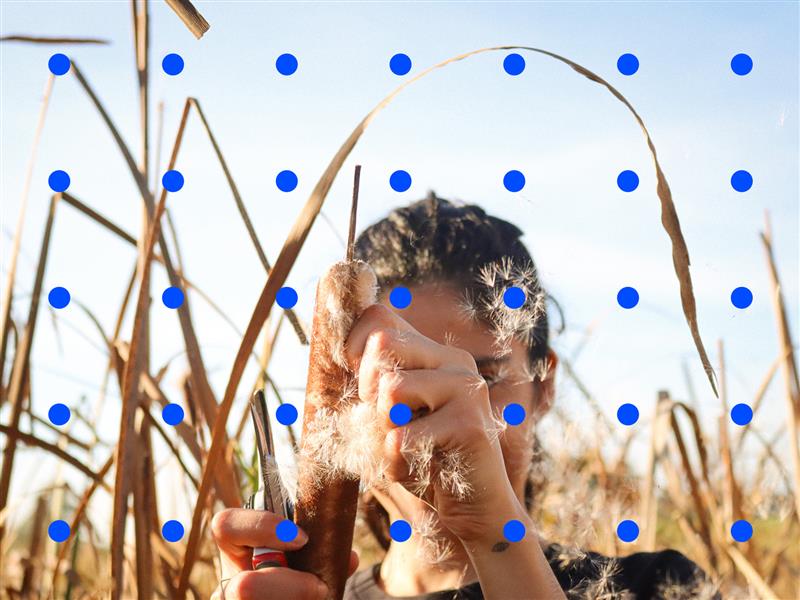
At the same time, they have been refining how to grow and harvest Typha, the wetland plant behind BioPuff®, at scale. Trials with low-ground-pressure harvesters and drone-assisted planting are now accelerating wetland regeneration and reducing manual work.
As Julian explains, the climate potential of this approach is significant.
Drained wetlands release around two gigatonnes of emissions globally each year, and restoring them can reduce 20-100 tonnes of emissions per hectare annually. On one of Ponda’s UK regeneration sites, they have recorded an 80% uplift in red-listed species after rewetting.
At the product level, Ponda estimates that one square metre of BioPuff® insulation requires roughly four square metres of restored wetland, helping avoid 10–40 kilograms of emissions while storing up to 800 litres of water in the landscape.
While these figures are based on early monitoring and estimates rather than final system-wide outcomes, they offer a strong indication of what this approach could unlock at scale. For Julian, they underline why building a regenerative supply chain matters: it channels value back to farmers and turns restoration into a viable economic opportunity.
Learning to scale
But scaling hasn’t been simple. Julian recalls pitching the same company “around twelve times,” meeting new teams from sustainability to procurement to product design.
The importance of momentum is really critical. You need every part of a company to understand why this matters.
Julian Ellis-Brown
Technically, too, the team had to rethink early methods: manual harvesting and small-scale planting simply weren’t viable at commercial scale. This pushed Ponda to co-develop low-ground-pressure machinery and explore drone-assisted wetland establishment to accelerate growth.
The production curve is now steepening. Back in 2022, Ponda harvested 3.5 tonnes of material. In 2025, they reached 12 tonnes, a sign of acceleration, with more on the way. They’re already halfway toward their ambition of creating the world’s largest paludiculture pilot: a 100-hectare wetland system capable of producing enough fibre for around 100,000 jackets each year.
The potential scale is significant. Globally, around 300 million hectares of wetlands have been drained, while the UK alone has roughly 200,000 hectares of drained fens under cultivation. Julian notes that restoring less than half of the UK’s suitable land could supply around 12% of the European insulation market, while generating roughly £300 million in revenue and avoiding up to 100 megatonnes of CO₂.
Julian credits the Global Change Award with shaping Ponda’s ability to think at that scale.
“Being part of the Changemaker Programme helped us broaden our horizons and understand what was possible,” he says. “It unlocked a door into a much larger world, and that large-scale thinking is exactly what you need when working with global supply chains.”
Looking ahead
For Ponda, the mission remains clear: make wetlands wet again. With new brand partnerships, a strengthened commercial team, and a growing regenerative supply chain, they are building the infrastructure for nature-based materials that support both climate mitigation and community resilience.
The goal is to prove that nature-based materials can compete on both performance and price: “Creating affordable, high-quality products that contribute directly to restoring wetlands – that’s what meaningful progress looks like for us in the year ahead.”
About Ponda
Ponda uses regenerative agriculture to rewet and regrow native plants to peatlands, transforming the harvest into warm, light-weight and water-repellent BioPuff® as an alternative to goose down.
Since winning the Global Change Award, Ponda has moved from idea-stage concept to commercially viable insulation material, expanding both sides of their supply chain.
The H&M Foundation supports the textile industry’s journey to halve greenhouse gas emissions every decade by 2050, while promoting a just transition for both people and the planet. Funded by the Persson family, the H&M Foundation leverages its philanthropic strengths to drive transformative change, focusing on high-emission areas in the textile value chain.
( Press Release Image: https://photos.webwire.com/prmedia/7/352446/352446-1.jpg )
WebWireID352446
This news content was configured by WebWire editorial staff. Linking is permitted.
News Release Distribution and Press Release Distribution Services Provided by WebWire.