

The Making of Cardboard
Scribbling on 3D Cardboard
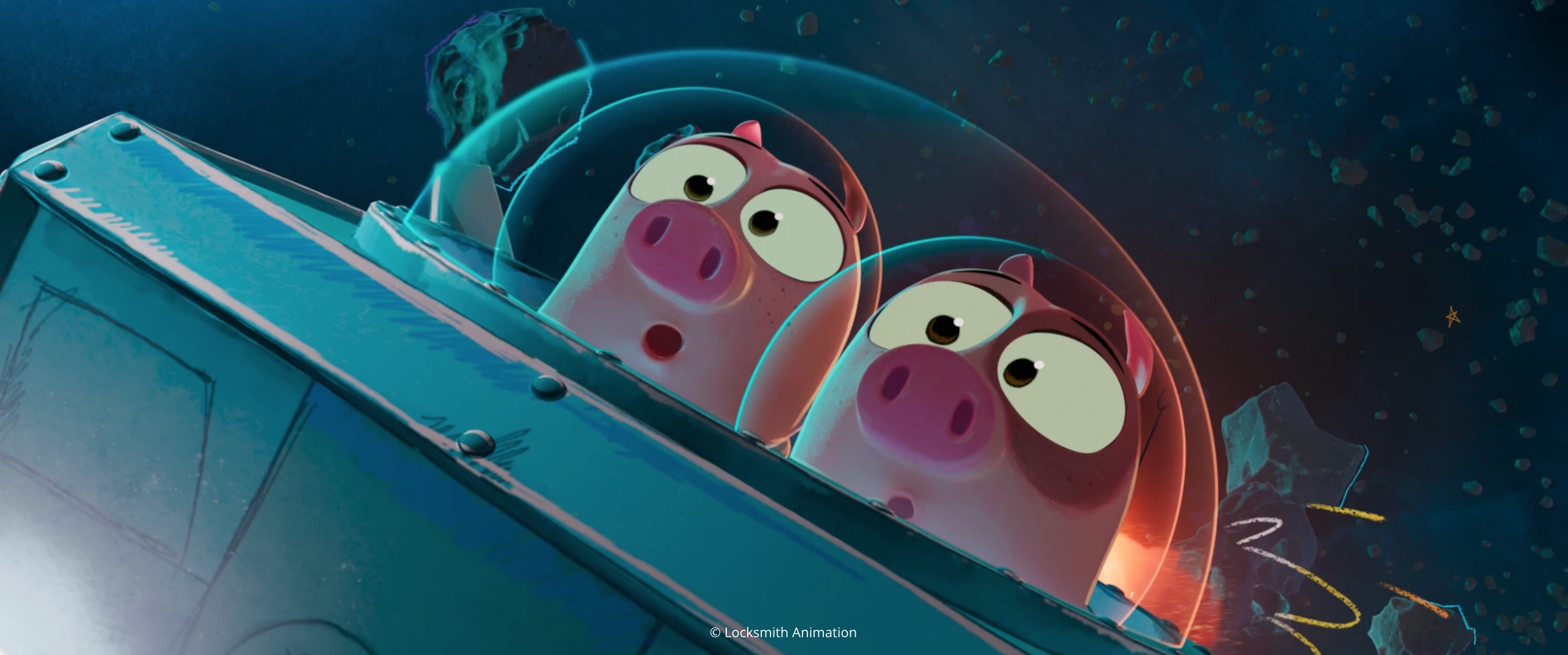
Directed by J.P. Vine, Cardboard takes us through an emotional journey thanks to a beautiful and subtle illustrated aesthetic crafted by J.P. and VFX Supervisor Andy Baggarley, with a fantastic execution by the artists at Locksmith, Ritzy, and DNEG Animation. Cardboard was shortlisted for the 98th Academy Awards and is a film full of heart, discovery, and childlike wonder that exemplifies how a small team with time constraints can accomplish the most beautiful creative solutions.
The fundamental visual goal of the film was clear from the start. “We knew we didn’t want to create a hyper-graphic film. Cardboard needed to feel inviting and textural in a more subtle way,” said J.P. Vine, Director of Cardboard.
Drawing inspiration from classic British illustrators like Quentin Blake and Raymond Briggs, J.P. envisioned a 3D film that didn’t actually look 3D. He wanted audiences to feel the hand of the artist, complete with visible brushwork, organic watercolor textures, and the charming imperfections of marker pens and colored pencils. “We asked ourselves a lot of questions … like how do you imbue shadows with textural qualities … we tackled these questions as they came to us during production,” added J.P. Vine.
Achieving that look within the DNEG Animation pipeline fell to Andy Baggarley, VFX Supervisor on Cardboard. Without the resources to build a proprietary stylized pipeline on the show, Andy had to rely on clever technical creativity. His workflow started by stripping away everything that inherently makes 3D look like 3D. Using Adobe Substance Painter, he applied completely flat colors to the models, removing standard shading, reflections, and ambient occlusion wherever possible. “I recall J.P. walking into the room early on, seeing the flat textures and shading and immediately saying … That’s Great!,” said Andy.
From there, Locksmith CG visual development artist, Olly Crawford, built a custom Nuke script that showcased the technical breakdown in detail. This was then shared with DNEG Animation to make sure the final look was represented as close as possible to the original artistic choices. Instead of traditional lighting, they manipulated RenderMan light passes (IDs) in Nuke, crunched the levels to isolate the harsh lines between light and shadow, also known as the terminator, and ran those through noise filters to create a toon line that felt hand-drawn and natural. “To sell the illusion completely, we placed a literal scan of watercolor paper as a top overlay on all the texture passes in Substance Painter,” said Andy.
The background environments required their own clever hacks. Initially, the team spent time trying out software for watercolor simulations, including clever API changes. Eventually, they solved the look by simply taking a standard 3D depth-pass out of RenderMan and using it to drive a coarse painterly look with paint strokes. The result was a stunning, smudged watercolor falloff that perfectly blurred the distant background elements.
In Cardboard, the father is overwhelmed, burdened by the baggage of life. “His world is oppressive, cluttered, and shot with static, locked-off cameras to emphasize his feeling of being trapped at the bottom of a pile,” said J.P. Vine, Director of Cardboard. “I really wanted an imperfect dad, because as a parent you often lose to frustration and expectations collapse on you,” he added.
The children, on the other hand, embody the innocence of childhood by living entirely in their imagination. When the film shifts to their perspective, those rigid gray boxes explode into vast, hand-painted watercolor nebulas and giant asteroid fields, crafted meticulously to feel expansive, colorful, and free. “The kids are one dimensional in a way, as they’re experiencing the world and immersing themselves in it, not carrying baggage,” said J.P. “I wanted to carry this notion to the artwork itself by communicating this naivety in the texturing and rendering, so the naive line work and wilder watercolor expressed the way they are experiencing the world - more a sense of play and wonder,” added J.P. Vine, Director of Cardboard.
“We chose to complete the largest matte painting during development — the moment when the rocket blasts out of the trailer — and then passed the Nuke script and elements to DNEG Animation so they could reuse them across the rest of the sequence. It was very much a plug-and-play approach due to time constraints,” said Andy Baggarley, VFX Supervisor on Cardboard. Andy didn’t have all the fun though, as his son’s nursery class participated in Cardboard by scribbling some pretty awesome galaxies too!
Perhaps the most incredible part of the Cardboard story is the sheer speed at which it all came together. Operating on a small budget, the team didn’t even have a traditional pre-production pipeline. Layout was completed in a mere two weeks, animation was hammered out in three months, and they entirely bypassed a dedicated rigging phase, begging for sculpting time wherever they could get it. They were sprinting toward their deadline, fueled by nothing but ambition, pride, and an incredible level of creative trust that can only exist when a small group can interact with each other quickly and transparently, making every directorial choice more concise and efficient.
Although there was no AI usage on Cardboard, Andy reflects on a shifting industry and pushes back on the fear surrounding AI, seeing it not as a replacement for artists, but as a vital companion for independent creators. “Lately, I’ve been using Google Gemini to write custom Nuke scripts. Experimenting with this new tech has allowed me to come up with quick hacks that have saved us hours … time we can use to get creative in other places,” he added.
For director J.P. Vine it was amazing being able to get such a personal creative vision out into the world with such a great group of people. “I had the look so internalized and Andy did a really great job guarding the aesthetic all the way through to the end,” said J.P. For a while it was hard getting the film done and it was particularly heartbreaking whenever it fell apart. “The biggest privilege was getting it done and getting it out of my system. No matter how bonkers it got, the sheer joy of the fact that we were making it, certainly carried me through the creative process,” Concluded J.P.
Watch Cardboard
If you’re an industry professional, Cardboard is available for streaming on The Animation Showcase.
( Press Release Image: https://photos.webwire.com/prmedia/7/351918/351918-1.jpg )
WebWireID351918
This news content was configured by WebWire editorial staff. Linking is permitted.
News Release Distribution and Press Release Distribution Services Provided by WebWire.