

Solvios Technology Debuts ‘Semantic Discovery’ for Strapi CMS, Bridging the Gap Between User Intent and Content Results
The new capability interprets the meaning behind search queries, not just the keywords, so users on Strapi-based platforms consistently reach the content they’re actually looking for.
In reality, users were searching naturally, and the system wasn’t equipped to interpret that. This was about improving understanding, not rebuilding workflows. The content was already there, it just wasn’t being found.
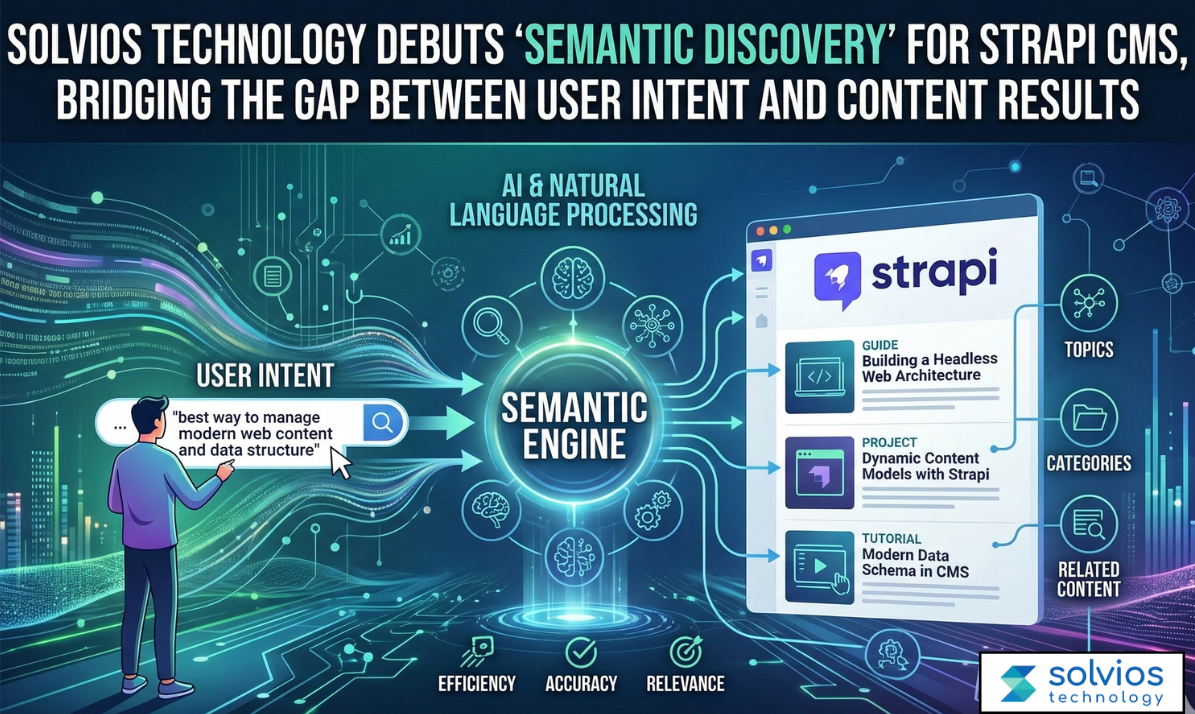
Solvios Technology today announced the launch of Semantic Discovery, a new capability built for Strapi CMS environments that aligns search results with user intent rather than keyword matches.
The release targets content teams managing large-scale documentation, product content, and knowledge bases where search relevance has become inconsistent, not because the content is missing, but because the system can’t interpret how users are actually asking for it.
Semantic Discovery integrates directly into existing Strapi environments as a separate discovery layer. Content models stay the same. Editorial workflows stay the same. The capability operates underneath, interpreting conversational, incomplete, or problem-framed queries and mapping them to relevant content, without requiring teams to change how they write, tag, or distribute.
“We kept seeing teams assume search problems meant content problems,” said Jigesh Shah, CEO at Solvios Technology. “In reality, users were searching naturally, and the system wasn’t equipped to interpret that. This was about improving understanding, not rebuilding workflows. The content was already there, it just wasn’t being found.”
Switching Between Different Content
Content-heavy Strapi platforms tend to hit the same wall. APIs are stable. Content models are clean. Cross-channel delivery is running. Then, as volume increases, users start struggling to find already published, well-structured content.
Most headless setups still rely on keyword matching and predefined filters. That works when users search with exact terms. It breaks down when queries are conversational, framed as a problem, or phrased in ways that don’t match internal terminology. Two users looking for the same information end up in different places. Relevant content stays buried.
Teams respond predictably. Editors duplicate pages to cover alternative phrasings, and developers build custom search logic that becomes brittle at scale. Or, search doesn’t improve over time; it just gets harder to manage.
Solvios observed this pattern across multiple Strapi implementations. The failure point was rarely technical. APIs worked. As a company working closely with product and engineering teams as a Strapi CMS development company, Solvios repeatedly saw the same issue emerge as content ecosystems grew. The failure point was rarely technical. The breakdown happened at interpretation.
How Semantic Discovery Works
Solvios didn’t change keywords or make content standards tougher. Instead, they constructed a layer that focused on understanding intent. Semantic Discovery figures out what a query means and connects it to relevant material, even if the words don’t match the way you use them in your own work or the names of your content.
It doesn’t override editorial priorities. It doesn’t promise perfect relevance from day one. The goal is narrower and more practical: improve baseline discovery so users reach the right content more consistently, without adding operational complexity for the teams managing the platform.
What Changes for Content and Product Teams
The impact shows up in small but compounding ways. Fewer duplicate pages are needed to support discovery. Existing content performs better across channels. Editors spend less time compensating for search gaps, and developers stop building custom fixes that create maintenance debt further down the road. The capability fits naturally into modern headless environments built on Strapi enterprise scalable API-first CMS digital platforms, where large content structures already exist but discovery remains a challenge.
For platforms where discovery failures create real friction: support deflection gaps, longer onboarding times, reduced self-service effectiveness, the change is more immediate. Users find what they need on the first try more often. The content that was already there starts doing the job it was built to do.
Solvios’ Semantic Discovery Positioning
Solvios has been deliberate about positioning. Semantic Discovery is designed for platforms where content already exists in volume and where search inconsistencies are creating real operational friction. It is not a lightweight add-on for early-stage projects with limited content depth.
That restraint is intentional. Most real CMS environments evolve incrementally, under pressure, and without appetite for disruptive rewrites. Semantic Discovery is designed to fit into that reality, improving what’s already there without asking teams to change how they work.
What Comes Next Solvios plans to expand Semantic Discovery based on early production use, with initial focus on documentation-heavy platforms and multilingual content environments. Broader availability is expected later in 2026, guided by outcomes from the first deployments rather than a fixed feature roadmap.
For now, the focus is intentional and limited: using the tools content teams already trust to make Strapi-based platforms connect user intent with content outcomes more consistently, without drawing attention to the machinery behind it.
About Solvios Technology
Solvios Technology, founded in 2022, specializes in enterprise technology solutions like Strapi, ERPNext, and other custom integrations for mid-sized and growing businesses. The firm works with product and engineering teams to design and scale content-driven platforms using modern headless architectures, with a focus on maintainability, clarity, and real-world usability.
( Press Release Image: https://photos.webwire.com/prmedia/104459/351673/351673-1.png )
WebWireID351673
 Strapi Development
- Contact Information
- Jigesh Shah
- CEO
- Solvios technology
- (1) +1 (561) 717-2700
- solviostechnology@gmail.com
This news content may be integrated into any legitimate news gathering and publishing effort. Linking is permitted.
News Release Distribution and Press Release Distribution Services Provided by WebWire.