

Landmark project improved farmers’ livelihoods and protected forests in Madagascar, new report finds
A Green Climate Fund-financed agricultural resilience project in one of the world’s most climate-stressed countries increased crop production and reduced deforestation, a new evaluation report released has found.

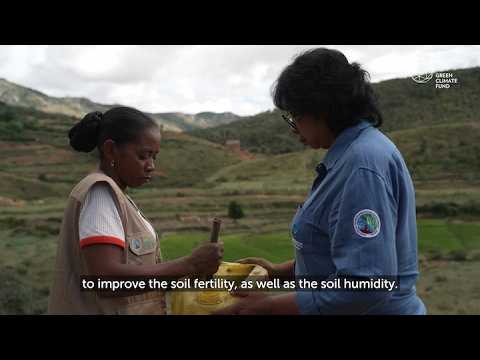
Findings from the impact evaluation conducted by Conservation International, in partnership with the Green Climate Fund’s Independent Evaluation Unit, found clear evidence of higher crop yields and lower deforestation rates among farming communities participating in the USD 16 million “Sustainable Landscapes in Eastern Madagascar” project.
The project supported more than 24,000 smallholder farming households in and around the Ankeniheny-Zahamena and the Ambositra-Vondrozo forest corridors with climate-smart agriculture techniques, distribution of seeds and equipment, forest patrols, agroforestry promotion and forest restoration.
“In Madagascar, we are seeing how climate-smart agriculture delivers real results for people and nature. When farmers have the tools to produce more, they are better equipped to adapt to climate change while reducing pressure on forests. By investing in approaches that increase food security, boost incomes, and protect forests at the same time, the Green Climate Fund is empowering communities to adapt to climate change while delivering lasting environmental and development benefits,” said Catherine Koffman, GCF’s Director of the Africa Region.
The endline impact report tracks the long-term outcomes of the seven-year project, from 2018 to 2025, drawing on results from over 1,600 smallholder farmers interviewed in this assessment.
The analysis compares farms that participated in project activities with similar farms from non-project areas, before and after the project activities. This allowed researchers to track the programme’s direct impact. The findings show:
- 32 per cent higher crop sales among participating farmers, driven by diversification into higher-value crops - with groundnut and Bambara pea production higher by 565 per cent and 196 per cent respectively
- Greater crop diversity – 13 per cent more kinds of crops than in non-project farms - which could lead to increased climate resilience over time
- A 30 per cent increase in food consumed from their own production, suggesting a possible connection to increased food security
- A significant increase in production of commercially viable crops like groundnuts and Bambara peas (565 per cent and 196 per cent higher, respectively)
- A drop in deforestation rate from 3.2 per cent to 0.8 per cent over the project period, alongside a decrease in environmentally harmful activities such as charcoal production and mining that are often undertaken to supplement farming-driven livelihoods
Andreas Reumann, Head of the GCF’s Independent Evaluation Unit said: “The findings inform in a credible way the sustained impact of the project. They also help us better understand the drivers of successful implementation. By strengthening the evidence base, the findings help ensure that climate finance is used more efficiently, informing the design and delivery of future sustainable landscapes investments for greater impact at scale.”
Daniela Raik, Executive Vice President and Chief Conservation Officer said: “The Ankeniheny-Zahamena and Ambositra-Vondrozo forest corridors make up the remaining large humid forested areas in Eastern Madagascar, but food insecurity on the island has partially driven deforestation of these areas as many smallholder farmers resort to clearing forests in search of new land and better soil to cultivate. These factors make the switch to sustainable agriculture practices all the more important, and here we see that agricultural abundance and forest protection don’t need to be at odds with each other.”
Madagascar is particularly vulnerable to climate threats due to its location, its susceptibility to climate impacts, and the limited capacity of its people to adapt. In 2021, the United Nations warned that Madagascar could be the site of the world’s first climate change-caused famine. Increased forest cover in Madagascar can be a critical natural climate solution as the island grapples with a warming world.
Improvements in longer-term outcomes for human well-being – such as continued adoption of sustainable agricultural practices, stronger food security, and greater climate resilience – showed promising trends. These early trends underscore the importance of continued support for farming communities to strengthen the local enabling environment, the report said.
( Press Release Image: https://photos.webwire.com/prmedia/7/351081/351081-1.png )
WebWireID351081
This news content was configured by WebWire editorial staff. Linking is permitted.
News Release Distribution and Press Release Distribution Services Provided by WebWire.