

Ekain Albite, Rod Llaverías, Inês Nunes, Gala Hernández, Kavich Neang and Valeria Hofmann will be working on their projects in the twelfth edition of Ikusmira Berriak
The residency run by the San Sebastián festival, Tabakalera and Elías Querejeta Zine Eskola has again broken its record for entries, with 488 proposals received
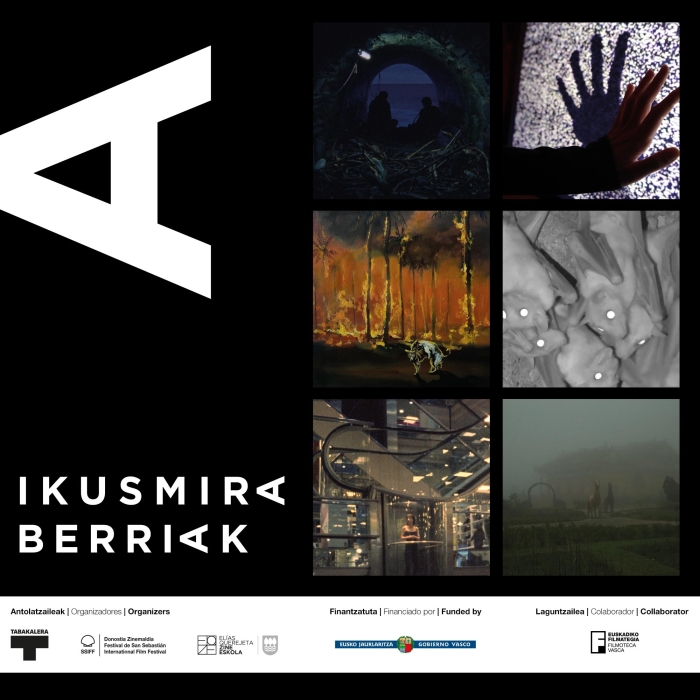
The suffocating heat, perhaps as an unmistakeable sign of the climate catastrophe, women’s bodies, exploring family structures, the industrial past and the digital universe are all present among the twelve proposals selected for the twelfth Ikusmira Berriak, approached in a rich variety of forms, reinterpreting genres like gothic horror, the road movie, psychological drama and body horror. The film projects by Ekain Albite, Rod Llaverías, Inês Nunes, Gala Hernández López, Kavich Neang and Valeria Hofmann were selected for the residencies organised by the San Sebastián Festival, the Tabakalera international arts centre and Elías Querejeta Zine Eskola. The programme once again broke its own record for entries, receiving 488 film projects. Among the six projects selected, five are debuts and one is a second film, reaffirming Ikusmira Berriak’s commitment to new cinematic voices and points of view.
In the Elías Querejeta Zine Eskola category, open to EQZE students, the project chosen was The Spirit Healer is Away for the Weekend, by Inês Nunes (b. Tavira, 1993). This Portuguese director, whose most recent short, A solidão dos lagartos / The Loneliness of Lizards (2025), was premiered in the official short film selection at the Cannes festival, and selected in the Nest category at the San Sebastián festival, where it won the Movistar Plus + prize for best short, portrays two women who, in an Algarve assailed by heat and tourism, take refuge in a shopping centre, which the film maker describes as “places that offer consolation and belonging, but at the same time work as traps that capitalise on our most deep-seated anxieties.”
In the Nest category, open to filmmakers chosen in the last five editions of the international students’ event at the festival (2020-2024), La Canícula by Dominican director Rod Llaverías (b. New York, 1989) was chosen. The first feature-length film by Llaverías, who co-wrote the short Darling, winner of the Orizzonti prize for best short film in Venice (2019), is working on the short Tropicalía, with which he took part in Nest in 2022, exploring care, the duel, trauma and identity through four women who live in a dilapidated family home in the Dominican capital.
In the Basque category the project chosen is Akira, by Ekain Albite (b. Zumaia, 1999), co-director of the collective film Negu hurbilak (2023), which earned a special commendation in the Cineasti del Presente section at the Locarno festival. The first solo feature-length project by Albite, an EQZE graduate, is a spectral, night-time road movie featuring two Georgian scrap merchants who travel from the Lemoiz nuclear power station to their native country.
The project selected in the Spanish category is Los animals magnéticos / Magnetic animals by Gala Hernández López (b. Murcia, 1993). This artist, film-maker and researcher, whose film La Mécanique des fluides won the César for best short documentary in 2024, tells the story of two women with a mysterious connection, a scientist in modern-day Berlin and a French aristocrat trying to deal with motherhood in the late 18th century, a gothic horror film which uses the idea of the female double.
In the international category two projects have been chosen. In Daemon, Chilean director and scriptwriter Valeria Hofmann (b. Santiago de Chile, 1988) uses body-techno horror to tell the story of two people who live on the fringes of the technological system: a content moderator and a worker in a factory that produces mobile phones. Her short film AliEN0089, which also explored the technological habitat, won the prize for best international director at Sundance (2023) and the Grand Prix Labo at Clermont Ferrand (2024).
Finally, Cambodian director Kavich Neang (b. Phnom Penh, 1987), after premiering Boden sar / White Building at the Venice festival (2021), winning the Orizzonti prize for best actor, uses his second feature-length project, Chas Khouch Kmeng Ropus / Bad Man Good Boy, to portray the coming of age of two friends, but also to reflect on the family and an authoritarian context.
The residency lasts eight weeks, divided into two stays. The group of six filmmakers will be arriving at Tabakalera on 9th March and will have time in the Film and Audiovisuals Laboratory there to work on their projects until 19th April. During this time, they will be advised by experts specially chosen on the basis of each project’s needs. In June, each resident will receive financial assistance to help them to carry on working on their project between the two stays. In September, coinciding with the festival, they will come back to San Sebastián to complete the last two weeks of their residency. During this phase they will be able to present their project to industry professionals and will have a personalised agenda of visits with people interested in taking part in their projects.
Eleven years of Ikusmira Berriak in figures
- Projects: 56
- Films completed: 28
- Awards: 57
- Appearances at festivals: 353
- Last films premiered: 5 in 2025
La misteriosa mirada del flamenco / The Mysterious Gaze of the Flamingo, Diego Céspedes (2025); Anoche conquisté Tebas / Last Night I Conquered the City of Tebas, Gabriel Azorín (2025); Hiedra / The Ivy, Ana Cristina Barragán (2025); Estrany Riu / Strange River, Jaume Claret (2025); Aro berria, Irati Gorostidi (2025).
EQZE Category
The Spirit Healer is Away for the Weekend
Inês Nunes (Portugal)
Country(ies) of production: Portugal
Every summer, the inhabitants of a seaside town witness a much-anticipated ritual: luxury cars speeding along at dawn, gauging the pulse of the annual economy. The heat and humidity drive locals to seek refuge in the air-conditioned shopping centre. Inside, two women: Sharon, pursued by the ghost of her daughter, and Celeste, a young girl marked by a serious car accident; without realising it, they seek one another. The shopping centre becomes a territory in suspension, in which the frontier between life and death dissolves.
I have seen the same show all my life. Every summer, a human tide flows over the Algarve, reshaping the territory, its rhythms and its hierarchies. While the new arrivals have fun, the locals work. So close and so far from the sea, we often find ourselves confined to the shopping centre, refuge, prison and main setting of my summers. A place that promised modernity and future, but which today represents a melancholy vestige of an idea of progress that was never fulfilled. - Inês Nunes, director
Nest Category
La Canícula
Rod Llaverías (USA)
Country(ies) of production: Dominican Republic - Brazil
Ciro, a repressed gay man, has devoted his life, with the support of his sister Dolores, to caring for the older women in his household. In the days following the death of his grandmother, Ciro has to deal with burying the body under the patio, the return of an absent aunt and the appearance of Facundo, a captivating stranger. These events shatter the routine of the house and awaken a long-suppressed desire in Ciro.
La Canícula is born out of my roots in the place where I grew up: a place of care, heat and inherited traumas, sustained by women. It is a film about the power that persists in invisible work, domestic ritual and unspoken pacts. Through Ciro, I set out to look at how desire and intimacy have been put off by family and social convention. The film offers a political interpretation of care and a defence of staying, loving and resisting in a world on fire. - Rod Llaverías, director
Basque Category
Akira
Ekain Albite (Spain)
Country(ies) of production: Spain - Georgia - France
Vakhtang, a Georgian rag and bone man who lives among derelict warehouses on the Basque coast, receives an unexpected visit from his cousin Giorgi. After entering the closed-down nuclear power station at Lemoiz together, a strange force makes them abandon everything to head into an endless night. In a van, they cross winter landscapes and uncertain frontiers, as their journey leaves behind their own story and drifts towards unknown territory, where other lives begin to emerge.
Akira is born out of the need to film the liminal state of exile The film is constructed out of fatigue, drift and the link between bodies that move forward without any clear destination. The journey, the night and the post-industrial landscapes are active forces that transform the characters and the very form of the film. Filming Akira means embracing uncertainty, letting reality cut through fiction and accepting that the film can only exist in this intermediate space where looking is also a way of inhabiting it. - Ekain Albite, director
Spanish Category
Los animales magnéticos
Gala Hernández López (Spain)
Country(ies) of production: France - Spain - Germany
Berlin, a near future. Hedda has just arrived to study a strange phenomenon in the behaviour of bats. She soon begins to suffer from nightmares and symptoms of an impossible pregnancy. Over two hundred years before, in the 18th century, Berthe, a French aristocrat, has the same birthmark on her neck. She is subjected to experiments carried out by mesmerist doctors seeking to cure her reproductive disorders. What is the origin of this fear they share, the fear of being devoured by the life they carry inside them?
This will be my first feature film after four shorts. It is a film that reflects on fear of maternity through a poetic, nocturnal, dark fiction. From a feminist point of view, the film explores maternity as a collective fear and questions this fear of being a mother as something that springs from a trans-historical, invisible and inherited female subconscious. This phantom thread is personified in two characters who belong to the same family line and are spiritually linked across time and space: Hedda, a woman in Berlin in the near future, and Berthe, her ancestor, in France in the late 18th century. - Gala Hernández López, director
International Category
Daemon
Valeria Hofmann (Chile)
Country(ies) of production: Spain - Chile
In a city devastated by fire, Liz, a solitary content moderator, discovers that her virtual lover is a being trapped inside her computer. As the limits between reality and the digital become blurred, Liz is obsessed with giving him a physical body using a bioprinter fed with blood, risking her humanity in the process.
Daemon alludes to an entity that guides human behaviour, sometimes to the dark side, and in computing also refers to software that runs in the background, invisible to the user. The film sets out from that idea: giving form to what we cannot see, to those who moderate Internet content and those who assemble the technology we use. I follow two characters who inhabit the margins of this digital infrastructure and subvert its codes to create a monster. As in Frankenstein, the assembled body expresses the desire to belong in a world that excludes it. - Valeria Hoffmann, director
Chas Khouch Kmeng Ropus / Bad Man Good Boy
Kavich Neang (Cambodia)
Country(ies) of production: Cambodia - France
In Phnom Penh, Sinoun rushes her half-paralyzed husband to the hospital after a stroke, facing fear, medical bills, and the return of her estranged eldest son, Tola. Her younger son, Arun, soon joins them, deepening family tension. As the father stabilizes, life worsens: Tola struggles at school and in his father’s workshop, Arun faces bullying, and Sinoun discovers her husband’s infidelity, leading to divorce. Months later, Tola works in Kampot and avoids returning home. Back in the city, Sinoun and Arun face theft, corruption, and the loss of their apartment. Through hardship, the brothers grow closer and face an uncertain future.
The film is inspired by my family history and follows Sinoun, a mother who feels homeless, guilty, and overwhelmed as her family falls apart. Her struggle reflects my childhood after my father left, when my mother worked tirelessly to support us. A key memory – the theft of our apartment’s metal door, later found hidden by a neighbor – became central to the story. This event echoes the pain of discovering my eldest brother grew up apart from us. The film explores home, trust, belonging, and how poverty and authority fracture families and communities. - Kavich Neang, director
( Press Release Image: https://photos.webwire.com/prmedia/6/349593/349593-1.jpg )
WebWireID349593
This news content was configured by WebWire editorial staff. Linking is permitted.
News Release Distribution and Press Release Distribution Services Provided by WebWire.