

Circular EV battery economy turns industry risk into reward
-
Circular electric vehicle (EV) battery economy essential to meet soaring demand, cutting supply chain risk and creating competitive advantage and value for industry players.
-
New Ellen MacArthur Foundation report sets out five leadership priorities to drive forward a circular EV battery economy at a pivotal moment.
-
Leading businesses endorse the report which urges stronger collaboration and implementation across EV battery sector at World Economic Forum launch.
The global EV boom is on track to hit a critical minerals bottleneck – threatening higher and volatile prices, slower uptake, and heightened exposure to supply chain disruptions, warns a report launched by the Ellen MacArthur Foundation.
With major supply shortfalls expected for some critical minerals by the mid-2030s – and independent estimates pointing to a potential 40-50% price hike for consumers under a sustained battery metals supply shock – the Foundation’s report calls for an urgent redesign of the EV battery sector.
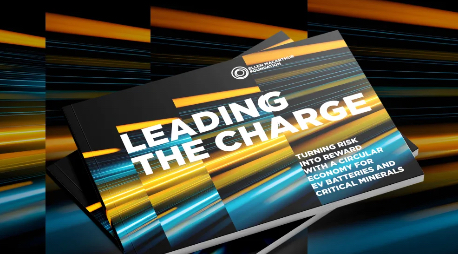
Its Leading The Charge – Turning risk into reward with a circular economy for EV batteries and critical minerals– report shows how only a practical, system-wide circular economy approach can keep pace with market appetite, build resilience in the supply chains, and deliver better value, while preparing the infrastructure and systems needed for tomorrow’s EV battery economy.
By keeping critical minerals in batteries in high-value use through maintenance, repair, refurbishment, and remanufacturing, exploring opportunities to extend battery life through second-life applications, and ensuring high-quality recycling at end of life, a circular economy approach can unlock new value and resilience.
“Today’s EV battery system is a strategic risk – it’s linear, material-hungry, and fragile,” says Wen-Yu Weng, Executive Leader for Critical Minerals at the Ellen MacArthur Foundation.
“As EV uptake surges, a circular economy for EV batteries and the critical minerals that power them is no longer optional. It’s how we ensure affordability, resilience and growth while reducing environmental and social impacts. EV batteries are strategic assets, and a circular economy is key to capturing and retaining the core value associated with critical minerals.
“It’s time for urgent coordinated action to scale the circular battery economy, securing battery value and ensuring the critical minerals needed to make them never become waste. This is our window of opportunity to turn mineral risk into a competitive advantage.”
EVs are emerging as the strategic backbone of the energy transition. By 2050, they are predicted to make up 65% to 75% of global car sales, fuelling economic growth, creating jobs, innovation, and major emissions cuts.
The EV boom is driving unprecedented demand for the critical minerals that power them. A typical EV contains more than 200kg of these minerals – six times more than a conventional car – with a large share of that value concentrated in the battery. The International Energy Agency has previously warned that a sustained supply shock in battery metals could lead to significant price increases for consumers.
A circular and far more resilient battery economy will cut costs and secure supply for car makers, derisk long-term returns for investors, while also reducing dependence on imports and strengthening industrial resilience for governments.
Drawing insights from more than 30 industry players across the EV battery value chain and backed by 15 years’ experience of uniting partners to deliver change at scale, the Foundation’s report outlines five ‘bright spots’ as leadership priorities and points to a platform for collaboration across industry, investors and policymakers.
Launched at the World Economic Forum in Davos, it outlines commercially driven recommendations for the EV battery industries and associated stakeholders such as creating longer battery lifetimes and second-life applications through repair, refurbishment and reuse, and better data systems. Practical steps include:
-
Design batteries for circularity, not disposal so they last and can be reused across multiple lives.
-
Rethink battery service within optimised energy-mobility systems so value isn’t about bigger batteries, and the co-optimisation of batteries and energy-mobility systems lead to greater circular potential without sacrificing function.
-
Scale circular business models to treat battery critical minerals as long-term assets managed through service models that reward durability
-
, performance, recovery, and second-life use.
-
Build and co-invest in regional circular infrastructure that enables materials to circulate efficiently, resiliently, and transparently.
-
Make the circular ‘operating system’ work through better industry-wide solutions such as data sharing
-
and clear policies that keep products and materials in circulation.
Additionally, the Foundation calls for coordinated action across product design, business models, and the wider systems of infrastructure, finance, and policy.
Welcoming the report, Jiang Li, Vice President and Board Secretary of the Chinese-based company CATL, a global leader in electric vehicle and energy storage system battery technologies and strategic partner of the Foundation, says:
“The insights outlined in this paper show how circular approaches are essential to the energy transition. CATL looks forward to working with the Foundation and partners across the value chain to turn these principles into practical impact, keeping batteries and materials in use longer to unlock environmental and economic value while strengthening resilience throughout the system.”
Vanessa Butani, Head of Global Sustainability at Volvo Cars, says:
“Electrification is the future, offering people more efficient vehicles and lowering lifecycle emissions. And electrification must go hand in hand with circularity. This report shows how circularity can help reduce risk, safeguard resources, and speed up the shift to climate‑neutral mobility – so our customers can benefit from durable, responsibly built cars.”
The publication of Leading The Charge is among the first steps taken by the Foundation in a multi-year campaign committed to accelerating circularity of critical minerals in the EV battery economy.
Notes to editors The Ellen MacArthur Foundation is a global charity accelerating the transition to a circular economy – one that eliminates waste, keeps materials in use, and regenerates nature to create a resilient system that benefits business, people, and the environment.
Launched in 2010, we work with global leaders to mobilise bold, evidence-based business and policy action, transforming markets through circular economy solutions that are led by design and delivered at scale.
Critical minerals are essential for the global energy transition, but the current take-make-waste system does not work. Our goal is to deliver systemic change in the areas of critical minerals, fashion and textiles, and plastics and packaging, by 2030.
( Press Release Image: https://photos.webwire.com/prmedia/7/349447/349447-1.jpg )
WebWireID349447
This news content was configured by WebWire editorial staff. Linking is permitted.
News Release Distribution and Press Release Distribution Services Provided by WebWire.