

Federal Audit Findings Prompt Call for NIH-Wide Scientific Integrity Standards
Patient advocacy group proposes framework to address systemic gaps affecting research quality, patient outcomes, and public trust
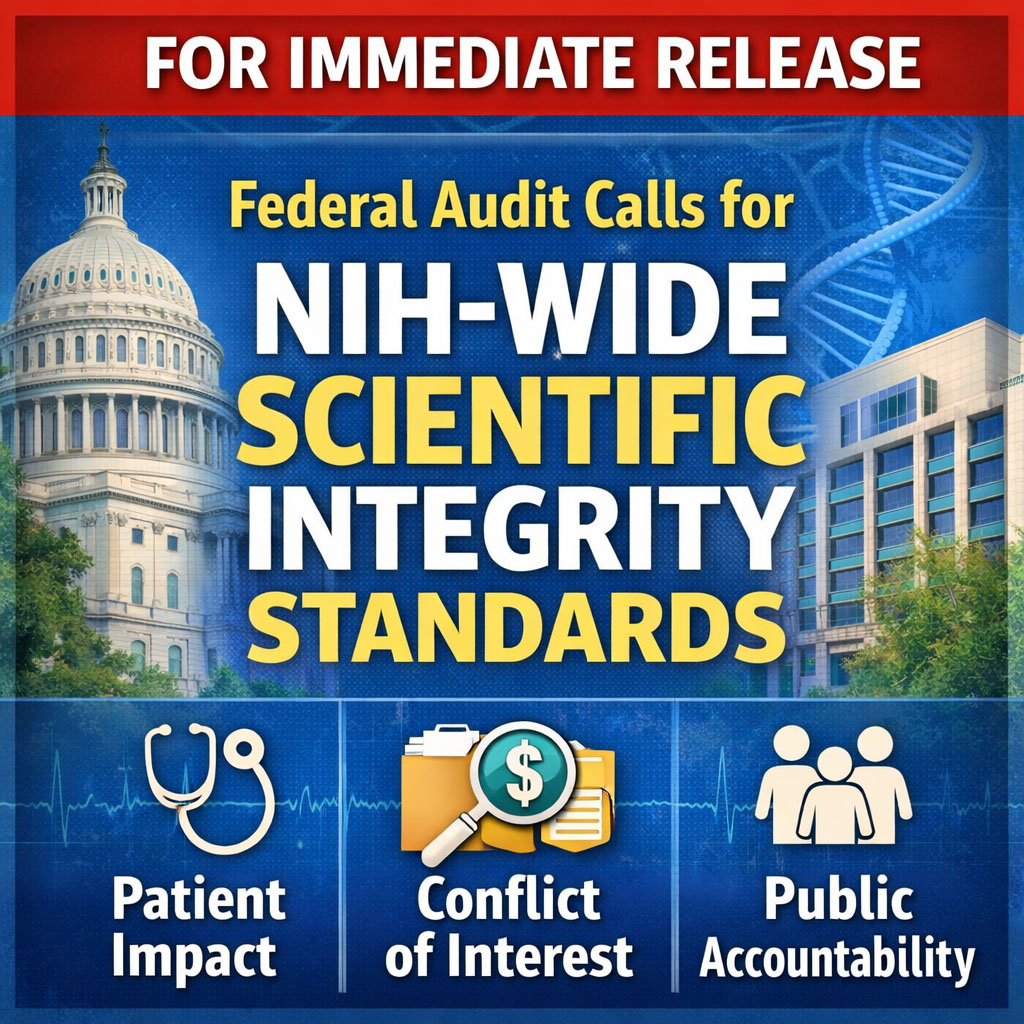
The proposal addresses longstanding structural issues including conflicts of interest, insufficient transparency in research prioritization, limited patient engagement, and potential bias in peer review that have been documented in multiple federal audits and reviews.
The Patient Centered Care Advocacy Group today submitted to National Institutes of Health Director Dr. Jay Bhattacharya “Strengthening NIH Research Standards: A Framework for Scientific Integrity, Transparency and Stakeholder Engagement,” a comprehensive proposal that advances his “replication revolution” vision by establishing systematic patient and stakeholder engagement in research priorities while creating infrastructure for reproducible, transparent science and addressing oversight gaps the new administration inherited.
Supporting the Replication Revolution
“Director Bhattacharya has articulated a bold vision for transforming biomedical research through his ‘replication revolution,’” said Bruce Fries, President of the Patient Centered Care Advocacy Group. “This proposal provides practical tools to make that vision reality by creating infrastructure that makes reproducibility trackable, transparent, and rewarded—shifting success metrics from publication volume to independently verifiable evidence.”
The ten recommended standards create essential infrastructure for the cultural transformation Director Bhattacharya envisions. Term limits and diverse review panels reduce entrenchment that can discourage independent validation of findings. Enhanced transparency makes data and methods available for independent verification. Systematic tracking of replication rates makes reproducibility the primary success metric.
Addressing Inherited Challenges
The proposal also addresses long-standing systemic challenges identified by federal oversight agencies in recent years. Government Accountability Office and Office of Inspector General reviews conducted before the current administration documented significant inconsistencies in research oversight—with direct implications for research quality, patient outcomes, and efficient use of taxpayer resources.
Federal oversight reviews identified persistent issues the current leadership inherited:
- A 2019 OIG report (OEI-03-19-00150) found that conflict-of-interest oversight varies across Institutes and Centers with no systematic quality-assurance process
- A related audit (A-03-19-03003) identified limited policies to ensure institutions consistently report financial interests that could bias research
- A 2025 GAO review found shortcomings in external research monitoring due to decentralized policy implementation
- The March 2025 rescission of NIH’s agency-specific Scientific Integrity Policy created an opportunity for comprehensive reform
“These are inherited inefficiencies, not new problems,” Fries noted. “Director Bhattacharya now has the opportunity to implement comprehensive reforms that strengthen research integrity while advancing his replication vision. Patient communities report that research priorities often fail to reflect real-world needs—these standards ensure research serves patients effectively.”
Ten Standards for Comprehensive Oversight
The proposal recommends ten specific standards—five for intramural programs and five for extramural grant review—that create infrastructure for reproducible, transparent, patient-centered research:
For Intramural Programs:
- Systematic stakeholder engagement ensuring patients have formal input into research priorities
- Term limits and open recruitment for leadership positions to prevent entrenchment
- Enhanced conflict-of-interest management with public disclosure
- Regular external review building on NIH’s existing Boards of Scientific Counselors with uniform standards
- Annual reporting on research outcomes and replication rates
For Extramural Grant Review:
- Term limits and open recruitment for peer review leadership
- Formal patient and stakeholder engagement in research priority-setting
- Centralized conflict-of-interest monitoring with consistent enforcement
- Independent external oversight of review processes
- Enhanced transparency linking funding allocations to disease burden
Patient and Economic Benefits
For millions of Americans living with chronic and complex conditions, the standards will result in better health outcomes through improved diagnostics, expanded treatment options, and research portfolios aligned with patient priorities rather than purely academic interests.
The economic returns are substantial: earlier diagnosis and more effective treatments reduce healthcare costs through decreased hospitalizations and long-term care needs, while increased workforce participation generates returns through reduced disability payments and increased tax revenue—far exceeding implementation costs.
Alignment with Administration Priorities
The proposal aligns with the President’s Management Agenda on eliminating waste and holding grant recipients accountable. It incorporates the HHS AI Strategy by deploying artificial intelligence to enhance oversight efficiency—demonstrating how government can harness emerging technologies to strengthen accountability while reducing administrative burden, consistent with HHS’s commitment to Gold Standard Science.
Implementation as Partnership
“These standards can be implemented through NIH Director authority without requiring new legislation,” Fries said. “We envision a collaborative approach with Federal Register public comment periods, pilot programs, and annual Scientific Integrity and Transparency Reports. Meaningful stakeholder engagement throughout implementation ensures the standards remain responsive to evolving evidence and patient needs.”
While modest resources would be required—primarily for centralized conflict-of-interest monitoring and independent audits—these investments are small relative to NIH’s overall budget and justified by substantial improvements in research integrity, efficiency, patient outcomes, and economic returns.
“Patients across all disease areas deserve the same rigorous safeguards,” Fries concluded. “Director Bhattacharya has articulated a compelling vision for the future of biomedical research. Our proposal provides a practical framework to achieve that vision while ensuring research serves patient needs effectively. The Patient Centered Care Advocacy Group stands ready to collaborate with NIH leadership and support stakeholder engagement in implementing these essential reforms.”
About the Patient Centered Care Advocacy Group
The Patient Centered Care Advocacy Group is a nonprofit organization dedicated to advocating for scientific integrity, transparency, and patient-centered approaches in federal health research and policy. The organization works to ensure that research addresses real-world patient needs and that research programs operate with the highest standards of scientific integrity.
Availability: The full proposal is available at https://c.org/smrpxq8XJC
( Press Release Image: https://photos.webwire.com/prmedia/48616/349340/349340-1.jpg )
WebWireID349340
 NIH
NIH- Contact Information
- Bruce Fries
- President
- Patient Centered Care Advocacy Group
- Contact via E-mail
This news content may be integrated into any legitimate news gathering and publishing effort. Linking is permitted.
News Release Distribution and Press Release Distribution Services Provided by WebWire.