

South Sudan plans for climate-resilient schools
Some schools relocate up to three times a year to escape the effects of climate change. The Climate Smart Education Systems Initiative is helping the sector prepare.
“Earlier this year, we had to close down schools,” says Owiri Angelo De Orubo, the Country Education Director in Kapoeta South.
He has witnessed firsthand how climate shocks are straining South Sudan’s education system, from rising temperatures and drought that keep learners out of school, to soil erosion and flooding that damage facilities. “This has especially affected our girls from attending school. When schools close because of heat, we see early child marriage and child labour,” he says.
His concerns echo those of many education officials grappling with an increasingly erratic climate across South Sudan’s states and administrative areas. Some schools even move their learners multiple times a year to escape the effects of heavy rainfall and flooding. But Angelo and other educational planners and managers are starting to see a glimmer of hope as planning for a climate-resilient education system takes shape.
Angelo says the schools need better ventilator systems and early warning systems to prepare communities. From Bor County, Michael Mading, Chairperson of the Relief and Rehabilitation Commission, agrees that new schools must be built to withstand climate shocks.
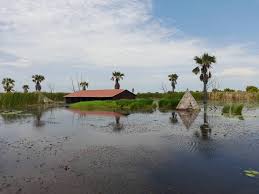
“When floods come, most of the schools are submerged in the water, and children have to be evacuated to higher grounds,” Mading says. “We need to come up with plans and policies that protect the most vulnerable and guide them in evacuations.”
In Eastern Equatoria, in South Sudan’s Magwi County, Education Director Achiro Grace Okumu says she has also witnessed the effects of climate change. Schools have closed down, and as a result, learners have dropped out, and some teachers have lost their jobs, she says.
“The roofs of classrooms have been taken off by heavy rainfalls,” she says, adding that flooding has often blocked access to schools. Achiro says collaboration among all the stakeholders, from the grassroots to the top-level officials, is critical. “When we coordinate, it will make sure that activities are implemented.”
South Sudan is one of the most climate-vulnerable countries in the world, with children being among the most vulnerable populations to climate change impacts. In 2021, South Sudan ranked seventh out of 163 countries on the Children’s Climate Risk Index.
Faced with these challenges, the Ministry of General Education and Instruction (MoGEI) of South Sudan has prioritized the development of a state-level climate risk analysis for the education sector as part of its Climate Smart Education Systems Initiative (CSESI) workplan. The goal is to effectively plan for climate change adaptation and environmental sustainability, as part of this global initiative being led in 35 countries with funding from the Global Partnership for Education and implemented by UNESCO, IIEP, and Save the Children.
A risk analysis for every stateAs part of CSESI and with technical support from IIEP, and in collaboration with the UNESCO Juba Office, the MoGEI is currently developing 13 climate risk analyses for the education sector, one for each state and administrative area. Between June and October 2025, five workshops have been held in different zones across South Sudan. These workshops enabled education officers to contribute their field expertise to the development of climate risk diagnostics for their states.
Emilie Martin, an IIEP education programme specialist, says conducting state-level climate risk analysis is critical for effective adaptation planning in South Sudan’s education sector. These analyses identify which climate hazards affect each state and county, where schools and learners are most vulnerable, and which capacities exist to respond. “These analyses provide the foundation for developing targeted, evidence-based strategies that address the diverse realities across the country”, says Martin.
The workshops provided valuable insights into the realities behind the data. Some schools relocate up to three times a year to temporary learning spaces to avoid flooding, explained education stakeholders, while other school facilities operate in multiple shifts to accommodate learners displaced from flooded schools.
“We now know how to analyze the high risks and hazards of climate change, and how we can come up with ways to prevent them, how we can raise awareness so that people understand how to carry out these assessments themselves,” says Simon Thankol Nynon, Director of Relief and Rehabilitation Commission of Longechuk County, who participated in a workshop in October.
CSESI supports countries to foster climate-resilient education systems and ensure continuous and safe learning for all children and youth.
Looking to the future, Michael says, “We want to see an education system that is not always disrupted by climate change, an education system that provides quality to all, that includes children with disabilities and encourages girls to reach their full potential, and an education system that protects the rights of minority groups.”
( Press Release Image: https://photos.webwire.com/prmedia/6/348767/348767-1.jpg )
WebWireID348767
This news content was configured by WebWire editorial staff. Linking is permitted.
News Release Distribution and Press Release Distribution Services Provided by WebWire.