

Toray Develops Energy-Saving Chemical Substance Conversion Bioreactor Technology
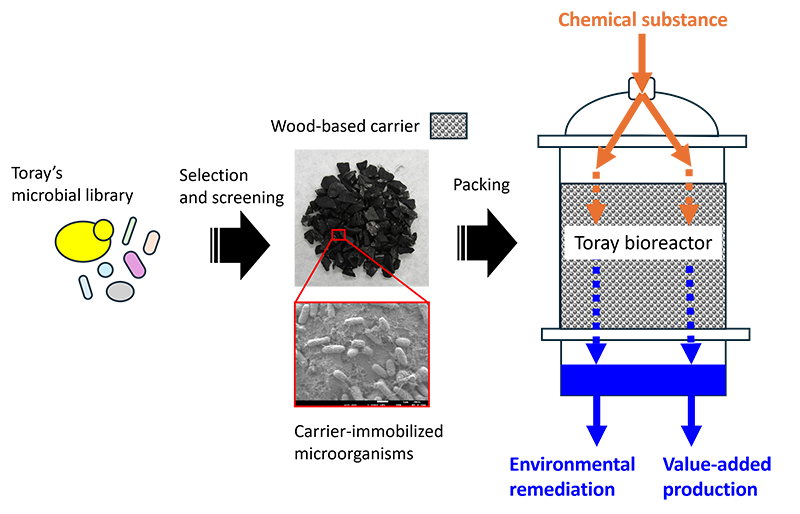
Toray Industries, Inc., announced that it has developed an immobilized-microorganism bioreactor technology (see note 1). The company estimates that this new technology would consume 80% to 90% less energy than conventional chemical conversion processes that entail high temperatures and pressures, thus slashing plant operational costs and lowering environmental impact.
This technology immobilizes specific microorganisms on wood-based carriers and packs them into a reactor. Ongoing contact between an aqueous solution containing the target chemical and a packed bed allows microbial enzymes to convert the target substance efficiently into a desired product.
An in-house demonstration trial employing acrylonitrile (note 3) confirmed conversion of more than 99.5% of that substance. Products include acrylic, propionic, acetic, and other organic acids. When combined with activated-sludge treatment (see Note 4), these products can be completely broken down to carbon dioxide. Because the reactor is tightly sealed, it is especially effective for volatile substances. It reduces losses from airborne dispersion and improves safety.
By tailoring the microorganisms immobilized on the wood-based carriers and the reactor structure, the technology can be applied to diverse chemicals.
Toray will step up technical verification and operational design at internal and external production sites to commercialize this technology as a new energy-conserving solution. The company will continue to tackle environmental challenges and contribute to a sustainable economy through its materials technologies.
Features of the new technology
- Customizable, optimizing microorganisms and reactor structure selection based on target chemical substances and site conditions. Diverse applications extend from environmental remediation to valuable product production, with selection possible from Toray’s library of around five hundred microbe species.
- High conversion efficiency from optimized microorganism selection and carrier structure. Can convert more than 99.5% of acrylonitrile to organic acids and employs a highly sealed structure for use with volatile substances.
- Energy-efficient and safe, requiring no heating or pressurization.
Reference
Chemical conversion with Toray bioreactor (See Image)
Notes
- A reactor is any apparatus in which a chemical reaction occurs. A bioreactor controls reactions by using microorganisms, cells, or other biological catalysts.
- Toray based this estimate on a scenario in which it replaces an existing in-plant process with this technology. It projects reductions of 80% to 90% in variable costs and more than 90% in carbon dioxide emissions.
- Toray obtained this result from a continuous test that ran for about one month using an aqueous acrylonitrile solution.
- Activated-sludge treatment boosts water quality by using aerobic microorganisms to break down organic matter in wastewater. The resulting microbial mass is called activated sludge. Because the microorganisms require air to grow and to decompose organic matter, the process uses an aeration tank. It is widely used to treat wastewater containing organic matter.
( Press Release Image: https://photos.webwire.com/prmedia/7/348466/348466-1.png )
WebWireID348466
This news content was configured by WebWire editorial staff. Linking is permitted.
News Release Distribution and Press Release Distribution Services Provided by WebWire.