

AI in the Courtroom: UNESCO’s New Guidelines for the Judiciary
UNESCO developed the new Guidelines for the Use of AI Systems in Courts and Tribunals in response to the rapid, uneven adoption of AI across justice systems worldwide. The Guidelines provide practical principles, safeguards and recommendations to ensure AI strengthens, rather than undermines, human-led justice.
The Current State of AI & Justice
Justice is on hold for many people around the world.
In one South Asian country, a staggering 53 million cases are currently pending. Many have been unresolved for more than 30 years, and the number of judges simply cannot keep pace with this demand.
AI tools, especially Large Language Models and automation, offer promising ways to ease this burden. In Argentina, for example, the virtual AI assistant Prometea has helped legal professionals process nearly 490 cases per month, compared to just 130 before its introduction. That is almost a 300% increase in productivity. In Egypt, automated transcription introduced in 2024 is enhancing court efficiency and improving access to proceedings.
The judiciary now stands at the frontline of AI’s rapid transformation. Courts are already facing AI-generated evidence, AI-assisted sentencing tools, and increasingly automated administrative processes. Judicial actors are the guardians of human rights, fairness, and accountability, but they cannot navigate these changes alone.
The impact of AI on justice systems is real, uneven, and often unpredictable.
This year, the United Kingdom’s High Court faced an unprecedented challenge. In two separate cases, lawyers submitted AI-generated legal arguments containing citations to non-existent cases. The result? Wasted legal costs, significant delays, and a $5000 fine for the lawyers involved.
As senior judge Dame Victoria Sharp, warned, there are “serious implications for the administration of justice and public confidence in the justice system if artificial intelligence is misused.”
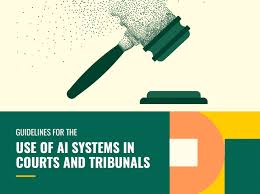
UNESCO Guidelines for the Use of AI Systems in Courts and TribunalsThese incidents underscore the urgency behind UNESCO’s Guidelines for the Use of AI Systems in Courts and Tribunals, developed in close collaboration egal scholars, and judicial training institutions around the world. These Guidelines will be formally launched at The Athens Roundtable on AI and the Rule of Law, in London on 4 December 2025.
The Guidelines offer 15 Principles to orient organisations and individuals in developing, acquiring, and using AI systems ethically and in full respect of human rights. These include information security, auditability, and human oversight and decision-making. In addition, the Guidelines provide recommendations for both judicial organisations and individual members of the judiciary. These recommendations focus on measures that the judiciary should take throughout the lifecycle of an AI system. Finally, these Guidelines serve as a benchmark for developing context-specific national and subnational guidelines.
UNESCO’s 2024 global survey on judicial uses of AI systems revealed startling gaps. Only 9% of surveyed judicial operators have received any AI-related training or information, despite 44% having used AI tools in their work thus far. Moreover, 73% of the respondents considered that there should be mandatory regulations and guidelines for the use of AI tools in the judiciary.
The launch of these Guidelines, therefore, is a lifeline, not a luxury.
The message from the ground is clear: with the right standards and training, AI can help deliver justice faster and more equitably, but it must always be anchored in human judgment. UNESCO is committed to supporting the people at the heart of courtrooms. As justice systems worldwide struggle to keep pace with overwhelming caseloads and rapid technological change, these new Guidelines will provide the necessary standard-setting to ensure that AI supports, not replaces, human-led judgment in the judiciary.
UNESCO Judges InitiativeSince 2013, UNESCO’s Judges’ Initiative has trained over 36,000 judicial operators across 160 countries on issues such as freedom of expression, access to information, and the application and impact of AI in justice systems. These judicial actors have received training through a series of Massive Open Online Courses (MOOCs), on-the-ground training, and workshops for Supreme Court judges, as well as the publications of several previous toolkits and guidelines.
The Judges’ Initiative has been integral to the development and peer-review of these Guidelines. It facilitated over 100 contributions from 41 countries during the 2024 public consultation and coordinated external reviews from 20 judges, legal scholars, attorneys, and technology specialists. These Guidelines mark a significant milestone in ongoing efforts to build capacity and foster knowledge exchange across the global judiciary.
( Press Release Image: https://photos.webwire.com/prmedia/6/347391/347391-1.jpg )
WebWireID347391
This news content was configured by WebWire editorial staff. Linking is permitted.
News Release Distribution and Press Release Distribution Services Provided by WebWire.